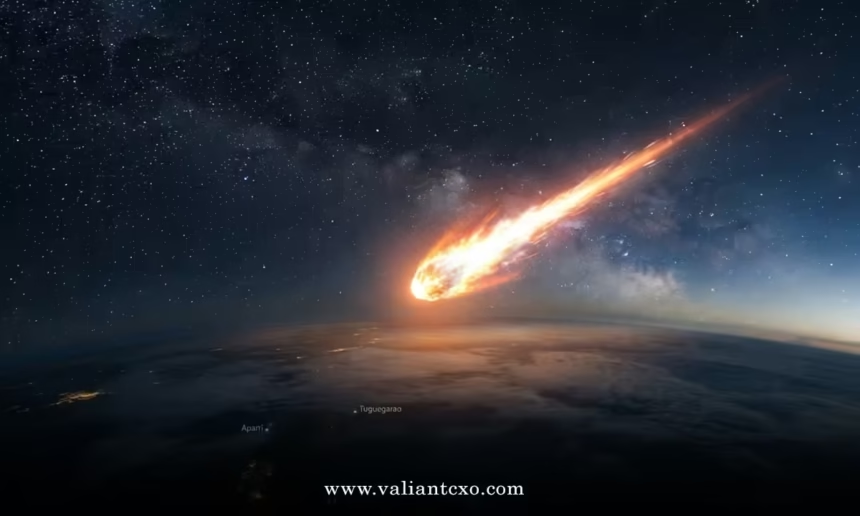
2026 RW1 asteroid impact marked a quiet win for planetary defense. On September 6, 2026, a rock smaller than a meter wide slammed into Earth’s atmosphere over the Indian Ocean northwest of Australia and burned up completely. No damage. No crater. Just a brief flash and a data point.
Here’s the quick rundown:
- A meter-class near-Earth object (Aten-class) entered the atmosphere at 16:07 UTC.
- Mount Lemmon Survey in Arizona spotted it roughly seven hours earlier.
- It became the 13th asteroid ever detected in space before impact.
- Scientists refined its path in real time and confirmed a harmless ocean entry.
- The event tested automated warning systems that matter far more for larger rocks.
Small impactors like this hit Earth dozens of times a year. Most go unnoticed. Catching one ahead of time shows the network is getting sharper.
How the 2026 RW1 Asteroid Impact Unfolded
Mount Lemmon’s telescopes, part of the Catalina Sky Survey, picked up a faint moving object late on September 5 into early September 6. Temporary designation: CERNQ52. Absolute magnitude around 33.3 put its size in the 0.8–0.9 meter range.
Observers fed positions to the Minor Planet Center. NASA’s Center for Near-Earth Object Studies and ESA’s Near-Earth Object Coordination Centre ran the numbers. Within hours the trajectory locked in: impact over the Indian Ocean near 13.9°S, 116.1°E. Entry speed typical for these objects. The rock never reached the surface.
What usually happens with something this small is straightforward. Friction with the atmosphere turns kinetic energy into heat. The object fragments and vaporizes high up. Recovery of meteorites? Almost zero chance here.
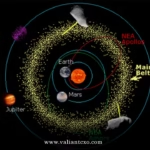
This one stood out for two reasons. First, the short warning window still produced a solid prediction. Second, it was the first confirmed Aten-class pre-impact detection. Previous dozen were Apollos. Aten orbits sit mostly inside Earth’s path. That geometry makes them trickier to catch early.
Why a Tiny Rock Gets Attention
People hear “asteroid impact” and picture city-killers. Fair. The 2026 RW1 asteroid impact was the opposite. Objects under 25 meters almost always burn up. Still, each detection calibrates the system.
In my experience tracking these events, the real value sits in the process. How fast did the orbit refine? How cleanly did the agencies share data? Did the automated flags fire correctly? NASA called scenarios like this valuable stress tests for monitoring larger threats.
Think of it like checking the smoke detectors after a small kitchen flare-up. The fire itself is nothing. The response tells you if the building is ready for worse.
Quick Comparison of Recent Predicted Impactors
| Object | Discovery Lead Time | Size (approx.) | Impact Location | Notes |
|---|---|---|---|---|
| 2026 RW1 | ~7 hours | 0.8–0.9 m | Indian Ocean | First Aten-class pre-impact |
| 2026 JN4 | ~3 hours | 0.6–1.4 m | Near New Guinea | Earlier 2026 event |
| 2024 RW1 | ~11 hours | 1–2.5 m | Pacific near Philippines | Visual confirmation |
| 2008 TC3 | ~20 hours | ~4 m | Sudan desert | First recovered meteorites |
Numbers come from the Center for Near-Earth Object Studies catalog and Minor Planet Center reports. All burned up or produced minimal ground effects.
Step-by-Step: What to Do When News of a Small Impactor Breaks
Beginners and intermediate readers often want a practical response plan. Here’s what I recommend:
- Check primary sources first. Go straight to the NASA Center for Near-Earth Object Studies or ESA’s NEO portal. Avoid secondary headlines that inflate size or risk.
- Look at the absolute magnitude (H). Values above 30 mean meter-scale or smaller. Harmless by default.
- Note the predicted impact coordinates and time. Ocean or remote land entries change the story.
- Watch for confirmation of atmospheric entry. Visual reports or infrasound can seal it.
- File the event under “system working as designed.” Then move on. Larger objects get different treatment.
If you’re the type who follows sky surveys, bookmark the Minor Planet Center circulars. That’s where the official designations land.

Common Mistakes People Make After Events Like the 2026 RW1 Asteroid Impact
Mistake 1: Treating every detection as a near-miss. Fix: Compare size and energy. A one-meter rock packs roughly the energy of a small conventional explosion at best, and most of that dissipates high up.
Mistake 2: Sharing unverified size claims. Fix: Stick to H magnitude and the published range from CNEOS or MPC. Media often rounds up for drama.
Mistake 3: Assuming short warning times mean the system failed. Fix: Meter-class objects are faint until close. Seven hours is solid for something this dim. Longer leads come with bigger, brighter targets.
Mistake 4: Ignoring the class difference. Fix: Note Apollo versus Aten. Orbit type affects discovery odds and future monitoring strategies.
What the Detection Really Tests
Surveys like Catalina, ATLAS, and Pan-STARRS keep expanding coverage. Each successful short-warning capture feeds algorithms that will one day flag a 50-meter or 100-meter object with days or weeks of notice. That’s the payoff.
ESA’s automated systems flagged this one early enough for trajectory confirmation. The network worked. No drama required.
Want the orbit details yourself? The IAU Minor Planet Center page for 2026 RW1 lists the elements. Aten-type. Low inclination. Short observational arc, as expected.
Key Takeaways
- 2026 RW1 was a sub-meter Aten asteroid discovered about seven hours before atmospheric entry.
- It burned up over the Indian Ocean with zero ground effects.
- This marked the 13th pre-impact detection on record and the first of its orbital class.
- Short-warning successes prove monitoring systems can handle faint, fast-approaching objects.
- Primary sources (CNEOS, ESA, MPC) remain the only reliable filter for size and risk claims.
- Small impactors provide free system tests that improve readiness for larger threats.
- Absolute magnitude above 30 almost always equals harmless entry.
The 2026 RW1 asteroid impact delivered clean data and a quiet validation of current capabilities. Keep an eye on the official portals next time a new designation appears. That’s the fastest way to separate signal from noise.
FAQs
Did the 2026 RW1 asteroid impact pose any risk to people or property?
No. Size under one meter and ocean entry meant complete atmospheric disintegration. Objects this small routinely produce only high-altitude meteors.
Why was 2026 RW1 harder to spot earlier?
Its faint absolute magnitude and Aten-class orbit kept it dim until it was already close. Survey telescopes caught it once it brightened enough against the background sky.
How does this event improve future asteroid tracking?
Each confirmed short-arc prediction refines detection algorithms and inter-agency data sharing. The same pipeline that handled a one-meter rock will scale to objects that actually matter.