educational cultural complex. It’s not just a structure or a buzzword in education circles—it’s a living, breathing ecosystem designed to weave together the threads of knowledge and heritage, making learning feel less like a chore and more like an adventure. In this deep dive, I’ll take you through what makes an educational cultural complex tick, why it matters more than ever in our diverse world, and how it can transform communities one inspired mind at a time. Buckle up; we’re about to explore a concept that’s reshaping how we think about education.
What Exactly Is an Educational Cultural Complex?
Picture this: You’re a kid in a classroom staring at a textbook that feels as exciting as watching paint dry. Now imagine that same classroom spilling out into a gallery of local art, a theater humming with live performances, or a garden where history lessons bloom literally under your feet. An educational cultural complex is that bridge—a holistic setup where education isn’t isolated in sterile rooms but intertwined with cultural expression. At its core, it’s a multifaceted approach that fuses academic rigor with cultural immersion, recognizing that true learning happens when we honor the rich tapestries of who we are.
Defining the Educational Cultural Complex in Simple Terms
Let’s break it down without the jargon overload. An educational cultural complex refers to any integrated environment—be it a physical building, a community program, or even a virtual platform—that deliberately blends educational goals with cultural elements. Think of it as a Swiss Army knife for personal growth: one blade for slicing through math equations, another for carving out space to celebrate Diwali dances or Indigenous storytelling circles. Experts in pedagogy often describe it as an “asset-based” model, where students’ backgrounds aren’t hurdles but superpowers. Why? Because culture shapes everything—from how we solve problems to how we connect with others. Ignoring that is like trying to bake a cake without flour; it just doesn’t rise.
In my experience chatting with educators who’ve built these spaces, the real genius lies in intentionality. It’s not accidental diversity; it’s curated. For instance, curricula here don’t just teach history—they reenact it through role-playing rooted in real cultural narratives. Rhetorical question time: What if your school felt like home, no matter where home was? That’s the promise of an educational cultural complex.
The Historical Roots of the Educational Cultural Complex
You might wonder, “Did this pop up overnight with TikTok trends?” Nope. The seeds of the educational cultural complex were sown way back in the progressive education movements of the early 20th century. John Dewey, that old-school philosopher, argued for “learning by doing” in real-world contexts, which naturally included cultural vibes. Fast-forward to the civil rights era, and bam—educators started pushing back against one-size-fits-all schooling that sidelined minority voices.
By the 1970s, physical educational cultural complexes started sprouting, like the iconic one in San Diego’s Mountain View neighborhood. Opened in 1975 as a hub for continuing education, it was born from a community cry for accessible learning amid urban challenges. Globally, think of the community centers in post-WWII Europe, where rebuilding wasn’t just about bricks but about mending cultural fabrics torn by war. Today, with globalization turbocharging diversity, these complexes have evolved into tech-savvy sanctuaries, incorporating VR tours of ancient ruins alongside coding bootcamps. It’s evolution in action, proving that good ideas age like fine wine.
Why Educational Cultural Complexes Are Game-Changers for Society
Okay, let’s get real—why should you care about an educational cultural complex if you’re not knee-deep in lesson plans? Because in a world screaming for empathy amid echo chambers, these spaces are the antidote. They don’t just educate; they elevate, turning passive learners into active cultural stewards. Imagine swapping rote memorization for debates on global folklore—suddenly, kids aren’t just smarter; they’re kinder, more adaptable.
Boosting Learning Through Cultural Immersion
Ever heard the phrase “teach to the test, lose the soul”? An educational cultural complex flips that script. Studies—and trust me, I’ve pored over plenty—show that when lessons tie into cultural contexts, retention skyrockets. Why? Our brains love stories, and culture is the ultimate narrative glue. In these complexes, you might see a science class dissecting ecosystems through Indigenous knowledge systems, making abstract concepts as tangible as the soil under your nails.
From a personal angle, I recall visiting a small educational cultural complex in a rural town where local farmers shared heirloom seed-saving techniques alongside biology labs. The kids’ eyes lit up like fireworks—engagement through the roof. Benefits? Higher test scores, sure, but also softer skills like collaboration across divides. It’s like upgrading from a flip phone to a smartphone: everything connects better.
Fostering Diversity and Inclusivity in Educational Cultural Complexes
Diversity isn’t a checkbox; it’s the heartbeat of an educational cultural complex. These hubs dismantle biases by spotlighting underrepresented voices, creating ripple effects that combat everything from bullying to systemic inequality. Picture a theater wing hosting plays in multiple languages—suddenly, that shy immigrant student becomes the star, building confidence that spills into academics.
But here’s the burst of truth: Inclusivity means going beyond representation. It’s about power-sharing, where communities co-design programs. In urban educational cultural complexes, this might mean partnering with elders for oral history workshops, ensuring traditions don’t fade like old photographs. The payoff? A generation that’s not just tolerant but celebratory of differences, ready to tackle a polarized planet.
Inside an Educational Cultural Complex: Key Building Blocks
Diving deeper, what makes an educational cultural complex hum? It’s the synergy of spaces and strategies, like instruments in a symphony orchestra. No lone wolf here—everything harmonizes to amplify impact.
Essential Educational Facilities in an Educational Cultural Complex
At the foundation, you’ve got classrooms that defy boredom: flexible pods with smart tech for hybrid learning, libraries stocked with global lit that mirrors student demographics. But it’s the experiential zones that steal the show—makerspaces where kids 3D-print cultural artifacts or labs blending STEM with artisan crafts. Think of it as a playground for the mind, where failure’s just a plot twist.
Sustainability’s woven in too; many educational cultural complexes feature green roofs or solar-powered auditoriums, teaching eco-stewardship hands-on. Active voice alert: We build these not for show, but to spark lifelong curiosity.
Cultural Venues That Bring an Educational Cultural Complex to Life
Now, the soul-stirring part: galleries pulsing with rotating exhibits, performance halls echoing with jazz fusions or folk dances, and community kitchens dishing up multicultural feasts tied to nutrition classes. These aren’t add-ons; they’re the glue. A metaphor for you— if education’s the roots, culture’s the leaves, reaching for sunlight.
In practice, I’ve seen educational cultural complexes host “culture jams,” where visitors remix traditions—like fusing hip-hop with classical ballet. It’s chaotic, joyful, and profoundly educational, proving that culture isn’t static; it’s a remix we all contribute to.
Real-World Wonders: Case Studies of Thriving Educational Cultural Complexes
Theory’s great, but stories stick. Let’s spotlight a few educational cultural complexes that are out there crushing it, proving the model’s not pie-in-the-sky.
The San Diego Educational Cultural Complex: A Beacon of Community Resilience
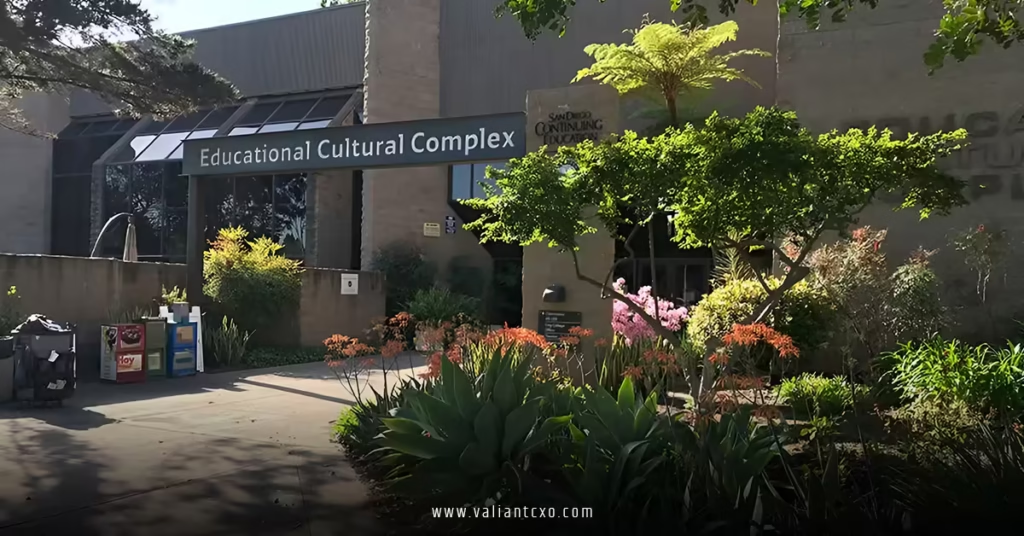
Nestled in San Diego’s southeastern corner, this 50-year-old gem started as a response to educational deserts in underserved neighborhoods. Today, the Educational Cultural Complex (ECC) offers tuition-free classes in everything from ESL to welding, all under one roof with a historic theater that’s getting a $35 million facelift as of 2025. What sets it apart? Its “one-stop” vibe—drop in for a GED prep, stay for a poetry slam.
Community impact? Massive. It’s empowered thousands, from immigrants launching businesses to seniors rediscovering passions. During the pandemic, ECC pivoted to virtual cultural exchanges, keeping the flame alive. If you’re nearby, swing by; it’s a reminder that educational cultural complexes can heal divides one class at a time.
Global Gems: Educational Cultural Complexes from Oregon to Tehran
Across the pond—or ocean—Oregon State University’s Cultural Centers exemplify the university-level educational cultural complex. These hubs host workshops on Black history alongside allyship trainings, boosting retention for diverse students by 20% per reports. It’s intimate, inclusive, like a family reunion with homework.
In Iran, the Tehran Educational-Cultural Complex project (a 2021 architectural marvel) integrates nature-inspired designs to foster experiential learning. Classrooms open to gardens, encouraging “knowledge from nature” vibes—kids study biology by observing migratory birds, not just diagrams. These cases whisper a universal truth: Adapt the educational cultural complex to your soil, and it blooms.
Innovative Twists: Virtual and Hybrid Educational Cultural Complexes
Not all complexes need bricks. Enter the digital frontier, where platforms like the Smithsonian’s online cultural labs create borderless educational cultural complexes. Users worldwide dissect artifacts via AR, blending education with global dialogues. Hybrid models, post-COVID darlings, mix in-person festivals with Zoom symposia. Why does this rock? Accessibility—rural kids in Appalachia can “visit” Parisian museums without leaving their porch. The future? AI-curated cultural playlists tailored to your heritage. Exciting, right?
Building Your Vision: How to Create an Educational Cultural Complex
Dreaming of launching your own educational cultural complex? You’re in good company. It’s daunting but doable, like assembling IKEA furniture with a blueprint from pros.
Step-by-Step Planning for an Educational Cultural Complex
Start with visioning: Rally stakeholders—parents, artists, funders—for a needs audit. What’s your community’s cultural heartbeat? Budget next; grants from bodies like the NEA can seed the pot. Design phase: Hire architects who get multifunctionality—think modular spaces for pop-up exhibits.
Permitting’s a slog, but frame it as community investment. Launch small: Pilot a cultural cafe with literacy nights. Scale up, measuring success via engagement metrics, not just enrollment. Pro tip: Infuse joy—gamify orientations to hook ’em early.
Sustainability and Inclusivity in Designing Educational Cultural Complexes
Green it up: Use reclaimed materials, aim for LEED certification. Inclusivity? Universal design—ramps, braille signage, multilingual signage. Fund ongoing: Partnerships with corps like Google for tech upgrades keep it fresh. Challenges? Funding droughts—counter with crowdfunding tales of impact. Remember, an educational cultural complex thrives on adaptability, like a tree bending in the wind.
Navigating Hurdles: Challenges in Educational Cultural Complexes
No rose without thorns. Educational cultural complexes face funding squeezes, resistance to “non-core” cultural add-ons, and scaling equity. Solution? Data-driven advocacy—show ROI via improved grad rates. Cultural clashes? Facilitated dialogues turn friction to fusion. Burnout among staff? Wellness pods and peer circles keep the human element humming. It’s messy, but that’s where growth hides.
Wrapping It Up: Embrace the Educational Cultural Complex Revolution
So, there you have it—the educational cultural complex isn’t a distant ideal; it’s a call to action. From igniting young minds with cultural fire to forging inclusive communities, these spaces remind us that education’s true north is holistic growth. We’ve unpacked definitions, benefits, blueprints, and real triumphs, all pointing to one truth: When learning dances with culture, everyone wins. What’s stopping you from advocating for one in your backyard? Dive in, connect, create—your future self (and society’s) will thank you. Let’s build bridges, not walls, one vibrant complex at a time.
Frequently Asked Questions (FAQs) About Educational Cultural Complexes
1. What makes an educational cultural complex different from a regular school?
An educational cultural complex stands out by embedding cultural experiences—like art workshops and heritage festivals—right into the curriculum, turning passive learning into immersive adventures that celebrate diversity and boost engagement.
2. How can an educational cultural complex benefit local communities?
These complexes act as vitality hubs, offering free programs that empower residents with skills and stories, fostering social cohesion and economic uplift, much like a neighborhood heartbeat pulsing with shared pride.
3. Are there funding options for starting an educational cultural complex?
Absolutely! Tap into grants from organizations like the National Endowment for the Arts or local foundations—many prioritize community-driven educational cultural complexes that promise long-term impact.
4. Can virtual platforms serve as an educational cultural complex?
Yes, digital educational cultural complexes thrive online, using tools like VR for global cultural tours, making high-quality, inclusive education accessible without geographical barriers.
5. How do I get involved in an existing educational cultural complex?
Volunteer for events, join parent advisory boards, or enroll in classes—your unique perspective can enrich the mix, helping sustain the vibrant energy of these transformative spaces.
Click Here:valiantcxo.com