1 valence electron and 7 energy levels? That’s Francium for you – the shadowy heavyweight of the alkali metals, lurking at the bottom of the periodic table like a forgotten treasure in a pirate’s chest. In this deep dive, we’ll explore what makes this atomic oddity tick, from its wild discovery to its mind-bending properties. Buckle up; we’re about to geek out on chemistry in a way that’ll make your inner science nerd do cartwheels.
What Exactly Is “1 Valence Electron and 7 Energy Levels”?
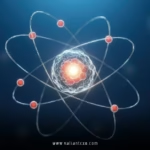
Let’s kick things off by breaking down this mouthful of a phrase: 1 valence electron and 7 energy levels. It sounds like a riddle from a mad scientist’s notebook, right? But it’s the perfect snapshot of Francium’s quirky atomic blueprint. Picture your atom as a bustling apartment building. The valence electron is that one outgoing tenant on the top floor, ready to mingle and react with neighbors. And those 7 energy levels? They’re the floors themselves, stacked from the cozy ground level (n=1) all the way up to the penthouse suite (n=7), each buzzing with electrons in their quantum dance.
Why does this matter? In the world of elements, that single valence electron in the outermost shell screams “reactivity.” It’s like a lone wolf howling for a pack – eager to lose itself in a chemical bond. Meanwhile, reaching the 7th energy level means Francium has crammed electrons into seven shells, making it a period 7 resident in the periodic table. This combo isn’t just trivia; it’s the key to understanding why Francium behaves like a supercharged version of its lighter cousins, lithium or sodium. But hold on – we’ll circle back to the fireworks after we unpack the basics.
Demystifying Valence Electrons: The Social Butterflies of Atoms
Valence electrons – those are the electrons in an atom’s outermost shell, the ones that dictate how it plays with others. For most elements, this number ranges from 1 to 8, but when it’s just 1, like in our 1 valence electron and 7 energy levels scenario, you’re dealing with an alkali metal. These guys are the ultimate donors, shedding that electron faster than you can say “explosion.”
Think of it this way: Imagine you’re at a party, and you’ve got one extra ticket to give away. That’s your valence electron – it’s itching to hand it off to snag a spot in someone else’s crew. In Francium’s case, that ticket’s up on the 7th floor, surrounded by a massive entourage of inner electrons. This setup amps up the instability because the higher energy levels are looser, like a frayed rope holding back a tidal wave. No wonder Francium’s the most reactive alkali metal; it’s primed for chaos.
Energy Levels: Atoms’ Version of a Multi-Story Mall
Now, energy levels – or principal quantum numbers, if you want to get fancy – are the shells where electrons orbit the nucleus. Bohr’s model simplified it to neat concentric circles, but quantum mechanics turned it into a probabilistic cloud. Still, the idea holds: n=1 is the tight inner core (just 2 electrons max), n=2 adds 8 more, and so on, up to n=7 in Francium, which can theoretically hold a whopping 32 electrons in its outer reaches.
Reaching 7 energy levels isn’t child’s play. It requires 86 electrons filling the lower shells before that lone 7s valence electron claims its spot. It’s like building a skyscraper: You can’t slap the spire on without the foundation. For Francium (atomic number 87), this towering structure makes it the heaviest natural alkali metal, tipping the scales at around 223 atomic mass units for its most stable isotope. But here’s the kicker – that height comes with vertigo. Higher levels mean weaker nuclear grip, fueling Francium’s radioactive decay. Intrigued yet? Let’s meet the star of our show.
Francium: The Element Defined by 1 Valence Electron and 7 Energy Levels
Enter Francium, symbol Fr, atomic number 87 – the embodiment of 1 valence electron and 7 energy levels. Discovered in the shadow of World War II, this element is rarer than a honest politician, with maybe 20-30 grams total in Earth’s crust at any time. It’s not something you’ll bump into at the grocery store; instead, it’s born from the decay of actinium or uranium, flickering into existence like a firefly in a storm.
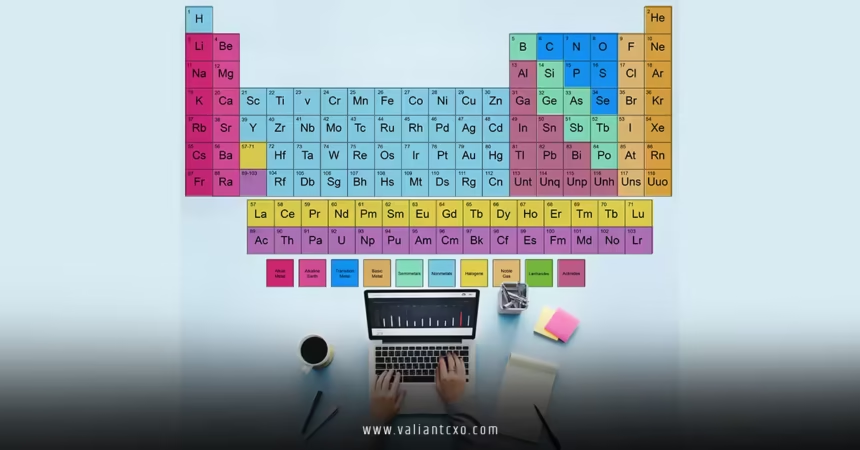
What sets Francium apart? That single 7s electron makes it a textbook alkali metal, but the 7 energy levels crank everything to 11. Its electron configuration? [Rn] 7s¹ – radon filling the first six shells, topped by that rebellious lone ranger. This setup predicts wild reactivity: Francium should ignite water more spectacularly than sodium, potentially exploding on contact with air. But we can’t test it easily because samples vanish in minutes. It’s the ultimate tease – promising pandemonium, delivering whispers.
Fun fact: If you could gather a pound of Francium, it’d weigh less than a paperclip yet pack enough heat from decay to vaporize itself. Talk about self-sabotage! As we delve deeper, you’ll see how this 1 valence electron and 7 energy levels duality shapes Francium’s every quirk.
The Thrilling Discovery Story Behind 1 Valence Electron and 7 Energy Levels
Ah, the drama of discovery! In 1939, French physicist Marguerite Perey, working at the Curie Institute in Paris, was sifting through actinium samples like a prospector panning for gold. She spotted faint alpha decay signals that didn’t match known elements. Boom – after purifying her haul, Perey isolated Francium-223, naming it after her homeland (France). It was the last natural element to be found, squeezing into that elusive spot at period 7, group 1.
Perey’s feat wasn’t luck; it was grit. Earlier chemists like Mendeleev had predicted an element with 1 valence electron and 7 energy levels, dubbing it “eka-cesium.” But Francium’s half-life – a measly 22 minutes – made it a ghost. Perey beat the odds using electrochemistry and spectroscopy, confirming its alkali nature through ion exchange. Imagine the thrill: In a lab echoing with Curies’ legacy, she unveiled an element that embodies 1 valence electron and 7 energy levels, forever etching her name in atomic history.
This tale isn’t just backstory; it highlights science’s persistence. Even today, labs at places like Berkeley recreate Francium in particle accelerators, probing its secrets one fleeting atom at a time. What if Perey had given up? We’d miss out on understanding how 1 valence electron and 7 energy levels push the periodic table’s boundaries.
Challenges in Isolating Francium: A Race Against Decay
Isolating Francium is like catching smoke with your bare hands. Its isotopes decay via beta emission or alpha particles, turning into radium or astatine. The longest-lived, Fr-223, poofs away in 21.8 minutes, while others last seconds. Scientists use online ion sources or laser ionization to snag micrograms, but purity? Forget it – contaminants tag along like unwanted party crashers.
These hurdles stem directly from that 1 valence electron and 7 energy levels setup. The weak electrostatic hold on the outer electron accelerates instability, compounded by relativistic effects in heavy atoms (electrons zipping near light speed, blurring orbitals). It’s a reminder: Nature doesn’t hand out prizes easily, especially for elements teetering on the edge of stability.
Physical Properties: How 1 Valence Electron and 7 Energy Levels Shape Francium’s Form
Let’s get tactile – or as tactile as we can with an element we’ve barely touched. Francium’s physical traits are extrapolated from trends, since direct measurements are rarer than hen’s teeth. Density? Around 1.87 g/cm³, making it float in water like its alkali siblings. Melting point? A balmy 27°C (81°F), so it’d puddle at room temp. Boiling point? 677°C, give or take.
Why so soft and low-melt? Blame the 1 valence electron and 7 energy levels. That distant valence electron forms feeble metallic bonds, like a loose handshake in a crowded room. The large atomic radius (about 270 pm) from seven shells spaces atoms out, weakening cohesion. Relativistic contraction shrinks the 7s orbital slightly, but overall, Francium’s a mushy, silvery blob – if you could hold it without it melting or decaying first.
Color? Silvery-white, oxidizing to yellow in air. Conductivity? Stellar, as expected for metals, but who’d wire a circuit with something that self-destructs? These properties paint Francium as the ultimate lightweight champ: Heavy atomic weight, feather-light density.
The Relativistic Twist in Francium’s Electron Behavior
Here’s where quantum weirdness shines. In heavy elements like Francium, electrons in inner shells (those first 6 energy levels) approach light speed, per special relativity. This contracts s-orbitals and expands p/d/f ones, tweaking the 1 valence electron and 7 energy levels interplay. For Francium, it boosts ionization energy slightly over cesium, making that valence electron a tad stickier.
Analogy time: It’s like traffic on a multi-lane highway. Inner electrons jam up (contracted), forcing the outer one to weave unpredictably. This relativistic spice adds flavor to Francium’s chemistry, hinting at why superheavies beyond it get even kookier.
Chemical Properties: The Reactive Rampage of 1 Valence Electron and 7 Energy Levels
Chemically, Francium lives up to its 1 valence electron and 7 energy levels hype. As an alkali metal, it forms +1 ions effortlessly: Fr → Fr⁺ + e⁻. That electron’s low binding energy (estimated 4.07 eV) means it’s eager to bail, sparking reactions with water (2Fr + 2H₂O → 2FrOH + H₂, with explosive hydrogen gas).
Compared to sodium? Francium’s larger size lowers the ionization potential further, predicting fiercer reactivity. It should displace hydrogen from acids vigorously and alloy with mercury like a liquid embrace. But halogen affinity? Francium halides (FrCl, FrBr) are the least stable in the series, hydrolyzing instantly.
Oxidation states? Mostly +1, but traces of +2 or +3 might lurk due to relativistic effects stabilizing higher charges. In solutions, Fr⁺ ions migrate like hyperactive bees, confirmed by electrochemical cells. Yet, aqueous chemistry is a pipe dream – decay outpaces reactions.
This reactivity stems from the 1 valence electron and 7 energy levels: Loose outer shell, screened by 86 inner electrons, turning the nucleus’s pull into a gentle nudge. It’s chemistry on steroids, confined to theory and trace experiments.
Francium in Compounds: Fleeting Partnerships
Compounds? Francium forms salts like francium carbonate (Fr₂CO₃) or nitrate (FrNO₃), all highly soluble and basic. But isolation? Impossible – they decompose before you blink. Gas-phase studies via mass spectrometry reveal Fr₂ molecules (diatomic, like other alkalis), but they’re theoretical phantoms.
Imagine dating a firework: Thrilling sparks, then poof. That’s Francium’s chemical life – intense bonds from that lone electron, severed by time’s cruel hand.
Applications and Uses: Why Bother with 1 Valence Electron and 7 Energy Levels?
Practical uses for Francium? Slim to none. Its half-life dooms it to research-only status. But don’t yawn yet – Francium illuminates atomic physics. Laser spectroscopy probes its hyperfine structure, testing quantum electrodynamics. Nuclear physicists smash it to study beta decay, probing weak force subtleties.
In medicine? Tracers, maybe, but iodine-131 steals the show. Materials science? Alloys for extreme conditions, theoretically. And astrochemistry: Francium analogs in stars help model nucleosynthesis.
Ultimately, studying 1 valence electron and 7 energy levels in Francium pushes periodic table frontiers. It’s the canary in the coal mine for superheavy elements, teaching us about stability’s edge. Who knows? Future tech might harness its decay heat for micro-batteries. Dream big, right?
Research Frontiers: Peering into Francium’s Future
Current quests? Cooling Francium atoms to near-absolute zero for Bose-Einstein condensates, revealing quantum behaviors. Or ion traps to measure magnetic moments precisely. Each breakthrough demystifies how 1 valence electron and 7 energy levels warp reality at atomic scales.
It’s not glamour; it’s grind. But unlocking these secrets could redefine energy, computing – heck, even time travel theories. Okay, maybe not that last one, but you get the vibe.
The Rarity and Environmental Impact of 1 Valence Electron and 7 Energy Levels
Francium’s scarcity is legendary: Less than 1 ounce globally, from uranium/actinium decay chains. No mining; it’s a decay byproduct, concentrated in uranium ores but diluted to parts per trillion.
Environmentally? Negligible. Its quick decay means no buildup – alpha particles zap locally, no long-term fallout. But lab handling demands lead shielding, ventilation. Ethical note: Research minimizes waste, aligning with green chem principles.
This ephemerality underscores 1 valence electron and 7 energy levels’ double-edged sword: Power in theory, fragility in practice.
Comparing Francium to Other Alkali Metals: A Family Affair
Stack Francium against lithium, sodium, potassium? All share 1 valence electron, but energy levels climb: Li (n=2), Na (n=3), up to Fr (n=7). Reactivity escalates down the group – smaller size, higher levels = easier electron loss.
| Element | Energy Levels (n) | Valence Electron | Reactivity Trend | Half-Life |
|---|---|---|---|---|
| Lithium (Li) | 2 | 1 (2s¹) | Moderate | Stable |
| Sodium (Na) | 3 | 1 (3s¹) | High | Stable |
| Potassium (K) | 4 | 1 (4s¹) | Higher | Stable |
| Cesium (Cs) | 6 | 1 (6s¹) | Very High | Stable |
| Francium (Fr) | 7 | 1 (7s¹) | Extreme | 22 min (Fr-223) |
See the pattern? Francium’s the apex predator, but instability clips its claws. This table highlights how 1 valence electron and 7 energy levels cap the alkali saga.
Conclusion: Embracing the Elusive Charm of 1 Valence Electron and 7 Energy Levels
Whew, what a ride through the atomic wilds! From Marguerite Perey’s triumphant isolation to Francium’s explosive potential, we’ve seen how 1 valence electron and 7 energy levels forge an element that’s equal parts marvel and mirage. It’s a testament to human curiosity – chasing shadows to illuminate truths about matter’s building blocks. Whether you’re a budding chemist or just trivia-hungry, Francium reminds us: The universe’s deepest secrets hide in the fleeting. So next time you glance at the periodic table, give a nod to atomic number 87. Who knows what other enigmas await discovery? Dive in, experiment, and let science spark your wonder.
Frequently Asked Questions (FAQs)
1. What element exemplifies 1 valence electron and 7 energy levels?
Francium (Fr) is the prime example, with its single 7s electron atop six filled shells, making it the most reactive yet unstable alkali metal.
2. Why is Francium so rare despite its 1 valence electron and 7 energy levels?
Its isotopes decay rapidly (shortest half-life ~22 minutes), so it doesn’t accumulate; total Earth supply is under 30 grams, born from heavier element decay.
3. How does the 1 valence electron and 7 energy levels affect Francium’s reactivity?
The distant valence electron is loosely bound, screened by inner shells, predicting violent reactions with water or air – more intense than cesium.
4. Can we see practical uses for an element with 1 valence electron and 7 energy levels?
Mostly research: Spectroscopy, nuclear studies. No everyday apps yet, but it aids superheavy element modeling and quantum tech explorations.
5. Is Francium dangerous due to its 1 valence electron and 7 energy levels?
Radioactivity poses alpha radiation risks, but scarcity limits exposure. Labs handle traces safely; chemically, its reactivity is theoretical due to short life.
For More !!valiantcxo.com