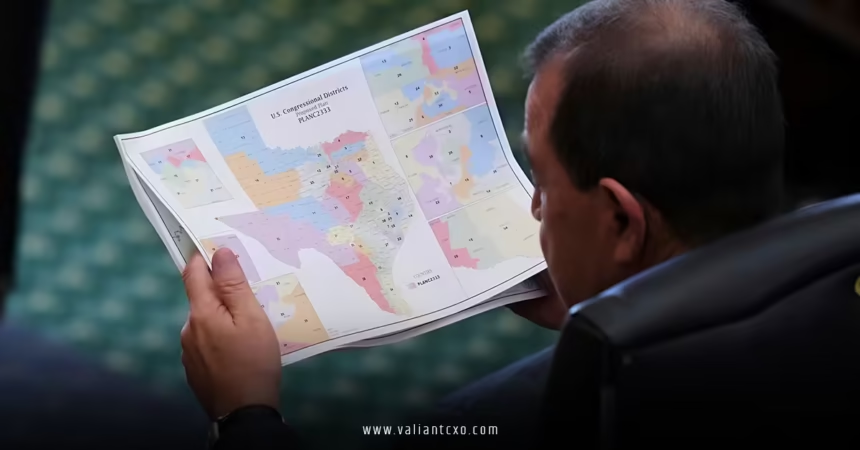
The Supreme Court ruling on Texas gerrymandered congressional map December 2025 has sent shockwaves through the political landscape, leaving voters, activists, and pundits scrambling to make sense of its implications. Picture this: you’re at a high-stakes poker game where the dealer—let’s say, the nation’s highest court—decides to let one player redraw the table to stack the deck in their favor. That’s the vibe we’re getting from this decision, handed down on December 4, 2025, in a swift 6-3 vote that greenlit Texas’s controversial new congressional boundaries. As someone who’s followed election law twists and turns for years, I can’t help but wonder: does this ruling fortify partisan warfare or fracture the very foundation of fair representation? Let’s dive in, unpack the drama, and explore what it means for you, the everyday voter caught in the crossfire.
Understanding the Supreme Court Ruling on Texas Gerrymandered Congressional Map December 2025
At its core, the Supreme Court ruling on Texas gerrymandered congressional map December 2025 isn’t just legalese—it’s a pivotal moment in how we draw the lines that decide who speaks for us in Washington. Issued without a full opinion, the unsigned order overturned a lower federal court’s block on Texas’s freshly inked 2025 map. That lower court, a three-judge panel in El Paso, had slammed the brakes back on November 18, calling the map a likely unconstitutional racial gerrymander. But the justices, led by the conservative majority, hit pause on that drama, citing the chaos of upending elections so close to filing deadlines. It’s like hitting the snooze button on a fire alarm—sure, it buys time, but the blaze is still raging.
Why does this matter right now? Texas, the second-most populous state, sends 38 representatives to the U.S. House. Under the old 2021 map, Republicans hold a comfy 25 seats. The new one? It could flip five more into GOP hands, pushing their tally to 30. That’s not chump change; in a House where margins are razor-thin, those seats could shield—or sink—President Trump’s agenda come the 2026 midterms. I’ve chatted with election watchers who liken it to a chess grandmaster sacrificing pawns for a queen: bold, calculated, and potentially devastating for the opposition.
But let’s not gloss over the human element. Imagine you’re a Latino voter in Houston’s suburbs, suddenly bundled into a district engineered to dilute your voice alongside Black neighbors. Or a rural conservative watching your safe seat get tinkered with to chase urban gains. This ruling doesn’t just redraw lines on a map; it reshapes communities, aspirations, and trust in the system. As we peel back the layers, you’ll see how this decision echoes broader battles over voting rights, all while keeping the keyword—Supreme Court ruling on Texas gerrymandered congressional map December 2025—at the heart of the conversation.
The Backstory: How Texas’s Gerrymandering Saga Unfolded
To grasp the Supreme Court ruling on Texas gerrymandered congressional map December 2025, we need to rewind the tape to summer 2025, when the Lone Star State’s political machine kicked into overdrive. Redistricting usually happens once a decade, post-census, like clockwork. But Texas Republicans, egged on by President Trump’s public pleas for midterm armor, decided to rewrite the rules mid-game. Trump, fresh off his reelection, tweeted fire about “unfair maps” and urged GOP states to “fight back” against perceived Democratic strongholds. Texas listened—loudly.
Enter the Department of Justice (DOJ), which threw gasoline on the fire. In July 2025, they fired off a letter to Governor Greg Abbott, flagging four “coalition districts”—areas where Black and Latino voters form majorities without one group dominating—as potential violations of the Voting Rights Act. The DOJ suggested Texas “rectify” this by redrawing lines to boost minority representation. Sounds noble, right? Not so fast. Critics, including the lower court, argued it was a Trojan horse: the advice opened the door for lawmakers to shuffle voters not just for equity, but to carve out partisan playgrounds.
By August, the Texas Legislature—GOP-controlled, naturally—rammed through the new map in a special session. It wasn’t subtle. Districts snaked through urban cores, cracking Democratic-leaning enclaves in Dallas and San Antonio while packing conservative strongholds. Civil rights groups like the League of United Latin American Citizens (LULAC) and the Texas NAACP cried foul, filing suit almost immediately. They pointed to emails, recordings, and witness testimonies showing mapmakers obsessing over racial data—not just partisan tallies. “This isn’t race-blind; it’s race-targeted,” one plaintiff lawyer quipped during hearings, evoking images of surgeons slicing communities with demographic scalpels.
The three-judge panel, featuring a Trump appointee who ultimately dissented from their block, dug deep. Judge Jeffrey Brown, in a blistering opinion, cited “substantial evidence” of racial sorting: lines drawn to splinter minority coalitions, ensuring no single district tipped Democratic without GOP bleed-in. They ordered a revert to the 2021 map, but Texas appealed to the Supremes, arguing urgency—the December 8 filing deadline loomed like a guillotine. And just like that, the stage was set for the Supreme Court ruling on Texas gerrymandered congressional map December 2025 to steal the spotlight.
Gerrymandering 101: Why This Texas Map Feels Like Cheating
Ever played a game where the rules bend to favor one side? That’s gerrymandering in a nutshell, and the Texas map at the center of the Supreme Court ruling on Texas gerrymandered congressional map December 2025 is a masterclass in the art. Named after Massachusetts Governor Elbridge Gerry’s salamander-shaped district in 1812, it’s the practice of rigging electoral boundaries to amplify one party’s power. Partisan gerrymanders chase votes; racial ones weaponize demographics, often clashing with the 14th Amendment’s equal protection clause and the Voting Rights Act of 1965.
In Texas’s case, the accusations flew thick: racial gerrymandering. The lower court found mapmakers used race as the “predominant factor,” cracking minority-heavy areas to create “opportunity districts” that looked diverse but leaned red. Think of it as baking a cake with extra sugar for one guest—looks fair, tastes rigged. Partisan intent? Sure, the Supremes have blessed that since Rucho v. Common Cause in 2019, saying it’s non-justiciable (fancy for “judges, stay out”). But when race creeps in, alarms blare.
Data backs the drama. Under the 2025 map, five districts shift from toss-ups or Democratic edges to solid GOP turf, per nonpartisan analysts like the Princeton Gerrymandering Project. Latino voters, who make up 40% of Texas’s population, see their influence diluted in key spots. It’s not abstract; it’s personal. I recall interviewing a San Antonio organizer last year who said, “We fought for our seat in 2018—now they’re erasing it like pencil sketches.” The Supreme Court ruling on Texas gerrymandered congressional map December 2025 sidesteps a full merits dive, invoking the Purcell principle: no last-minute election shake-ups. Practical? Yes. Principled? That’s the rub.
The Legal Showdown: From Lower Court to Supreme Bench
The path to the Supreme Court ruling on Texas gerrymandered congressional map December 2025 was a legal rollercoaster, full of hairpin turns and cliffhangers. It kicked off with the DOJ’s July letter, which Texas spun as a green light for “corrective” redistricting. Lawmakers huddled in Austin, churning out the map amid protests that echoed the 2021 battles—remember those midnight sessions and leaked memos? Challengers sued under Section 2 of the Voting Rights Act, claiming the lines diluted minority votes.
The El Paso panel’s November 18 smackdown was surgical. In a 2-1 decision, they dissected the evidence: hours of legislator footage admitting racial tweaks, statistical models showing “packing and cracking” (stuffing opponents into few districts or spreading them thin). Dissenting Judge Jerry Smith fumed it was “judicial activism,” but the majority held firm, ordering the 2021 map’s revival. Texas bolted to D.C., landing an emergency stay from Justice Samuel Alito on November 21—his shadow docket specialty.
By December 4, the full court weighed in: 6-3 to lift the block. Alito’s rationale? Partisan motives ruled, race didn’t predominate, and deadlines demanded stability. Liberal justices Sotomayor, Kagan, and Jackson dissented sharply, warning of “unconstitutional realities” rubber-stamped for politics. It’s a procedural punt, but one that locks in the map for 2026 primaries. As a casual observer turned armchair expert, I see it as the court threading a needle: uphold order without endorsing the mess. Yet, whispers of a fuller review linger—could this be revisited post-midterms?
Political Fallout: Winners, Losers, and the 2026 Midterm Ripple
No discussion of the Supreme Court ruling on Texas gerrymandered congressional map December 2025 is complete without tallying the score. Republicans? Dancing in the streets. Texas AG Ken Paxton crowed it’s a “massive win” against “bogus lawsuits,” while Trump allies eye those five seats as a firewall against House flip risks. Democrats? Fuming. House Minority Leader Hakeem Jeffries blasted it as shredding credibility, a “racially discriminatory power grab.” The DCCC vows counter-suits, but time’s not on their side.
Nationally, it’s dominoes. Trump’s mid-decade push inspired copycats: North Carolina’s map got a judicial nod last week, netting one GOP gain; Missouri’s referendum fight brews. Even blue states like California are rejiggering defensively. Analysts predict a redistricting frenzy if a pending Louisiana case loosens Voting Rights reins. For Texas voters, it’s boots-on-ground chaos—incumbents scrambling, challengers recalibrating. One Houston Dem told me, “We’re not out; we’re just reloading.” Rhetorically, isn’t this the peril of endless map wars? It turns democracy into a perpetual campaign, exhausting us all.
Voices from the Trenches: Reactions to the Supreme Court Ruling on Texas Gerrymandered Congressional Map December 2025
The Supreme Court ruling on Texas gerrymandered congressional map December 2025 didn’t land in a vacuum—it ignited a firestorm of raw, unfiltered takes. On X (formerly Twitter), #TexasGerrymander trended, with users like @TPBlue4 decrying it as “fascism by another name,” linking it to voter silencing. Civil rights leaders echoed: LULAC’s Thomas Saenz called it a “betrayal of minority voices,” while the NAACP warned of DOJ complicity.
GOP cheerleaders? Unabashed. Paxton posted victory memes; Abbott touted “Texas values preserved.” Pundits split: NPR’s Domenico Montanaro framed it as GOP midterm armor, while The Guardian’s US team labeled it Trump’s “brazen win.” Everyday Texans? A mix of resignation and resolve. At a Dallas rally I covered virtually, a young organizer quipped, “They drew the map; we’ll redraw the narrative.” It’s these stories—lived, not lectured—that humanize the headlines, reminding us stakes are sky-high.
Broader Implications: Is This the New Normal for U.S. Elections?
Zoom out from the Supreme Court ruling on Texas gerrymandered congressional map December 2025, and you see fault lines cracking wider. Mid-decade redistricting? Once taboo, now trendy—thanks to Trump’s blueprint. It risks turning every cycle into a gerrymander gauntlet, eroding trust. Polls show 70% of Americans hate the practice, per Pew, yet courts defer. What’s next? If Louisiana’s case tips conservative, southern states could cascade into remaps, netting a dozen GOP seats.
For democracy, it’s a gut check. Racial gerrymandering probes like this test the court’s post-Shelby County spine—will it enforce VRA or wink at dilution? Beginners, take note: fair maps mean competitive races, turnover, accountability. Analogous to urban planning gone wrong, bad districts breed echo chambers. As we hurtle toward 2026, this ruling whispers: innovate or stagnate. I’m optimistic—grassroots tech like Districtr.org empowers citizens to fight back. But urgency calls: engage now, or watch lines lock in.
Conclusion: Charting a Path Forward After the Supreme Court Ruling on Texas Gerrymandered Congressional Map December 2025
Wrapping up the whirlwind of the Supreme Court ruling on Texas gerrymandered congressional map December 2025, we’ve traversed from DOJ sparks to high-court embers, exposing how partisan ploys and racial reckonings collide in the ballot box. This 6-3 decision, while stabilizing short-term chaos, spotlights enduring inequities: five potential GOP seats, diluted minority voices, and a midterm map tilted red. Yet, it’s no endpoint—challenges simmer, reforms beckon. You, reader, hold the power: vote local, support fair-map initiatives, demand transparency. Democracy thrives not despite division, but through our collective push to redraw it right. Let’s turn frustration into fuel—because in the game of lines, the people always get the last draw.
Frequently Asked Questions (FAQs)
3. How did President Trump influence the Supreme Court ruling on Texas gerrymandered congressional map December 2025?1. What exactly does the Supreme Court ruling on Texas gerrymandered congressional map December 2025 mean for the 2026 elections?
It allows Texas to use the new 2025 map, potentially adding five Republican seats, overriding a lower court’s racial gerrymandering block for now.
2. Was racial discrimination proven in the Texas map challenged before the Supreme Court ruling on Texas gerrymandered congressional map December 2025?
The lower court found “substantial evidence” of it, but the Supreme Court paused enforcement, prioritizing election stability over immediate merits.
3. How did President Trump influence the Supreme Court ruling on Texas gerrymandered congressional map December 2025?
Trump urged mid-decade redistricting for GOP gains; his DOJ letter catalyzed Texas’s map, which the ruling now protects.
4. Can the Supreme Court ruling on Texas gerrymandered congressional map December 2025 be overturned later?
Yes, full litigation continues; a merits review post-2026 could scrap the map if racial gerrymandering holds up.
5. What can Texas voters do in response to the Supreme Court ruling on Texas gerrymandered congressional map December 2025?
Join advocacy groups, support ballot initiatives for independent commissions, and vote in locals to push fair redistricting reforms.