Interstellar comet discoveries have captivated astronomers and space enthusiasts alike, offering rare glimpses into the vast expanse beyond our solar system. These wandering celestial bodies, unbound by the Sun’s gravity, travel through space at incredible speeds, carrying clues about distant star systems and the early universe. As of December 2025, only a handful of such objects have been confirmed, each sparking intense scientific interest and advancing our understanding of cosmic origins.
In this article, we’ll explore the history of interstellar comet discoveries, their significance, and the latest breakthroughs, including the remarkable comet 3I/ATLAS.
What Are Interstellar Comets?
Interstellar comets are icy bodies that originate from outside our solar system, often ejected from their home stars due to gravitational interactions. Unlike solar system comets, which follow elliptical orbits around the Sun, interstellar visitors exhibit hyperbolic trajectories, meaning they enter our neighborhood briefly before speeding away forever. These objects are typically composed of ice, dust, and organic compounds, and their high velocities—often exceeding 50 km/s—set them apart.
The study of interstellar comets helps scientists probe the chemistry of other star systems, potentially revealing insights into planet formation and even the building blocks of life. With advanced telescopes like the James Webb Space Telescope (JWST) and Hubble, we’re now better equipped to analyze these fleeting visitors.
The Pioneering Discovery: 1I/’Oumuamua
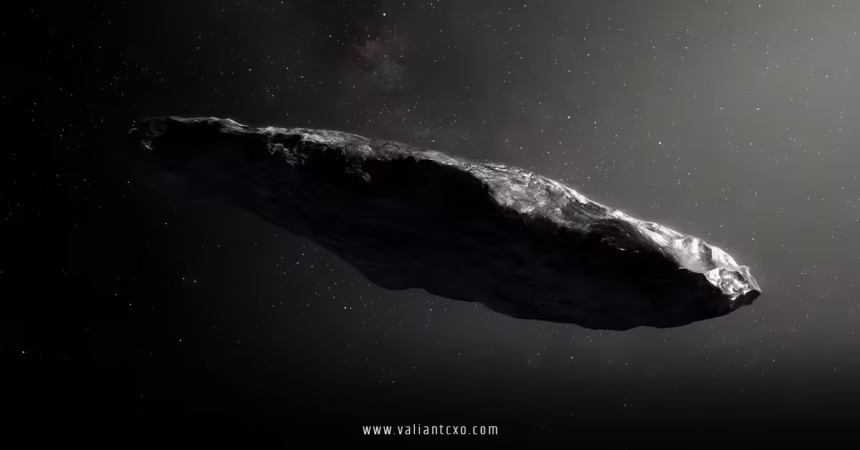
The era of confirmed interstellar comet discoveries began in 2017 with 1I/’Oumuamua, the first known interstellar object to pass through our solar system. Detected by the Pan-STARRS telescope in Hawaii, ‘Oumuamua (Hawaiian for “scout”) was initially mistaken for an asteroid due to its lack of a visible coma. However, its cigar-shaped form—estimated at 200 meters long—and tumbling motion suggested it might be a fragment of a larger body.
Traveling at about 26 km/s, ‘Oumuamua originated from the direction of the constellation Lyra and displayed unexpected acceleration, possibly from outgassing. No cometary activity was directly observed, leading to debates about its nature—some even speculated it could be artificial, though natural explanations prevail. Artist’s impressions depict it as a reddish, elongated rock, hinting at exposure to cosmic rays over billions of years.
The Second Visitor: 2I/Borisov
In 2019, amateur astronomer Gennadiy Borisov spotted the second interstellar comet, 2I/Borisov, using a homemade telescope. This object, about 1 km in diameter, showed clear cometary features, including a bright coma and tail composed of water, carbon monoxide, and other volatiles—similar to solar system comets but with unique ratios indicating a different origin.
Borisov approached from the constellation Cassiopeia at 32 km/s, reaching perihelion in December 2019. Observations by Hubble and other telescopes revealed it fragmenting as it neared the Sun, providing data on its composition. Unlike ‘Oumuamua, Borisov was unambiguously a comet, enriching our knowledge of interstellar chemistry.
The Latest Breakthrough: Comet 3I/ATLAS and Ongoing Discoveries
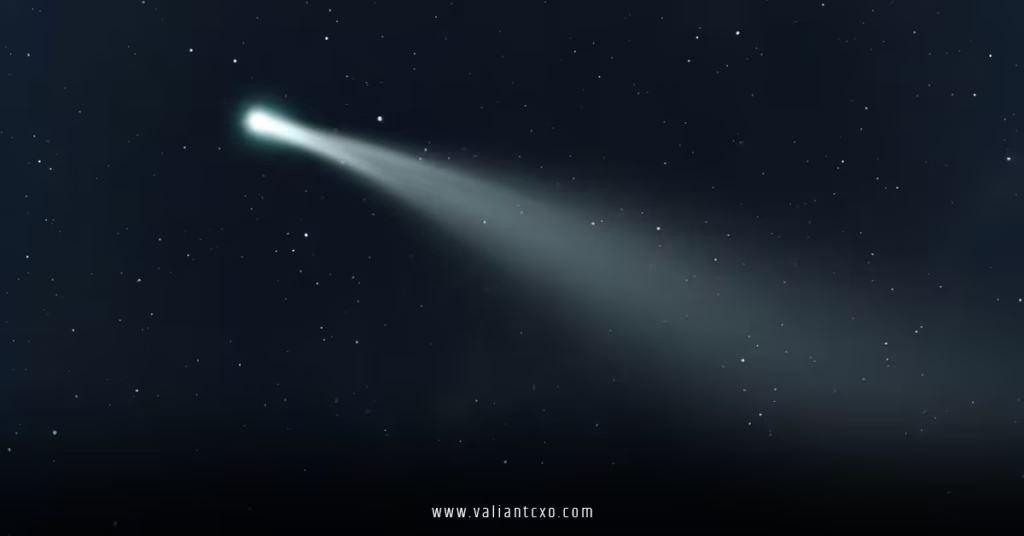
Fast-forward to 2025, and interstellar comet discoveries continue to accelerate with improved detection technologies. The third confirmed interstellar object, 3I/ATLAS (also known as C/2025 N1), was discovered on July 1, 2025, by the Asteroid Terrestrial-impact Last Alert System (ATLAS) telescope in Chile. This comet, with a nucleus likely under 1 km in diameter, follows a hyperbolic orbit with an eccentricity of about 6.14 and a speed of 58 km/s, making it one of the fastest objects ever observed in our solar system.
Originating from the Milky Way’s disk—possibly over 7 billion years old—3I/ATLAS is rich in carbon dioxide, with traces of water, carbon monoxide, and nickel. Its coma spans hundreds of thousands of kilometers, and it has shown intense outgassing, including dust ejection rates up to 60 kg/s. Closest approach to the Sun occurred on October 29, 2025, at 1.36 AU, followed by a safe flyby of Earth on December 19, 2025, at about 1.8 AU.
NASA has led extensive observations using a fleet of missions, including Hubble’s ultraviolet spectroscopy in November 2025 to study gas emissions, and the Psyche spacecraft’s tracking in September. The comet’s tail and coma have been captured in stunning detail, revealing a teardrop-shaped dust cocoon and hydrogen halo. Recent data from December 2025, as the comet moves outbound, includes reobservations by Hubble and potential JWST follow-ups to monitor fading activity.
For in-depth details, check out the NASA latest observations of comet 3I/ATLAS in December 2025.
Why Interstellar Comet Discoveries Matter
These discoveries underscore the dynamic nature of the universe, with objects constantly exchanging between star systems. They provide “free samples” from afar, helping refine models of stellar evolution and exoplanet atmospheres. Future missions, like the Vera C. Rubin Observatory, promise more detections, potentially dozens per year.
As we analyze 3I/ATLAS and await the next visitor, interstellar comet discoveries remind us of our place in a vast, interconnected cosmos. Stay tuned for more updates as technology pushes the boundaries of exploration.
Frequently Asked Questions: Interstellar Comet Discoveries
1. What are interstellar comets, and how do they differ from regular comets?
Interstellar comets are icy bodies originating from outside our solar system, ejected from distant star systems. Unlike solar system comets, which orbit the Sun in elliptical paths, interstellar comets follow hyperbolic trajectories—they enter our system at high speeds, swing around the Sun once, and exit forever, unbound by the Sun’s gravity. Only three have been confirmed: 1I/’Oumuamua (2017), 2I/Borisov (2019), and 3I/ATLAS (2025).
2. How many interstellar objects have been discovered, and what is the latest one?
As of December 2025, three confirmed interstellar objects have visited our solar system:
1I/’Oumuamua (2017): Asteroid-like, no visible coma or tail.
2I/Borisov (2019): Classic comet with a prominent coma and tail.
3I/ATLAS (also C/2025 N1): Discovered July 1, 2025, by the ATLAS telescope in Chile. It’s an active comet with a reddish coma, dust tail, and high speed (hyperbolic excess velocity ~58 km/s).
No additional interstellar objects were discovered in 2025 beyond 3I/ATLAS.
3. Is comet 3I/ATLAS a threat to Earth?
No, 3I/ATLAS poses no danger. Its closest approach to Earth occurred on December 19, 2025, at a safe distance of about 1.8 AU (approximately 170 million miles or 270 million kilometers)—nearly twice the Earth-Sun distance. It passed perihelion (closest to the Sun) on October 29, 2025, at 1.36 AU and is now heading outbound.
4. What have NASA’s latest observations revealed about comet 3I/ATLAS in December 2025?
As the comet departed after its Earth flyby, NASA missions continued monitoring:
Hubble Space Telescope reobserved it in late November/early December for ultraviolet spectroscopy and composition analysis.
James Webb Space Telescope (JWST) scheduled follow-up observations in December to study fading activity and volatiles.
Parker Solar Probe captured images from October-November, showing tail development.
Other assets like Europa Clipper, Perseverance rover (from Mars), and X-ray telescopes (XRISM, XMM-Newton) detected signatures of carbon, oxygen, nitrogen, and a diffuse X-ray glow. Recent data shows the comet’s activity decreasing as it moves away, with a teardrop-shaped dust cocoon and traces of water, CO2, and nickel.
5. Why are interstellar comet discoveries important?
These rare visitors provide “free samples” from other star systems, revealing unique chemistries (e.g., high CO2 in 3I/ATLAS, possibly from an ancient system over 7 billion years old). They challenge models of planet and comet formation, hint at life’s building blocks elsewhere, and prepare us for future detections—with surveys like Vera C. Rubin Observatory expected to find many more. Each discovery, from ‘Oumuamua’s anomalies to 3I/ATLAS’s activity, expands our view of the Milky Way’s diversity.