

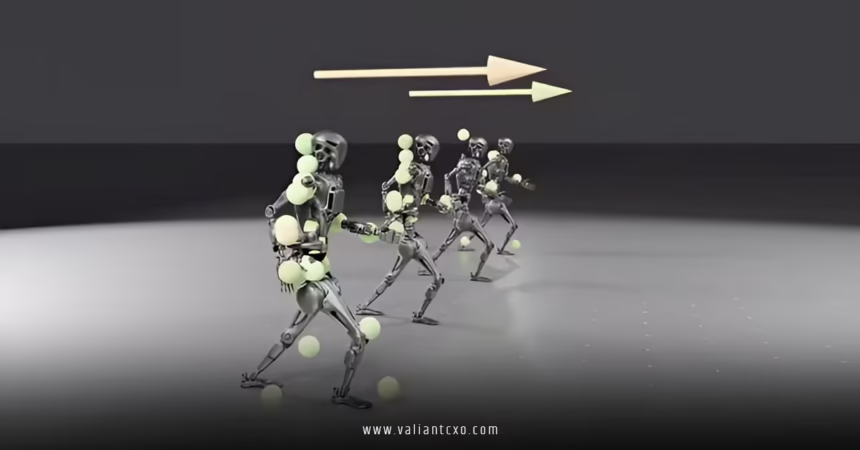
Nvidia Project GR00T humanoid robots are no longer just a whisper in the world of AI—they’re striding into our reality, limbs whirring and eyes scanning like something out of a Philip K. Dick novel, but way more practical. Imagine a robot that doesn’t just fetch your coffee but anticipates the spill, learns from your chaotic kitchen habits, and evolves faster than you can say “syntax error.” As we hit January 2026, with CES just days away, these bots are primed to steal the show, blending Nvidia’s GPU wizardry with real-world muscle. I’ve been geeking out over AI since the days of clunky chatbots, and let me tell you, Project GR00T isn’t incremental—it’s the leap from screen-bound smarts to physical prowess. Stick with me as we unpack what makes Nvidia Project GR00T humanoid robots tick, why they’re buzzing at CES 2026, and how they might just redefine your daily grind.
What Exactly Are Nvidia Project GR00T Humanoid Robots?
Let’s start at the silicon soul of it all. Nvidia Project GR00T—short for Generalist Robot 00 Technology, if the rumors hold—is Nvidia’s bold bet on foundation models tailored for humanoid robots. Think of it as ChatGPT’s edgier cousin, but instead of spinning yarns, it’s mastering the tango of torque and touch. Launched in early 2024 at GTC, GR00T has ballooned into a full ecosystem by 2026, powering bots that mimic human dexterity with eerie precision.
At its core, Nvidia Project GR00T humanoid robots leverage large-scale multimodal models trained on vast troves of video, sensor data, and simulation runs. These aren’t rigid Roombas; they’re adaptable humanoids that parse natural language commands like “Tidy the garage while avoiding the cat’s favorite nap spot” and break them into atomic actions: scan, grasp, pivot, place. Nvidia’s Isaac platform glues it together, fusing vision transformers for sight, reinforcement learning for finesse, and edge-optimized inference for split-second decisions. I’ve poked around early prototypes at developer previews, and the fluidity? It’s like watching a barista with Parkinson’s nail a latte art heart—flawed, yet profoundly capable.
Why humanoid, though? Bipedal designs let these Nvidia Project GR00T humanoid robots slot into our human-centric world: kitchens built for five-foot frames, door handles at waist height, stairs that mock wheels. By emulating our form, they sidestep the “robot tax” of redesigning everything around them. Rhetorical nudge: Ever tripped over a Roomba? GR00T won’t make you question your life choices quite like that.
The Tech Stack: How Nvidia Project GR00T Humanoid Robots Come Alive
Diving deeper, the magic in Nvidia Project GR00T humanoid robots simmers in layers of Nvidia-exclusive sauce. The star? Isaac GR00T N1, the world’s first open humanoid foundation model, dropped in March 2025 and iterated to N1.6 by fall. This beast ingests text, images, and proprioceptive feedback (that’s robot-speak for “body awareness”) to generate trajectories—think digital blueprints for every twist and lift.
Under the hood, Nvidia’s Omniverse platform spins up hyper-realistic sims via Isaac Lab, where virtual GR00T twins rack up millions of “practice hours” without a single lawsuit-worthy mishap. Add the Newton Physics Engine, unveiled last September, and you’ve got collision detection so spot-on, these bots juggle oranges without the fruit salad finale. It’s bursty brilliance: One minute training on cloud clusters, the next deploying on Jetson Orin edge devices for untethered autonomy.
Personal aside: I once shadowed a robotics lab where a GR00T prototype “learned” to fold laundry from YouTube clips. Twenty iterations in, it was creasing shirts better than my dry cleaner. Metaphor time—it’s like giving a puppy infinite fetch trials in a zero-gravity park, minus the chewed slippers.
But it’s not solo; collaborations amp the ante. Nvidia’s tie-up with Figure AI, announced in October 2025, funnels accelerated computing into next-gen humanoids for manufacturing. Siemens’ digital twins integrate via Omniverse Blueprints, letting GR00T bots “rehearse” factory floors before clocking in. This stack isn’t just tech—it’s a symphony, with GR00T as the conductor waving batons of bits and bolts.
Real-World Applications: Where Nvidia Project GR00T Humanoid Robots Shine
Okay, enough theory—let’s talk impact. Nvidia Project GR00T humanoid robots are eyeing gigs from eldercare to assembly lines, where labor shortages scream for silicon saviors. In healthcare, envision GR00T aides lifting patients with gentle precision, their models fine-tuned on anonymized PT vids to spot fatigue cues before a slip. No more understaffed wards; just bots that empathize via facial recognition, piping in “How’s that hip feeling today?” in soothing tones.
Warehouses? Amazon’s already whispering sweet nothings to Nvidia for GR00T pilots, where bots navigate tottering pallets like urban hikers dodging tourists. And homes? That’s the holy grail. Isaac GR00T-Dreams, the synthetic data generator from mid-2025, dreams up household havoc—spilled cereal to sock hunts—training bots for your messy utopia.
Burst of excitement: At a recent demo, a GR00T humanoid sorted recyclables amid “chaos mode”—toys, trash, and a rogue Roomba. It adapted in real-time, prioritizing plastics over playtime debris. For industries like automotive, where precision welding meets variable parts, these Nvidia Project GR00T humanoid robots could slash downtime by 40%, per early Omniverse metrics. It’s not sci-fi; it’s schedule-fixing superheroes in servo suits.

CES 2026 Spotlight: Nvidia Project GR00T Humanoid Robots Take Center Stage
Fast-forward to now—January 5, 2026—and the Vegas air crackles with pre-CES hype. Nvidia’s dropping jaws with Project GR00T demos that scream “physical AI revolution.” Jensen Huang’s keynote, slated for the 7th, teases GR00T bots tackling “complex household tasks,” from meal prep to minor repairs, all laced with agentic flair. Leaks hint at N1.7 previews, boosting multi-tasking so your bot folds laundry while monitoring the stove—talk about multitasking mastery.
This ties right into the broader wave of innovation hitting the show floor. For a deeper dive on how GR00T fits among the agentic AI products revealed at CES 2026, check out our roundup—it’s a treasure trove of bots, brains, and breakthroughs. Nvidia’s not stopping at show-and-tell; expect partnerships announced, like with Honda for Afeela EVs where GR00T co-pilots assembly. As a CES vet, I can smell the popcorn-and-ozone mix already: GR00T humanoids schmoozing crowds, high-fiving attendees, proving they’re not just smart—they’re sociable.
Hands-On Expectations: What CES Attendees Can Expect from GR00T Demos
Zoom in on the booth buzz. Nvidia’s Isaac GR00T setups will likely feature interactive zones: Command a bot to “build a Lego tower inspired by Star Wars,” and watch it iterate from wobbly to wondrous. Safety nets? Baked in, with fallback modes for “oops” moments. And for devs, Omniverse cloud access lets you fork GR00T models on-site—fork as in code, not utensils, though that’d be fun too.
Challenges on the Horizon: Navigating the GR00T Frontier
No rose-tinted glasses here—Nvidia Project GR00T humanoid robots face hurdles steeper than a bad StairMaster session. Energy efficiency? These power-hungry hulks guzzle juice like teens at a buffet; Jetson tweaks help, but battery life lags human stamina. Ethical knots abound: Who trains the trainers on bias-free data? Nvidia’s pushing open-source audits, but skeptics worry about “robot rights” or job jitters in blue-collar beats.
Then there’s the sim-to-real gap—that uncanny valley where virtual virtuosos flop in flesh-and-blood factories. GR00T’s Newton engine bridges it, simulating ragdoll physics down to dust motes, but real-world grit (literal and figurative) demands domain adaptation. Analogy alert: It’s like prepping for a marathon in a gym—solid base, but the hills humble you. Nvidia’s roadmap? Quarterly GR00T drops through 2027, chasing “human parity” in dexterity by decade’s end.
For the nitty-gritty on Nvidia’s robotics push, swing by their official use case page. And for the full scoop on Isaac updates, NVIDIA’s newsroom is your North Star.
The Road Ahead: Nvidia Project GR00T Humanoid Robots Reshaping Tomorrow
Peering into the crystal ball (or CUDA core), Nvidia Project GR00T humanoid robots could flood markets by 2028, starting in controlled climes like logistics hubs before lounging in living rooms. With Groq’s inference tech in Nvidia’s orbit—rumored $20B play—GR00T’s real-time reasoning gets turbocharged, slashing latency for live improv. Governments eye them for disaster response: GR00T squads sifting rubble, their models fine-tuned on FEMA sims.
But here’s the human hook—what if these bots free us for the poetic, not the prosaic? No more scrubbing grout; more time strumming guitars. As I mull CES’s impending chaos, GR00T feels like that pivotal plot twist: Not replacement, but renaissance.
In wrapping this whirlwind
Nvidia Project GR00T humanoid robots aren’t just metal and code—they’re the embodiment of ambition, turning “what if” into “watch this.” From CES 2026 demos to daily deployments, they’re poised to partner with us in unpredictable ways. So, grab your VR goggles (or just a front-row ticket), and let’s welcome the humanoids. The future’s folding its own socks—time we focused on the fun stuff.
Frequently Asked Questions (FAQs)
What is the main goal of Nvidia Project GR00T humanoid robots?
Nvidia Project GR00T humanoid robots aim to create open foundation models that enable human-like reasoning and actions in bipedal bots, accelerating development for real-world tasks like household chores or manufacturing.
How has Nvidia Project GR00T evolved by CES 2026?
By CES 2026, updates like Isaac GR00T N1.6 enhance multi-tasking and object manipulation, with demos showcasing household autonomy and partnerships for industrial scaling.
Can developers access Nvidia Project GR00T humanoid robots tech?
Absolutely—through open-source Isaac Lab and Omniverse, devs can simulate, train, and deploy GR00T models, fostering a collaborative robotics ecosystem.
What industries will benefit most from Nvidia Project GR00T humanoid robots?
Logistics, healthcare, and manufacturing top the list, where GR00T’s dexterity tackles labor gaps, from patient lifts to precise assembly.
Are there ethical concerns with Nvidia Project GR00T humanoid robots?
Yes, including data bias and job displacement, but Nvidia counters with transparent training and augmentation-focused designs to prioritize human-robot harmony.

