
Bank of Japan interest rate policy 2026 is shaping up to be one of the most closely watched stories in global finance right now. After decades of fighting deflation with ultra-easy money, the BOJ is finally stepping into a new chapter, and the decisions they make this year could ripple through everything from the yen’s value to your investment portfolio. If you’ve ever wondered why Japan’s central bank moves matter—even if you’re halfway across the world—this is the moment to pay attention.
Why the Bank of Japan Interest Rate Policy 2026 Matters More Than Ever
Let’s be honest: central bank policy can feel dry and distant. But think of the Bank of Japan as the captain of a massive ship that’s been drifting in calm waters for years. Suddenly, the winds are picking up, and the captain has to decide whether to raise the sails or keep them trimmed low. That’s essentially what the Bank of Japan interest rate policy 2026 is all about—deciding how fast to normalize after an extraordinarily long period of near-zero (and even negative) rates.
As we sit here in early 2026, inflation in Japan has finally settled above the BOJ’s 2% target for a sustained period, wages are growing at the fastest pace in decades, and the yen has strengthened considerably. These are the very conditions the BOJ has been waiting for. Yet every rate decision carries risk. Hike too fast, and you could choke the recovery. Stay too dovish, and inflation could become entrenched or the yen could weaken again. The balancing act is delicate.
A Quick History Lesson: How We Got to Bank of Japan Interest Rate Policy 2026
To understand where the Bank of Japan interest rate policy 2026 stands today, you have to look back. Japan spent the better part of three decades battling deflation. The BOJ slashed rates to zero in the 1990s, introduced quantitative easing early, and then—when that wasn’t enough—went negative in 2016. For years, the policy rate sat at -0.1%, and yield curve control kept 10-year JGB yields pinned near zero.
That all began to change in 2023–2024. Governor Kazuo Ueda signaled a shift, first tweaking yield curve control, then ending negative rates in March 2024, and finally raising the short-term policy rate to 0.25% by late 2024. Gradual hikes continued through 2025, bringing the policy rate to its current range of 0.50%–0.75% as of January 2026.
This normalization isn’t dramatic compared to the Fed or ECB, but for Japan it’s seismic. The Bank of Japan interest rate policy 2026 builds directly on that foundation.
Current Status of Bank of Japan Interest Rate Policy 2026
Right now, the BOJ’s overnight call rate target sits in the 0.50%–0.75% range, with the actual uncollateralized overnight call rate trading near the upper end. The central bank has made it clear it will continue “normalizing” policy as long as inflation and wage growth remain solid.
At the January 2026 Monetary Policy Meeting, the BOJ left rates unchanged but upgraded its inflation outlook slightly, suggesting that another 25-basis-point hike could come as early as spring if incoming data cooperates. Markets are currently pricing in one to two additional hikes by year-end, potentially taking the policy rate toward 1.0%–1.25%.
For the latest official statements, visit the Bank of Japan’s Monetary Policy page.
Key Factors Shaping Bank of Japan Interest Rate Policy 2026
Several forces are tugging at the BOJ’s decision-making this year. Let’s break them down:
1. Inflation and Wage Dynamics
Japan’s core CPI (excluding fresh food) has hovered around 2.5%–3% for much of 2025, and the spring wage negotiations delivered another round of solid gains. This virtuous cycle—inflation leading to higher wages, which then supports consumption—is exactly what the BOJ has been trying to engineer for decades. As long as this cycle holds, the Bank of Japan interest rate policy 2026 will likely remain on a gradual tightening path.
2. Yen Strength and Global Conditions
A stronger yen reduces imported inflation but also hurts exporters. With the Fed cutting rates and the dollar softening, the yen has appreciated significantly. The BOJ must decide whether that appreciation gives it room to hike further or whether it risks tipping the economy into slowdown.
3. Fiscal Policy and Government Debt
Japan’s public debt exceeds 250% of GDP. Higher interest rates mean higher debt-servicing costs. The government and the BOJ are in constant dialogue, and any hint of fiscal strain could slow the pace of normalization.
4. Global Risks
Geopolitical tensions, commodity price swings, and slowdowns in China or the U.S. could all force the BOJ to pause. The Bank of Japan interest rate policy 2026 is not being made in a vacuum.
For in-depth analysis on global central bank trends, check Bloomberg’s coverage of BOJ policy.
Market Expectations for Bank of Japan Interest Rate Policy 2026
Analysts are largely aligned: most major houses expect the policy rate to end 2026 somewhere between 1.0% and 1.5%. A few more hawkish forecasts see 1.75% if wage growth accelerates further. Dovish scenarios—triggered by a global slowdown—could keep rates capped near 1%.
Bond markets reflect this caution. The 10-year JGB yield has climbed to around 1.3%, but the curve remains relatively flat, signaling that investors don’t expect aggressive tightening.
Currency strategists generally forecast USD/JPY trading in the 140–150 range by year-end, assuming gradual hikes continue.
Economic Impact of Bank of Japan Interest Rate Policy 2026
Higher rates affect every corner of the Japanese economy:
- Households: Borrowing costs for mortgages and consumer loans are rising slowly. Savers, long punished by negative rates, are finally earning a modest return.
- Corporates: Investment remains strong thanks to healthy profits and wage growth, but highly leveraged firms face higher refinancing costs.
- Stock Market: The Nikkei has been resilient, supported by earnings growth and foreign inflows, but rapid rate hikes could trigger volatility.
- Real Estate: Commercial property in major cities remains attractive, but residential affordability is starting to feel the pinch.
Overall, the gradual approach embedded in Bank of Japan interest rate policy 2026 aims to support sustainable growth without derailing the recovery.
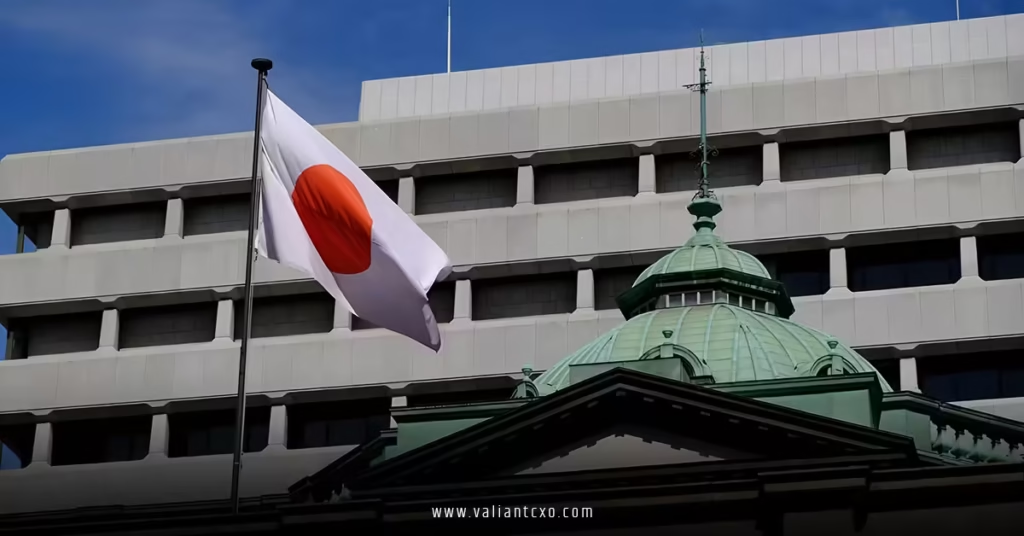
Global Spillovers from Bank of Japan Interest Rate Policy 2026
Remember the 2024 carry-trade unwind? When the BOJ began tightening, yen-funded positions unraveled across global markets. A continuation of normalization in 2026 could produce similar—though likely milder—effects.
Emerging-market currencies, commodity prices, and even U.S. Treasury yields can feel the BOJ’s moves. When Japan stops being the world’s cheapest source of funding, capital flows shift.
For broader context on how BOJ actions affect global markets, see Reuters’ latest BOJ reporting.
How Investors Should Think About Bank of Japan Interest Rate Policy 2026
If you’re investing in Japanese assets:
- Consider overweighting sectors that benefit from domestic demand (retail, services, construction).
- Be cautious with highly leveraged real estate or export-heavy manufacturers.
- Currency-hedged exposure can reduce yen volatility risk.
- Japanese bonds are finally offering positive real yields—something unthinkable just a few years ago.
For global portfolios, the key is monitoring the pace of normalization. A smooth path higher in rates is generally positive for risk assets; abrupt hikes are not.
Potential Risks to the Bank of Japan Interest Rate Policy 2026 Outlook
Nothing is certain. A sharp global slowdown, renewed deflationary pressures, or fiscal slippage could force the BOJ to pause or even reverse course. Conversely, overheating wages and inflation could push the central bank to tighten more aggressively than markets expect.
The BOJ has emphasized data-dependence, so every CPI print, wage negotiation result, and Tankan survey will move markets this year.
Conclusion
Bank of Japan interest rate policy 2026 represents the culmination of a decades-long experiment in ultra-easy money. The central bank is cautiously guiding Japan toward a more normal interest-rate environment, supported by sustained inflation and wage growth. While risks remain—both domestic and global—the baseline outlook is for gradual normalization, with the policy rate likely ending the year near or above 1%.
For investors, households, and businesses, staying informed and flexible is key. The BOJ’s decisions this year will shape Japan’s economic trajectory for years to come, and their ripple effects will be felt worldwide. Keep watching the data, trust the process, and adjust as new information arrives.
FAQs
1. What is the current Bank of Japan policy interest rate in early 2026?
As of January 2026, the BOJ targets the overnight rate in a 0.50%–0.75% range, following gradual hikes in 2024 and 2025.
2. Will the Bank of Japan raise rates further in 2026?
Most analysts expect one to two additional 25-basis-point hikes in 2026, potentially bringing the policy rate to 1.0%–1.5%, depending on inflation and wage data.
3. How does the Bank of Japan interest rate policy 2026 affect the yen?
Higher rates generally support yen appreciation by reducing the interest-rate differential with other major currencies and unwinding carry trades.
4. What are the biggest risks to the Bank of Japan interest rate policy 2026 outlook?
The main risks are a global economic slowdown, renewed deflationary pressures, fiscal strain from rising debt-servicing costs, or unexpectedly strong wage-driven inflation.
5. How should households prepare for changes in Bank of Japan interest rate policy 2026?
Lock in fixed-rate mortgages if possible, consider shifting some savings into higher-yielding deposits or bonds, and maintain an emergency fund to buffer potential increases in borrowing costs.