
Artemis II mission astronauts 2026 are gearing up for a historic journey that will mark humanity’s return to deep space exploration after more than five decades. Imagine four brave explorers strapped into the Orion spacecraft, blasting off atop the mighty Space Launch System (SLS) rocket, heading toward the Moon on a path no one has taken since the Apollo era. This isn’t just another spaceflight—it’s a bold step forward, testing cutting-edge technology and paving the way for future lunar landings and even Mars missions. If you’re fascinated by space, the Artemis II mission astronauts 2026 represent the pinnacle of human ambition, courage, and innovation.
The excitement around the Artemis II mission astronauts 2026 is palpable because this crewed flyby will be the first time humans venture beyond low Earth orbit since 1972. Why does this matter now? Well, with advancing global space programs and the drive to establish a sustainable presence on the Moon, NASA is leading the charge through the Artemis program. The Artemis II mission astronauts 2026 will not only test life-support systems in deep space but also inspire a new generation to look up at the stars and dream big.
What Is the Artemis II Mission?
Have you ever wondered what it takes to send humans around the Moon again? The Artemis II mission is essentially a proving ground for NASA’s next-generation deep space capabilities. Scheduled for launch no earlier than February 2026, with windows extending into April, this 10-day adventure will see the Artemis II mission astronauts 2026 embark on a lunar flyby trajectory.
Unlike Artemis I, which was uncrewed and successfully looped around the Moon in 2022, Artemis II adds the human element. The mission launches from Kennedy Space Center in Florida, using the powerful SLS rocket to propel the Orion spacecraft. Once in space, the crew will orbit Earth a couple of times before slingshotting toward the Moon using a free-return trajectory—this clever path uses lunar gravity to whip them back home without needing extra fuel for major course corrections.
Think of it like throwing a stone across a pond; it skips and returns naturally. This approach ensures safety while allowing the Artemis II mission astronauts 2026 to travel farther from Earth than anyone has in over 50 years, reaching up to thousands of miles beyond the Moon.
Mission Objectives for Artemis II Mission Astronauts 2026
The primary goal? Test everything with humans on board. The Artemis II mission astronauts 2026 will evaluate Orion’s environmental control and life support systems—crucial for producing breathable air, managing waste, and keeping the cabin comfortable during high-activity periods like exercise or low ones like sleep.
They’ll also conduct science experiments, monitoring radiation exposure, human health in deep space, and even using innovative tools like organ-on-a-chip technology to study biological effects. Rhetorical question: Isn’t it amazing how this mission blends engineering prowess with groundbreaking research?
Moreover, the flight will validate navigation, communications, and reentry procedures. Orion will perform a “skip reentry,” dipping into Earth’s atmosphere, skipping out, and then plunging back for a precise splashdown in the Pacific. This technique reduces G-forces on the Artemis II mission astronauts 2026, making the return smoother.
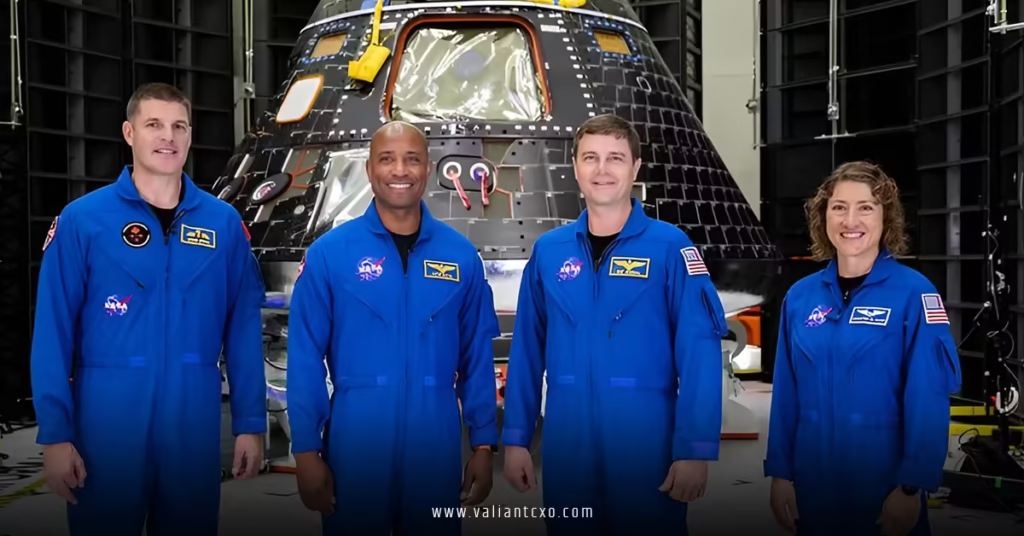
Meet the Artemis II Mission Astronauts 2026
The heart of any space mission is its crew, and the Artemis II mission astronauts 2026 are a diverse, highly skilled team embodying international collaboration and trailblazing spirit.
Commander Reid Wiseman
Leading the pack is Reid Wiseman, a seasoned NASA astronaut with a background in naval aviation. Wiseman spent months on the International Space Station during Expedition 40/41, conducting spacewalks and experiments. As commander, he’ll oversee operations, making critical decisions in real-time. Picture this: a calm, experienced pilot guiding the team through the vastness of space—Wiseman’s leadership will be key for the Artemis II mission astronauts 2026.
Pilot Victor Glover
Victor Glover, the mission’s pilot, brings test pilot expertise and a historic role as the first person of color to venture to the Moon’s vicinity. Glover flew on SpaceX’s Crew-1 mission to the ISS, logging extensive time in orbit. He’ll handle Orion’s controls during key maneuvers. Glover’s journey highlights diversity in space exploration, inspiring countless others.
Mission Specialist Christina Koch
Christina Koch holds the record for the longest single spaceflight by a woman, nearly 11 months on the ISS, including the first all-female spacewalk. As a mission specialist, she’ll manage scientific payloads and systems checks. Koch’s endurance and expertise make her invaluable for testing long-duration effects on the Artemis II mission astronauts 2026.
Mission Specialist Jeremy Hansen
Rounding out the crew is Jeremy Hansen from the Canadian Space Agency, making his spaceflight debut and becoming the first non-American to fly beyond low Earth orbit. A former fighter pilot, Hansen has supported ISS missions from the ground as a capcom. His inclusion underscores the international partnerships driving Artemis, with Canada contributing robotic arms for future lunar gateways.
Together, these Artemis II mission astronauts 2026 have undergone rigorous training: simulations, suit-ups, and countdown rehearsals. They’ve even named their Orion spacecraft “Integrity,” symbolizing trust in the team and technology.
Training and Preparation for Artemis II Mission Astronauts 2026
Training for the Artemis II mission astronauts 2026 is no joke—it’s intense, immersive, and relentless. Have you ever tried simulating zero gravity while solving emergencies? These astronauts do it regularly in mockups at Johnson’s Space Center.
They practice everything from launch aborts to splashdown recoveries with the U.S. Navy. Recent countdown demonstration tests had them suiting up, walking out like Apollo legends, and boarding Orion in the Vehicle Assembly Building. Backup crew members, including Andre Douglas and Jenni Gibbons, ensure redundancy.
The Artemis II mission astronauts 2026 also focus on health: monitoring radiation with advanced sensors and conducting experiments on themselves. It’s like being both explorer and lab rat—fascinating, right?
Challenges Facing the Artemis II Mission Astronauts 2026
No mission is without hurdles. Delays from heat shield issues on Artemis I and life support refinements pushed the timeline to 2026. But these fixes enhance safety. Radiation beyond Earth’s magnetic shield, psychological isolation, and precise reentry are risks the Artemis II mission astronauts 2026 are trained to mitigate.
Analogies help: it’s like upgrading a car before a cross-country road trip—you want it reliable.
The Significance of Artemis II Mission Astronauts 2026 in Space Exploration
Why get excited about the Artemis II mission astronauts 2026? This mission isn’t an end—it’s a beginning. It certifies Orion and SLS for crewed deep space, setting the stage for Artemis III’s lunar landing in 2027.
Long-term, Artemis aims for sustainable Moon presence: bases, resources, and science. It’s a springboard to Mars. Geopolitically, it reinforces leadership in exploration amid global competition.
For more details, check NASA’s official Artemis page here, Wikipedia’s comprehensive overview here, and the Canadian Space Agency’s insights here.
The Artemis II mission astronauts 2026 embody resilience and curiosity. They’re not just flying around the Moon; they’re testing boundaries for humanity’s future among the stars.
Conclusion
In summary, the Artemis II mission astronauts 2026—Reid Wiseman, Victor Glover, Christina Koch, and Jeremy Hansen—represent a pivotal moment in space history. This 10-day lunar flyby in early 2026 will validate critical systems, conduct vital science, and reignite global enthusiasm for exploration. From overcoming technical challenges to fostering international cooperation, their journey highlights what we can achieve together. As they loop around the Moon, gazing at Earth from afar, they’ll remind us of our shared home and boundless potential. Get ready—the Artemis era is here, and it’s inspiring us all to reach further.
FAQs About Artemis II Mission Astronauts 2026
1. Who are the Artemis II mission astronauts 2026?
The crew consists of NASA astronauts Reid Wiseman (commander), Victor Glover (pilot), Christina Koch (mission specialist), and Canadian Space Agency astronaut Jeremy Hansen (mission specialist).
2. When will the Artemis II mission astronauts 2026 launch?
The launch is targeted no earlier than February 2026, with opportunities extending through April, depending on final testing and readiness.
3. What will the Artemis II mission astronauts 2026 do during the mission?
They’ll test Orion’s life support, navigation, and reentry systems, conduct science experiments, and fly a free-return trajectory around the Moon over 10 days.
4. Why is the Artemis II mission astronauts 2026 crew historic?
It includes the first woman, first person of color, and first non-American to travel beyond low Earth orbit, promoting diversity and international partnership.
5. How does Artemis II prepare for future missions involving the Artemis II mission astronauts 2026 legacy?
By certifying human-rated deep space systems, it lays groundwork for lunar landings in Artemis III and eventual Mars exploration.