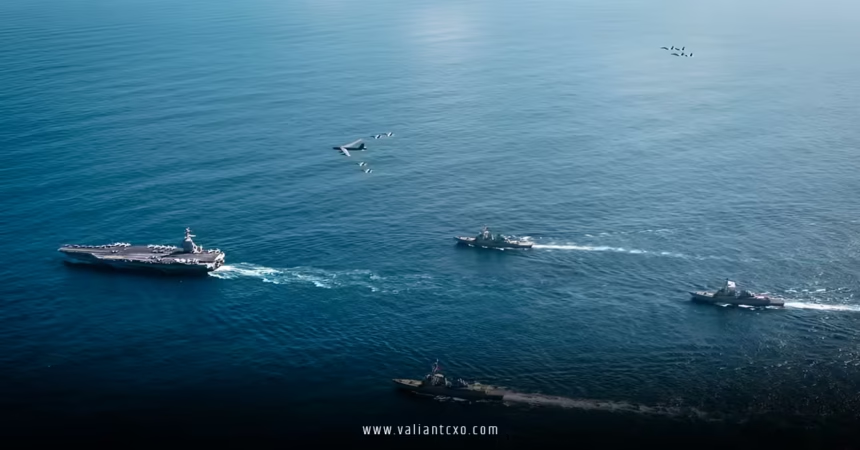
Operation Southern Spear Drug Boat Strikes has become one of the most controversial military campaigns of the Trump era, transforming the decades-old war on drugs into a high-stakes, lethal operation across the Caribbean and Eastern Pacific. Launched amid escalating tensions with Venezuela, this initiative has seen the U.S. military conduct dozens of airstrikes on suspected drug-trafficking vessels, resulting in over 100 deaths since September 2025. While the administration hails it as a bold defense of American lives against “narco-terrorists,” critics decry it as a dangerous overreach that flirts with violations of international law—including the infamous Trumpian perfidy using unmarked aircraft to attack drug boats in the opening strike.
Have you ever wondered what happens when the fight against drugs shifts from Coast Guard boardings to missile strikes from the sky? That’s exactly what Operation Southern Spear drug boat strikes represent—a dramatic escalation that has reshaped U.S. counternarcotics strategy.
The Origins: How Operation Southern Spear Drug Boat Strikes Began
Everything kicked off in late August 2025, when the U.S. began deploying warships, fighter jets, and personnel to the Caribbean. The stated goal? Disrupt maritime drug networks allegedly linked to Venezuelan gangs and cartels. President Trump framed the effort as a necessary response to the flood of narcotics—particularly fentanyl and cocaine—killing tens of thousands of Americans annually.
The first major action came on September 1–2, 2025: a speedboat allegedly originating from Venezuela was struck in the Caribbean, killing all 11 people aboard. Trump announced it triumphantly on social media, releasing dramatic video footage of missiles hitting the vessel and flames engulfing it. He claimed the targets were members of Tren de Aragua, a gang designated as a terrorist organization, operating under Nicolás Maduro’s influence.
This initial incident quickly became notorious due to reports that the attacking aircraft was disguised as a civilian plane—painted without military markings and with hidden munitions. Legal experts have questioned whether this constituted Trumpian perfidy using unmarked aircraft to attack drug boats, a potential war crime under international humanitarian law that prohibits feigning civilian status to gain a tactical advantage.
Subsequent strikes shifted to clearly marked platforms like MQ-9 Reaper drones, but the damage to perceptions was already done.
Key Milestones in Operation Southern Spear Drug Boat Strikes
By November 2025, Defense Secretary Pete Hegseth formally unveiled Operation Southern Spear drug boat strikes as a full-fledged campaign under Joint Task Force Southern Spear, coordinated with U.S. Southern Command (SOUTHCOM). The operation expanded rapidly:
- September–October 2025: Initial focus on the Caribbean, with strikes targeting speedboats and low-profile vessels near Trinidad, the Dominican Republic, and Venezuela’s coast.
- Late October onward: Extension into the Eastern Pacific, where semi-submersibles (so-called “narco-subs”) became frequent targets.
- By late December 2025: Over 30 strikes reported, with death tolls climbing past 100–115 people across 35+ vessels.
- December 2025: First land-based actions, including a CIA drone strike on a Venezuelan marine facility allegedly used for loading drug boats.
The campaign incorporated advanced tech—robotic surface vessels, autonomous drones, and real-time intelligence—to detect and destroy targets without traditional interdictions.
Here’s a glimpse of the wreckage from one such strike washing ashore on Colombia’s Guajira Peninsula—charred debris that locals say tells a different story from official briefings:
(Imagine images here: blackened boat fragments scattered on a beach, smoke rising over calm waters, and survivors’ families holding photos—visual reminders of the human cost.)
These scenes highlight the stark reality behind the statistics.

Legal and Ethical Controversies Surrounding Operation Southern Spear Drug Boat Strikes
The biggest flashpoint? Legality. The Trump administration declared a “non-international armed conflict” with drug cartels, treating boat crews as “unlawful combatants” and justifying lethal force as self-defense. They argue the strikes target vessels (and their cargo) rather than individuals, with follow-up “double-tap” attacks aimed at destroying evidence, not survivors.
But international law experts push back hard. Drug trafficking is traditionally a criminal matter, not an armed conflict. Human rights groups like the ACLU and Human Rights Watch call the operations extrajudicial killings, lacking due process or imminent-threat justification. Families and governments in Colombia and Venezuela claim many victims were innocent fishermen, not hardened traffickers.
Then there’s the elephant in the room: Trumpian perfidy using unmarked aircraft to attack drug boats. In that first September strike, the use of a disguised aircraft raised alarms. Retired U.S. Air Force legal officers noted it could violate prohibitions against perfidy—pretending to be civilian to trick adversaries into lowering their guard.
Congressional Democrats (and some Republicans) demanded briefings, legal opinions, and War Powers Resolution compliance. Resolutions to curb the authority failed in the Republican-led Senate, but questions linger: Is this effective policy, or a slippery slope toward unchecked military power?
For deeper insight into international humanitarian law, see the International Committee of the Red Cross: ICRC – Rules of War.
Regional Reactions and Geopolitical Fallout
Latin American leaders haven’t stayed silent. Venezuela’s Maduro called the strikes “piracy” and “state terrorism.” Colombia’s Gustavo Petro accused the U.S. of murdering civilians and even labeled Trump an “illegal drug leader” in heated exchanges. Other Caribbean nations expressed quiet support for curbing gangs, but broader alliances frayed.
The operation escalated further in December 2025 with oil tanker seizures and a blockade of Venezuelan waters—moves that framed Operation Southern Spear drug boat strikes as part of a larger pressure campaign against Maduro, culminating in his dramatic capture by U.S. forces on January 3, 2026.
Impact on the War on Drugs: Does It Work?
Proponents point to disrupted routes and deterred traffickers. Trump has repeatedly claimed the strikes are “crushing” cartels and protecting American streets.
Skeptics, including drug policy analysts, argue otherwise. History shows militarized approaches often displace trafficking (new routes emerge), inflate prices temporarily, and fuel violence without reducing overall supply. Most fentanyl enters via land borders from Mexico, not boats from Venezuela. The human toll—over 100 lives lost, many potentially non-combatants—raises profound ethical questions.
Is Operation Southern Spear drug boat strikes saving lives by stopping poison, or creating new tragedies in the name of security?
Conclusion: The Legacy of Operation Southern Spear Drug Boat Strikes
Operation Southern Spear drug boat strikes marks a pivotal, polarizing chapter in U.S. counternarcotics efforts. From the controversial first strike involving Trumpian perfidy using unmarked aircraft to attack drug boats to the broader campaign that killed over 100 people and helped topple Maduro’s regime, it showcases aggressive innovation—and serious risks. While supporters see it as decisive action against a deadly threat, opponents warn of eroded legal norms, civilian harm, and questionable long-term effectiveness.
As the dust settles in early 2026, one thing is clear: this operation has forever changed how America wages war on drugs. The real question now? Will future administrations follow this path, or seek more measured, collaborative solutions? The stakes—for justice, security, and human lives—couldn’t be higher.
FAQs About Operation Southern Spear Drug Boat Strikes
1. What is Operation Southern Spear drug boat strikes?
It’s a U.S. military campaign started in September 2025 to target suspected drug-trafficking vessels in the Caribbean and Eastern Pacific, resulting in dozens of lethal strikes and over 100 deaths.
2. How does Trumpian perfidy using unmarked aircraft to attack drug boats relate to Operation Southern Spear?
The first strike in September 2025 reportedly used a disguised (unmarked) aircraft that looked civilian, raising perfidy concerns—a potential war crime under international law—before later operations switched to marked platforms.
3. How many people died in Operation Southern Spear drug boat strikes?
As of late December 2025, at least 107–115 people were killed across 30–35 strikes, according to U.S. Southern Command reports, though exact numbers and victim identities remain disputed.
4. Why did the U.S. launch Operation Southern Spear drug boat strikes?
The Trump administration aimed to disrupt narco-trafficking networks linked to terrorist-designated groups, framing it as self-defense against drugs killing Americans, while critics see it as an escalation tied to regime change in Venezuela.
5. Are Operation Southern Spear drug boat strikes considered legal?
The administration claims yes under armed conflict rules; many experts and human rights groups argue no, citing violations of international humanitarian law, lack of due process, and risks of civilian casualties.