SpaceX Crew Dragon re-entry procedures represent one of the most thrilling and technically demanding phases of any human spaceflight mission. Picture this: after months floating in microgravity aboard the International Space Station, four astronauts strap into their seats for a high-speed plunge back to Earth. The capsule screams through the atmosphere at over 22 times the speed of sound, glowing like a meteor, before gently splashing down in the ocean. This process proved reliable once again during the [NASA Crew-11 medical evacuation International Space Station January 2026], when the Crew Dragon Endeavour safely brought the team home on January 15, 2026.
In this detailed guide, we’ll walk through every stage of SpaceX Crew Dragon re-entry procedures, from undocking to recovery. Whether you’re a space enthusiast or just curious about how astronauts make it back alive, let’s break it down.
Why Crew Dragon Re-entry Is So Critical
Returning from space isn’t like landing a plane—it’s more like controlled falling from 250 miles up. The spacecraft must shed massive orbital velocity (about 17,500 mph) while surviving extreme heat, g-forces, and precise timing. SpaceX designed Crew Dragon with advanced features like the PICA-X heat shield (a tough, ablative material that chars away to carry heat off) to make this possible.
These procedures have been refined through dozens of test flights and operational missions. In the case of the [NASA Crew-11 medical evacuation International Space Station January 2026], the system performed flawlessly under real-world pressure, highlighting why SpaceX Crew Dragon re-entry procedures are trusted for crew safety.
Pre-Re-entry Preparations: Getting Ready for the Ride Home
Before the fiery part begins, astronauts follow a meticulous checklist.
- Packing and Suiting Up — Crew members secure experiments, personal items, and stow gear in the capsule. They don their pressure suits (which protect against cabin depressurization) and perform leak checks.
- Hatch Closure — The hatch between the Dragon and ISS seals tightly, ensuring a good pressure seal.
- Undocking — The spacecraft autonomously undocks using small Draco thrusters. For Crew-11, this happened on January 14, 2026, around 5:20 p.m. ET, over Australia.
After separation, a series of departure burns adjust the trajectory toward the re-entry corridor. The crew then rests briefly while the vehicle coasts.
The Deorbit Burn: Slowing Down to Drop Back to Earth
This is the point of no return.
The Crew Dragon’s Draco thrusters fire for a deorbit burn—typically lasting 10-13 minutes. This reduces speed just enough for gravity to pull the capsule into the atmosphere. Without this burn, the spacecraft would stay in orbit forever.
For the [NASA Crew-11 medical evacuation International Space Station January 2026], the burn aligned the trajectory perfectly for a Pacific splashdown off San Diego.
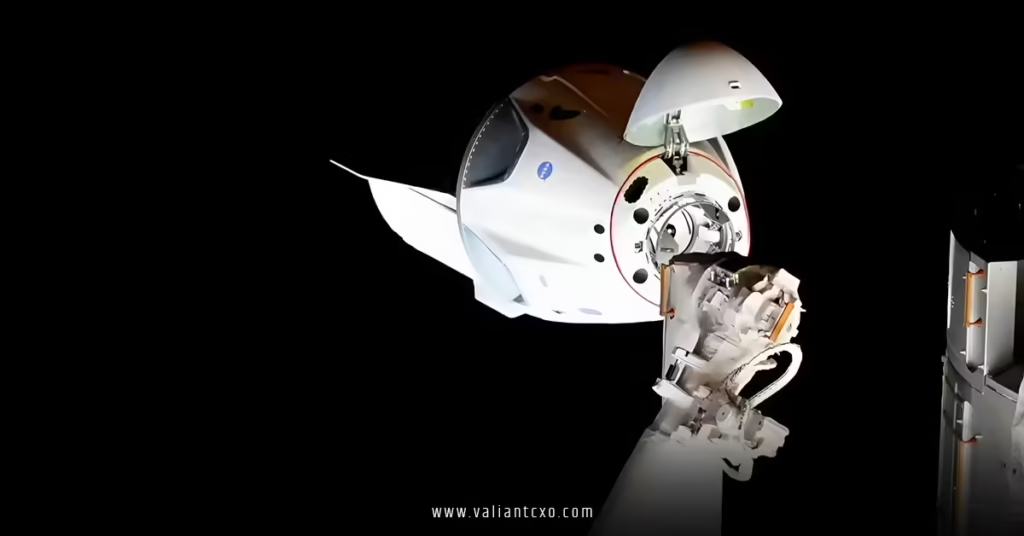
Before entry, the trunk (the unpressurized cylindrical section below the capsule) is jettisoned, exposing the heat shield. The nose cone closes and locks for protection.
Atmospheric Re-entry: Facing the Fire
Now comes the intense part—the heat of re-entry.
- Entry Interface — At about 400,000 feet, the capsule hits the atmosphere’s upper edge.
- Peak Heating — Friction generates temperatures up to 3,500°F (1,926°C) on the exterior—hotter than lava! The PICA-X heat shield absorbs and radiates this heat, keeping the interior cool.
- Plasma Sheath and Blackout — Superheated air forms a glowing plasma layer, causing a communications blackout lasting several minutes (often 4-6 minutes). Ground control loses contact—everything relies on onboard systems and the crew.
- G-Forces — Astronauts experience peak loads of 4-5 g’s (sometimes up to 5+ g’s), feeling five times their body weight pressing down. After months in zero-g, this feels intense!
The capsule uses its shape for lift, allowing controlled steering to manage heat and deceleration. It’s like skipping a stone across water—but vertically and at hypersonic speeds.
Here’s a dramatic view of what the re-entry glow looks like from the ground:
These striking images capture the fiery trail during Crew Dragon re-entry—pure engineering magic!
Descent and Parachute Deployment: Slowing to a Safe Splashdown
Once through the hottest phase, things calm down.
- Communication Restored — Blackout ends as plasma dissipates.
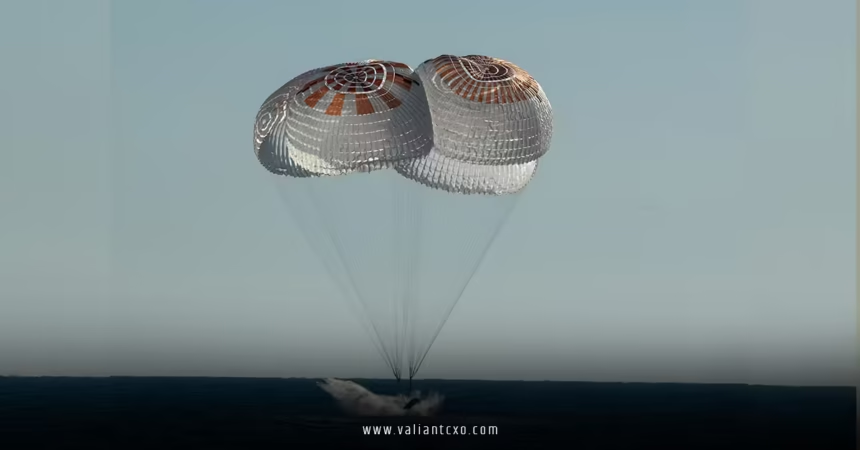
- Drogue Parachutes — Two small drogues deploy first to stabilize and slow the capsule.
- Main Parachutes — Four large mains then open, reducing speed to about 15-20 mph for splashdown.
The capsule hits the water gently—often with curious dolphins swimming nearby, as seen during the Crew-11 recovery.
Post-Splashdown Recovery: Back on Solid Ground
Recovery is swift and professional.
- Fast Boats Arrive — SpaceX teams secure the capsule and check for hazards.
- Hoisting Aboard — The Dragon is lifted onto the recovery ship (like the Shannon for Crew-11).
- Hatch Opening and Egress — A doctor checks the crew first. Astronauts exit (often assisted onto gurneys due to gravity readjustment) and receive initial medical evaluations.
- Hospital Transfer — The team flies to a nearby hospital for thorough checks before heading to Houston.
In the [NASA Crew-11 medical evacuation International Space Station January 2026], this process unfolded smoothly, with all four astronauts safe after their historic early return.
What Makes SpaceX Crew Dragon Re-entry Procedures Stand Out?
Compared to older capsules, Crew Dragon offers:
- Autonomous systems for reliability
- Advanced heat shield tech
- Precise ocean splashdown targeting
- Proven performance in both routine and emergency scenarios
The [NASA Crew-11 medical evacuation International Space Station January 2026] demonstrated how robust these procedures are—even when a medical issue forces an unplanned return.
Conclusion
SpaceX Crew Dragon re-entry procedures combine cutting-edge engineering, precise planning, and human courage to bring astronauts safely home from orbit. From the deorbit burn to that gentle ocean splashdown, every step is designed for safety and reliability—as proven during the [NASA Crew-11 medical evacuation International Space Station January 2026]. These missions remind us how far we’ve come in making space travel routine (and survivable). Next time you watch a live stream, remember: that glowing streak across the sky is humanity pushing boundaries—and coming back stronger.
For more on this topic, check these high-authority sources:
FAQ :
1. How long does a SpaceX Crew Dragon re-entry take from deorbit burn to splashdown?
Approximately 30–45 minutes total, with the most intense atmospheric phase lasting about 6–10 minutes.
2. What is the maximum heat during Crew Dragon re-entry?
The heat shield experiences temperatures up to ~3,500°F (1,926°C), but the cabin stays comfortable thanks to the advanced PICA-X material.
3. Why do astronauts experience high g-forces during Crew Dragon re-entry?
The heat shield experiences temperatures up to ~3,500°F (1,926°C), but the cabin stays comfortable thanks to the advanced PICA-X material.
4. Where did the Crew Dragon splash down during the NASA Crew-11 medical evacuation in January 2026?
Off the coast of San Diego, California, in the Pacific Ocean, early on January 15, 2026.
5. Can Crew Dragon target a specific landing spot during re-entry?
Yes — it uses lift generated by its shape and precise trajectory control to achieve accurate ocean splashdown within a few kilometers of the target zone.