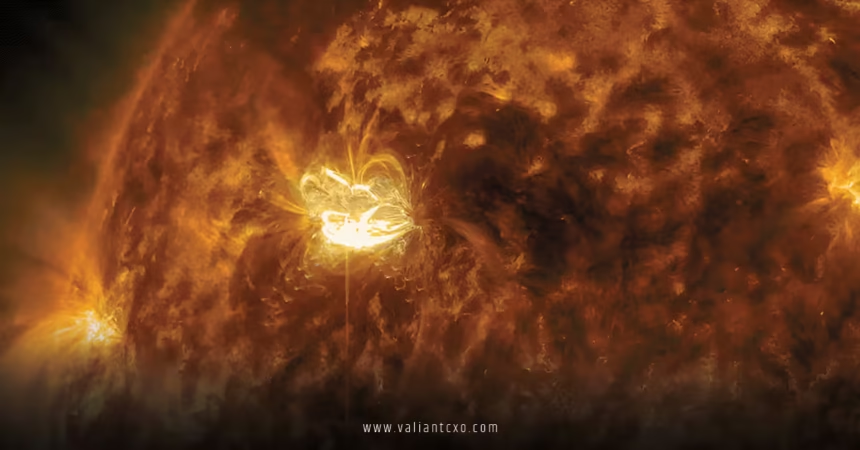
X4.2 solar flare from sunspot AR4366 effects grabbed headlines recently when the Sun unleashed a powerful burst on February 4, 2026. Have you ever wondered what happens when our star throws a tantrum like this? Picture the Sun as a giant, restless giant—sometimes it just erupts in ways that ripple all the way to Earth. This particular event from active region AR4366 wasn’t just another flare; it was a colossal X-class explosion that briefly disrupted radio signals and reminded us how connected we are to solar activity.
As someone who’s followed space weather for years, I find these moments thrilling yet humbling. The X4.2 solar flare from sunspot AR4366 effects highlight the raw power of our nearest star during the peak of Solar Cycle 25. Let’s dive deep into what this flare was, how it unfolded, and—most importantly—the real-world X4.2 solar flare from sunspot AR4366 effects we saw and might still feel.
Understanding Solar Flares: The Basics Before the Big One
Solar flares are sudden, intense flashes of radiation from the Sun’s surface, powered by twisted magnetic fields in sunspots. Think of them like magnetic snaps in a rubber band that’s been stretched too far. They come in classes: A, B, C, M, and X, with each step up being ten times stronger than the last.
X-class flares? Those are the heavy hitters—the ones that can rattle Earth’s atmosphere. An X4.2 means it’s four times more powerful than an X1 baseline. Now, imagine this energy blasting out from a massive sunspot group that’s grown rapidly and turned “Earth-facing.” That’s exactly what happened with AR4366.
Sunspots are cooler, darker patches where magnetic fields poke through the Sun’s surface like invisible threads. When those threads tangle and reconnect explosively, boom—flare time. AR4366 didn’t just pop up; it ballooned quickly, becoming one of the most complex and active regions we’ve seen lately.
The Monster Sunspot: Meet AR4366
AR4366 didn’t sneak up on us. It rotated into view around late January 2026 and quickly earned a reputation as a “solar flare factory.” This beast was huge—comparable to several Earths across—and packed a beta-gamma-delta magnetic configuration, the kind that screams instability.
Before the X4.2 event, AR4366 had already spit out multiple X-class flares, including stronger ones like X8-level outbursts earlier in the week. By early February, it was churning out dozens of M-class flares daily, building tension like a coiled spring.
What made AR4366 special? Its size and complexity. Sunspots this large and messy are rare, and when they’re Earth-directed, every eruption has potential to affect us directly. The X4.2 solar flare from sunspot AR4366 effects came at a peak moment, with the region squarely facing our planet.
Timeline of the X4.2 Solar Flare Event
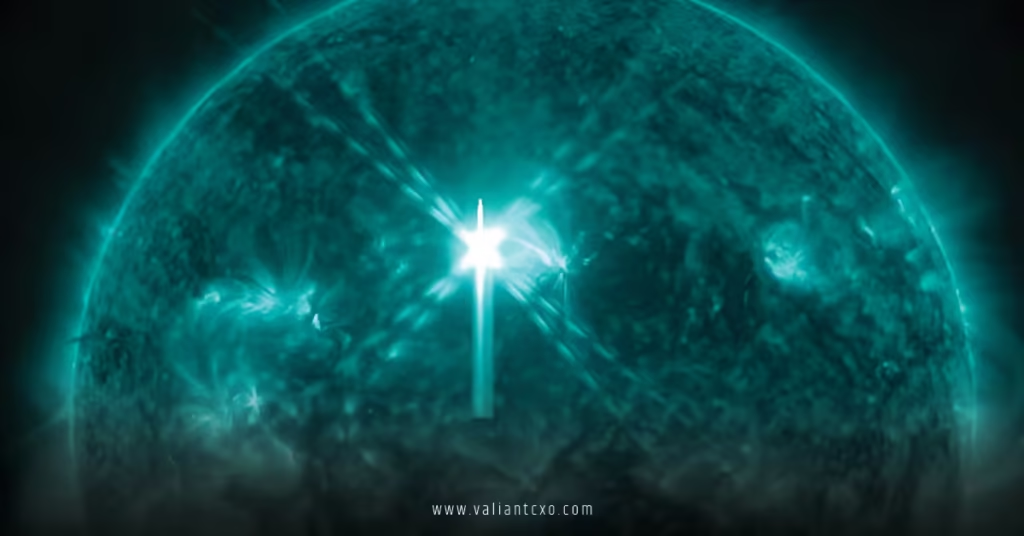
On February 4, 2026, at around 12:13 UTC (7:13 a.m. EST), AR4366 erupted with the X4.2 flare. It was impulsive—meaning it peaked fast and faded quickly—but intense enough to flood Earth’s upper atmosphere with X-rays and extreme ultraviolet radiation.
Satellites like NASA’s Solar Dynamics Observatory captured the drama in real time: a brilliant flash lighting up the Sun’s disk. No dramatic coronal mass ejection (CME) followed this particular blast, according to NOAA’s Space Weather Prediction Center. That was a relief—CMEs are the plasma clouds that can trigger geomagnetic storms when they hit Earth.
But the flare’s radiation hit hard and immediate.
Immediate X4.2 Solar Flare from Sunspot AR4366 Effects on Earth
The X4.2 solar flare from sunspot AR4366 effects showed up fastest in our ionosphere—the upper atmospheric layer that bounces radio waves.
This flare triggered strong radio blackouts, classified as R3-level on NOAA’s scale. High-frequency (HF) communications took a hit across sunlit regions, particularly western Africa and southern Europe. Pilots, ham radio operators, and maritime users reported sudden signal loss or static. It’s like the Sun temporarily jammed the airwaves.
Why does this happen? X-ray radiation ionizes the lower ionosphere (D-layer), absorbing rather than reflecting HF signals. During daylight hours on the flare-facing side of Earth, shortwave radio essentially goes dark for minutes to hours.
GPS and navigation systems? Minor glitches possible, but nothing catastrophic from this impulsive event. Power grids stayed stable—no widespread concerns there.
Potential Longer-Term and Secondary Effects
Even without a major CME tied to the X4.2, the X4.2 solar flare from sunspot AR4366 effects didn’t exist in isolation. AR4366 had launched earlier CMEs from its barrage of flares, some expected to deliver glancing blows around February 5-6.
Those could spark G1 or G2 geomagnetic storms—mild to moderate. What does that mean?
- Auroras: Enhanced chances for northern (and southern) lights at higher latitudes. Some forecasts suggested visibility in northern U.S. states or southern Europe if conditions aligned.
- Satellite Operations: Increased drag on low-Earth orbit satellites, potential orientation issues.
- Astronaut Safety: No major radiation risks for ISS crew, but heightened monitoring.
The cumulative activity from AR4366 ramped up overall space weather noise. Shortwave conditions stayed jumpy for days.
Why This Matters: Broader Implications of Strong Solar Activity
We’re in solar maximum—the peak of the roughly 11-year cycle—where flares and CMEs become more frequent. Events like the X4.2 solar flare from sunspot AR4366 effects remind us our tech-dependent world is vulnerable.
Modern society relies on satellites for everything from weather forecasts to global banking. A direct hit from a Carrington-level event (1859) could cause trillions in damage. While AR4366’s outbursts weren’t that extreme, they underscore the need for monitoring and preparedness.
Space agencies like NOAA, NASA, and ESA track these in real time. Tools like GOES satellites provide early warnings, giving us minutes to hours to mitigate.
How Scientists Monitor and Predict Such Events
Solar physicists use magnetograms, EUV images, and X-ray detectors to spot trouble brewing. AR4366’s delta spots—where opposite magnetic polarities crunch together—were red flags.
Forecasts improve yearly, but the Sun still surprises. That’s why alerts go out quickly, and why sites like SpaceWeather.com or SWPC keep us updated.
Staying Safe and Informed About Solar Events
Curious about protecting yourself? Everyday folks don’t need bunkers, but:
- Use apps for space weather alerts.
- Have backup communication if you’re in remote areas relying on HF radio.
- Enjoy auroras safely—head to dark skies during storms.
The X4.2 solar flare from sunspot AR4366 effects was a wake-up call, but also a spectacle. The Sun keeps us on our toes.
Conclusion: The Sun’s Power and Our Place in It
In wrapping up, the X4.2 solar flare from sunspot AR4366 effects delivered immediate radio disruptions, potential auroral displays from related activity, and a stark reminder of solar influence on modern life. AR4366’s frenzy—multiple X-flares, massive size, Earth-directed position—made this a standout event in 2026’s solar maximum. While no apocalypse ensued, it highlighted vulnerabilities and the beauty of space weather.
Next time you see a headline about the Sun acting up, remember: it’s not just science—it’s our star shaping the world around us. Stay curious, stay informed, and keep looking up. Who knows what the Sun has in store next?
For more details, check these high-authority sources:
- NOAA Space Weather Prediction Center – Official updates on solar activity.
- NASA Solar Dynamics Observatory – Real-time Sun imagery.
- SpaceWeather.com – Daily solar flare reports and aurora forecasts.
FAQs
What exactly caused the X4.2 solar flare from sunspot AR4366 effects?
The flare stemmed from magnetic reconnection in the complex beta-gamma-delta field of AR4366, a rapidly growing sunspot region that became highly unstable in early February 2026.
How long did the radio blackouts from the X4.2 solar flare from sunspot AR4366 effects last?
Blackouts were brief but strong, typically lasting minutes to an hour in affected daylight regions like parts of Africa and Europe, due to ionospheric absorption of HF signals.
Did the X4.2 solar flare from sunspot AR4366 effects cause auroras?
The flare itself didn’t launch a major CME, but prior eruptions from AR4366 raised chances for minor geomagnetic activity and auroras at high latitudes around February 5-6.
Is the X4.2 solar flare from sunspot AR4366 effects dangerous for everyday people?
Not directly—no health risks on the ground. Impacts were mostly on radio comms and space assets, with no widespread power or GPS failures reported.
Could more flares like the X4.2 solar flare from sunspot AR4366 effects happen soon?
AR4366 remained active and Earth-facing for days after, so additional X-class activity was possible before it rotated away.