Have you ever wondered what giants hide in the ocean’s midnight zone, drifting silently where no sunlight dares to go? Meet Stygiomedusa gigantea, the scientific name for the creature commonly called the giant phantom jellyfish. This deep-sea marvel has captured imaginations worldwide, especially after the giant phantom jellyfish spotted off Argentina coast 2026 made global headlines. That rare sighting reminded everyone just how mysterious and impressive these animals truly are.
In this article, we’ll dive into the most fascinating Stygiomedusa gigantea facts, from its mind-blowing size to its ghostly lifestyle. Whether you’re a marine biology enthusiast or just curious about ocean oddities, prepare to be amazed by one of the sea’s most elusive predators.
What Is Stygiomedusa Gigantea?
Stygiomedusa gigantea is the only known species in its genus, making it a truly unique member of the jellyfish family (Ulmaridae). First collected in 1899, scientists didn’t formally describe and name it until the 1960s—proving how rarely humans encounter it.
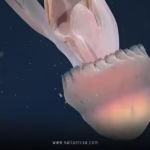
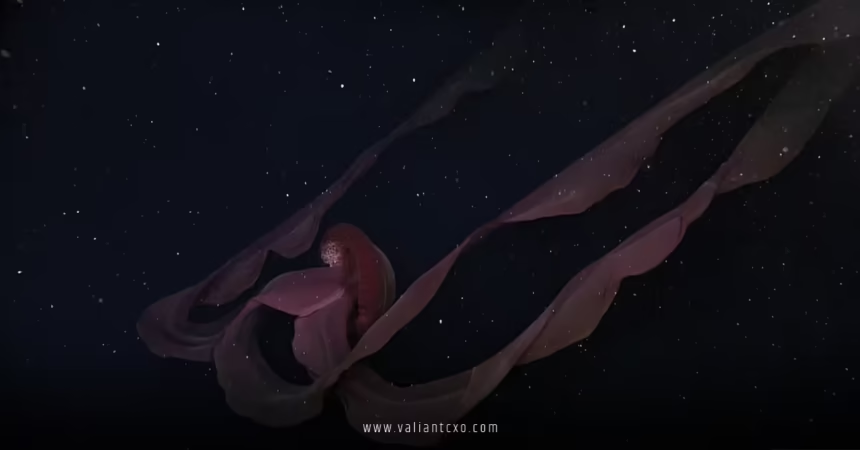
This jelly belongs to the scyphozoan class but stands apart from typical jellyfish. No stinging tentacles here. Instead, it relies on four massive, ribbon-like oral arms to capture food. Its translucent, almost ghostly appearance in the deep ocean gives it the “phantom” nickname—perfect for a creature that seems to appear and vanish like a specter.
The giant phantom jellyfish spotted off Argentina coast 2026 highlighted this species’ widespread but hidden presence. Filmed at around 250 meters during a Schmidt Ocean Institute expedition, the video showed its ethereal pulsing motion, captivating viewers and reminding scientists of the deep sea’s untapped secrets.
Mind-Blowing Size and Appearance Facts
Let’s talk dimensions because the size of Stygiomedusa gigantea is what stops people in their tracks.
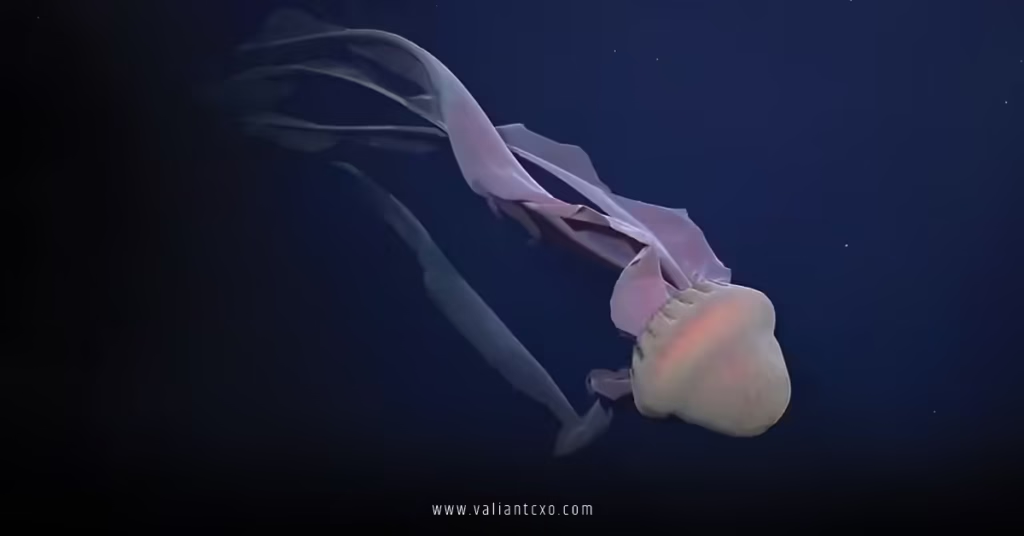
- Bell diameter: Up to 1 meter (over 3.3 feet) across—roughly the width of a large beach umbrella.
- Oral arms length: Each of the four arms can stretch more than 10 meters (33 feet), giving the whole animal a total length comparable to a school bus.
- Color and texture: In artificial ROV lights, it often appears reddish-orange or crimson. In its natural dark habitat, the translucent body makes it nearly invisible, blending seamlessly into the black water.
The bell is soft and pliable, capable of expanding 4–5 times its normal size—likely to engulf prey more effectively. Those paddle- or kite-shaped arms flare out in a V-formation, wide at the base and tapering to delicate tips. They flutter gently as the jelly drifts, looking more like flowing curtains than predatory tools.
Imagine drifting through total darkness and suddenly seeing this massive, billowing form emerge—like a living ghost ship sailing the abyss. That’s the experience researchers get during rare encounters like the giant phantom jellyfish spotted off Argentina coast 2026.
Habitat and Depth Range
Where does such a giant choose to live? Almost everywhere humans can’t easily reach.
Stygiomedusa gigantea inhabits the mesopelagic (twilight) and bathypelagic (midnight) zones, typically between 200–6,700 meters deep. That’s from the dimly lit twilight layer down to crushing-pressure abyssal depths.
Sightings span nearly all major ocean basins—Pacific, Atlantic, Indian, Southern—with one glaring exception: the Arctic Ocean. At higher latitudes or in upwelling areas, individuals occasionally venture shallower, sometimes as high as 200–300 meters.
The 2026 Argentina sighting occurred at about 250 meters in the South Atlantic, expanding known southern range limits and showing this species patrols farther than previously mapped.
Pressure at these depths reaches insane levels—up to 40,000 kPa (about 5,800 psi)—yet the spongy, jelly-like body withstands it effortlessly. No wonder we see so few: exploring these zones requires expensive ROVs or submersibles.
Diet and Feeding Strategy
Forget venomous stings—this predator uses brute elegance.
Stygiomedusa gigantea captures plankton, small fish, and other drifting organisms with its long oral arms. The arms sweep through the water column like slow-motion nets, trapping prey and transferring it toward the bell’s mouth opening.
No nematocysts (stinging cells) on the arms, unlike most jellies. Instead, the sheer size and surface area do the work. Some observations suggest the bell engulfs food directly when expanded.
Interestingly, juvenile fish sometimes hitch rides around the bell, gaining protection without becoming meals— a classic commensal relationship seen in deep-sea footage.
As one of the largest invertebrate predators in the deep sea, Stygiomedusa gigantea plays a key role in nutrient cycling, helping transfer energy through the food web in an otherwise sparse environment.
Reproduction and Life Cycle Mysteries
Here’s where things get really intriguing: Stygiomedusa gigantea is viviparous—the only known scyphozoan jellyfish that gives birth to live young.
Most jellyfish alternate between polyp and medusa stages, releasing eggs and sperm externally. Not this giant. Females retain developing young inside the bell until they’re ready as miniature medusae, then “give birth” to live offspring.
This adaptation likely boosts survival in the harsh deep sea, where finding mates or suitable conditions for larvae is tough. Scientists still know little about mating, gestation, or growth rates—each sighting adds precious clues.
Why So Rare? Only ~120 Sightings in Over a Century
Despite its size, Stygiomedusa gigantea remains extraordinarily rare in human records.
- Fewer than 120 confirmed sightings since 1899.
- Many come from accidental trawl nets or brief ROV glimpses.
- MBARI (Monterey Bay Aquarium Research Institute) has seen it only about nine times in thousands of dives.
Its deep habitat, vast range, and passive drifting lifestyle make encounters unlikely. But when they happen—like the giant phantom jellyfish spotted off Argentina coast 2026—they generate excitement and valuable data.
Ecological Importance and Conservation Insights
In the midnight zone, Stygiomedusa gigantea acts as both predator and habitat provider. Small fish use its bell for shelter, while it controls plankton and small-fish populations.
As deep-sea mining, climate change, and pollution threaten these ecosystems, understanding species like this becomes crucial. Rare sightings help map biodiversity and highlight the need for protected areas.
The Argentina expedition that filmed the giant phantom jellyfish spotted off Argentina coast 2026 also uncovered potential new species and vast coral reefs—showing how much remains undiscovered.
Conclusion: Why Stygiomedusa Gigantea Captivates Us
From its school-bus-sized silhouette to its live-birth reproduction and ghostly deep-sea lifestyle, Stygiomedusa gigantea embodies ocean mystery. Events like the giant phantom jellyfish spotted off Argentina coast 2026 prove these giants still surprise us, even in 2026.
Next time you look at the sea, remember: beneath the waves drifts a phantom predator larger than most people realize, pulsing quietly in eternal darkness. The deep ocean holds wonders we’ve barely begun to understand—let’s keep exploring, because who knows what other secrets Stygiomedusa gigantea and its kin still hide?
Curious for more? Check these high-authority sources:
FAQs About Stygiomedusa Gigantea Facts
1. How big does Stygiomedusa gigantea really get?
The bell reaches up to 1 meter across, while the four oral arms extend over 10 meters—making the total length school-bus-sized, as seen in sightings like the giant phantom jellyfish spotted off Argentina coast 2026.
2. Where does Stygiomedusa gigantea live?
Primarily in the deep twilight and midnight zones (200–6,700 meters) across most oceans except the Arctic. Shallower appearances occur in places like the recent giant phantom jellyfish spotted off Argentina coast 2026 at 250 meters.
3. What does Stygiomedusa gigantea eat?
It captures plankton and small fish using its long arms to sweep and engulf prey—no stinging tentacles required.
4. Why is Stygiomedusa gigantea so rarely seen?
With only about 120 sightings in over 120 years, its extreme depth, passive drifting, and near-invisible body in darkness keep it hidden from human observation.
5. Is Stygiomedusa gigantea dangerous to humans?
No—it’s harmless to people. It lacks stinging cells and lives far too deep for any interaction outside scientific expeditions.