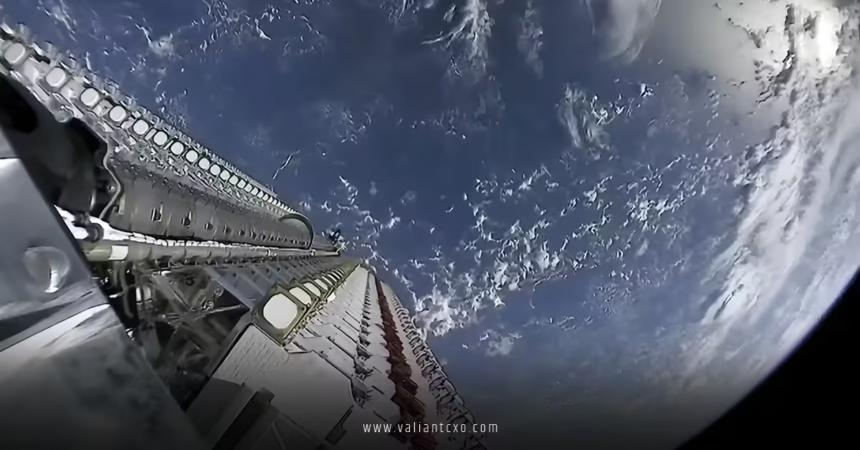
Starlink v2 Mini satellites features are what make the constellation hum with faster, more reliable global internet. These compact powerhouses represent a huge leap from earlier versions, packing advanced tech into a Falcon 9-friendly design. Launched in batches like the recent SpaceX Starlink 17-24 mission live launch Vandenberg March 2026, which deployed 25 of them from California and helped push the total past the 10,000-satellite milestone, these satellites are quietly revolutionizing connectivity.
Ever wondered why your Starlink speeds feel snappier in 2026? It boils down to clever engineering upgrades. Let’s break down the Starlink v2 Mini satellites features that set them apart.
Why Starlink v2 Mini Satellites Features Matter So Much
SpaceX didn’t just make the satellites a bit bigger—they engineered them for massive performance gains while keeping them launchable on existing Falcon 9 rockets. The full Gen2 vision required Starship, but the v2 Mini version bridges the gap brilliantly. Think of it as a “mini” upgrade that delivers “maxi” results.
These satellites weigh around 740–800 kg at launch, roughly 2.5–3 times heavier than the original v1 models. But size isn’t the story—capability is. Each v2 Mini brings about four times the communications capacity compared to v1.5 predecessors, with reports of up to 96 Gbps per satellite in total bandwidth. That’s a game-changer for handling more users, higher speeds, and lower latency.
In real-world terms? Streaming 4K without buffering on a cruise ship, video calls from remote farms, or emergency internet after a natural disaster—all smoother thanks to these upgrades.
Key Physical and Design Features of Starlink v2 Mini Satellites
The Starlink v2 Mini satellites features start with their impressive solar arrays. Each has two massive panels, spanning about 52.5 square meters each, giving a total wingspan around 30 meters (nearly 100 feet). That’s a huge jump in power generation—essential for running power-hungry payloads.
These arrays are aero-neutral, meaning they minimize drag in orbit, helping satellites maintain altitude longer without constant thrusting. Plus, SpaceX designed them to off-point slightly near the terminator (day-night line) to cut down on brightness, addressing astronomer concerns about light pollution.
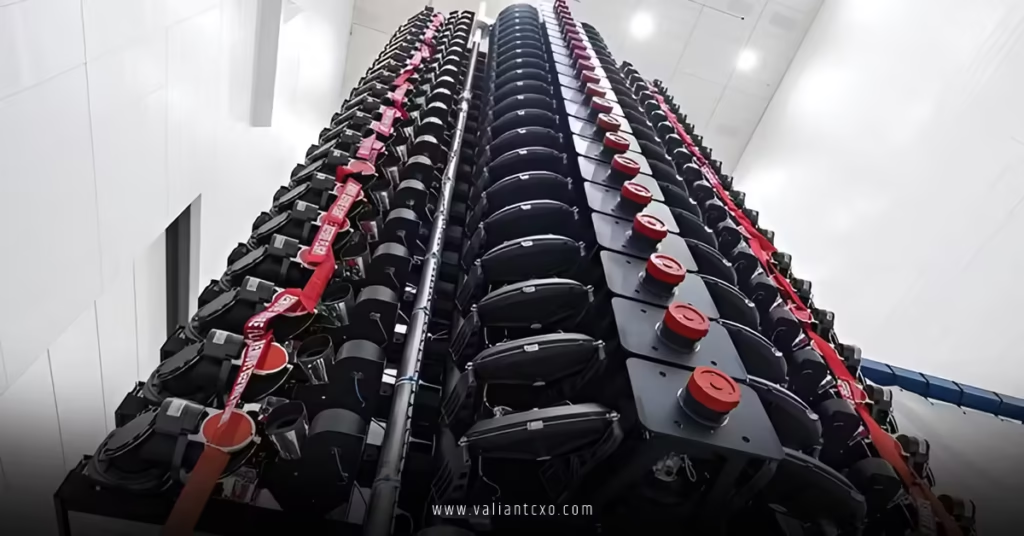
The body itself measures roughly 4.1 meters wide, making them stackable efficiently in the Falcon 9 fairing. During missions like the SpaceX Starlink 17-24 mission live launch Vandenberg March 2026, you see dozens packed tightly before they spring free one by one.
Advanced Propulsion: The Argon Hall Thrusters Upgrade
One of the standout Starlink v2 Mini satellites features is the shift to argon-fueled Hall-effect thrusters. Argon is cheaper and more abundant than the krypton used earlier, while delivering better performance: about 2.4 times more thrust and 1.5 times higher impulse.
What does that mean practically? Faster orbit raising after deployment, precise station-keeping to avoid collisions, and efficient de-orbiting at end-of-life to reduce space debris. It’s like giving each satellite its own efficient mini rocket engine—reliable, powerful, and eco-friendlier for orbit management.
Phased-Array Antennas and E-Band Capabilities
Communication is king in Starlink, and the v2 Minis shine here. They sport larger, more advanced phased-array antennas for both user links (to your dish) and backhaul (to ground stations or other satellites).
The big win? Using E-band frequencies for backhaul, which allows nearly quadruple the data capacity per satellite compared to older models. Combined with bigger antennas and higher power from those solar wings, each v2 Mini handles way more traffic.
Users report noticeable improvements: higher peak speeds, better performance in congested areas, and lower latency thanks to smarter beamforming. It’s like upgrading from a narrow dirt road to a multi-lane highway in space.
Inter-Satellite Laser Links: The Backbone of Global Coverage
Perhaps the coolest Starlink v2 Mini satellites features are the built-in optical inter-satellite links—those mini lasers zapping data between satellites at up to 25 Gbps in low-Earth orbit (and higher in ideal conditions).
No more relying solely on ground stations. Data hops from satellite to satellite around the planet, bypassing oceans, mountains, or geopolitical barriers. This creates a true “space internet” mesh network.
During polar launches from Vandenberg—like the SpaceX Starlink 17-24 mission live launch Vandenberg March 2026—these lasers help ensure seamless coverage over remote northern or southern regions where ground stations are sparse.
Capacity and Performance Boost in Numbers
Let’s put some numbers on it:
- Per-satellite bandwidth: Around 96 Gbps (up from ~24 Gbps in v1.5)
- Network impact: A single launch of 25 v2 Minis adds roughly 2.4–2.7 Tbps of total capacity
- User benefits: Higher downlink/uplink speeds, more simultaneous connections, reduced congestion
As the constellation grows—with thousands of v2 Minis now orbiting—the overall experience improves for everyone. It’s cumulative: more satellites + better satellites = dramatically better service.
How v2 Mini Fits into Starlink’s Future Roadmap
The v2 Mini isn’t the endgame—it’s a stepping stone. Full Gen2 satellites (the really big ones) await Starship for deployment, promising even wilder specs like 1 Tbps downlink per satellite in later versions. But right now, v2 Minis deliver the bulk of upgrades.
They also pave the way for direct-to-cell service expansions, where satellites act like cell towers in space for unmodified phones. While not every v2 Mini has full D2C hardware yet, the architecture supports future retrofits or specialized variants.
Environmental and Astronomical Considerations
SpaceX has listened to feedback. The Starlink v2 Mini satellites features include mitigations like darker coatings, visor-like shades (in some iterations), and array off-pointing to reduce visibility. They’re not invisible, but brightness is managed better than early models.
End-of-life de-orbiting via those powerful thrusters ensures they burn up quickly, keeping orbits clean.
Conclusion: Why Starlink v2 Mini Satellites Features Are a Big Deal
The Starlink v2 Mini satellites features—from beefy solar arrays and argon thrusters to laser links and massive bandwidth—turn good satellite internet into truly global, high-performance broadband. Missions like the SpaceX Starlink 17-24 mission live launch Vandenberg March 2026 keep feeding this beast, adding capacity that reaches the most disconnected corners of Earth.
Whether you’re in a rural village in Maharashtra or streaming on a yacht, these little orbiting wonders make it possible. As SpaceX keeps launching them, expect even faster speeds, lower prices, and broader coverage. The future of internet isn’t buried in cables—it’s beaming down from space, one v2 Mini at a time.
FAQs
1. What are the main Starlink v2 Mini satellites features that improve internet speed?
The Starlink v2 Mini satellites features that drive faster speeds include much larger phased-array antennas, E-band backhaul frequencies, and roughly 96 Gbps of total communications capacity per satellite — about 4× more than the older v1.5 models.
2. How do the laser links work in Starlink v2 Mini satellites features?
The inter-satellite laser links (also called optical interlinks) are one of the most important Starlink v2 Mini satellites features. Each satellite has built-in lasers that transmit data at up to 25 Gbps to neighboring satellites. This creates a mesh network in space, allowing data to hop between satellites instead of always traveling down to a ground station.
3. Why are Starlink v2 Mini satellites so much bigger than earlier versions?
The Starlink v2 Mini satellites features include significantly larger solar arrays (totaling ~105 m² of surface area) and a heavier design (~740–800 kg at launch). SpaceX made them bigger on purpose to generate more electrical power, support larger antennas, and carry more advanced payloads — all while still fitting dozens inside a standard Falcon 9 fairing.
4. Do Starlink v2 Mini satellites features help reduce light pollution for astronomers?
Yes — SpaceX incorporated several brightness mitigation measures into the Starlink v2 Mini satellites features. The solar arrays are designed to be “aero-neutral” and can be tilted (off-pointed) slightly when crossing the day-night terminator to reflect less sunlight toward Earth.
5. How do argon thrusters improve the Starlink v2 Mini satellites features?
One of the standout Starlink v2 Mini satellites features is the switch to argon-fueled Hall-effect thrusters. Argon provides about 2.4× more thrust and 1.5× higher specific impulse than the earlier krypton system.