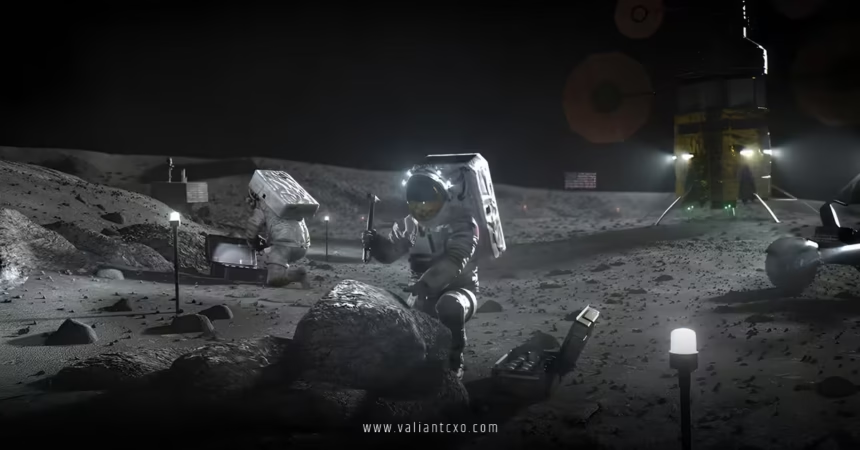
NASA Artemis III Moon landing mission 2027 represents humanity’s most ambitious space endeavor since Apollo 17, promising to land the first woman and next man on the lunar surface after more than five decades. This groundbreaking mission builds directly on the success of the NASA Artemis II Launch Live Stream April 1 2026, transforming orbital reconnaissance into boots-on-ground lunar exploration.
What Makes Artemis III a Game-Changer
- First lunar landing since 1972: Breaking a 55-year human presence gap
- Gender milestone: First woman to walk on the Moon’s surface
- Advanced technology: Next-generation spacesuits and landing systems
- Strategic location: South Pole region with water ice deposits
- Extended duration: Week-long surface operations vs. Apollo’s 3-day maximum
Unlike the Apollo program’s limited exploration scope, Artemis III establishes the foundation for permanent lunar habitation. The mission targets the Moon’s South Pole, where perpetual sunlight and accessible water ice create ideal conditions for sustainable operations.
Mission Timeline and Critical Phases
Pre-Landing Operations (Days 1-4)
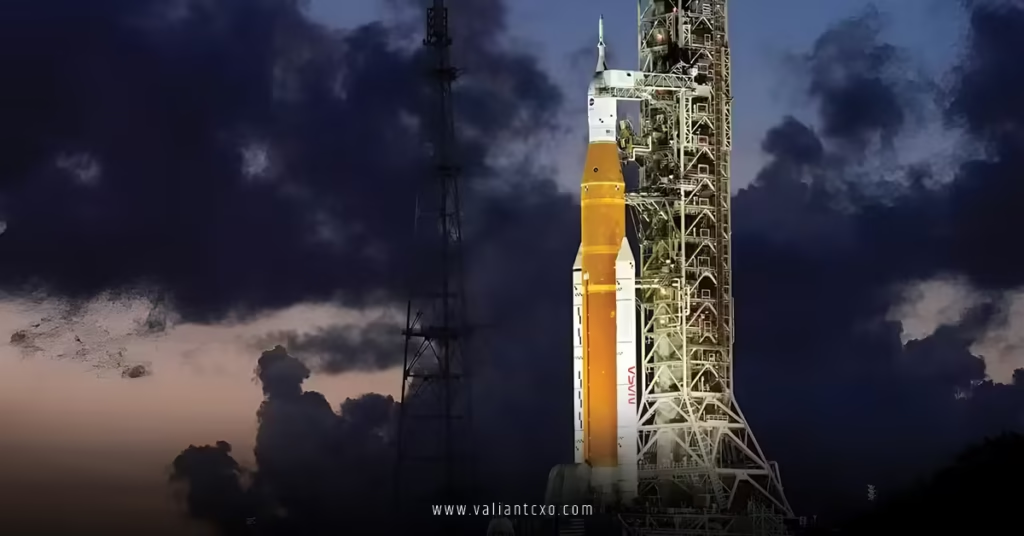
The Artemis III crew follows a similar trajectory to their Artemis II predecessors, departing Earth aboard the powerful SLS rocket system. However, this mission includes a crucial rendezvous with the Lunar Gateway station—humanity’s first permanent Moon-orbiting outpost.
Key Milestones:
- Earth departure and trans-lunar injection
- Gateway station docking and crew transfer
- Human Landing System (HLS) preparation
- Final descent preparations and system checks
Historic Lunar Landing (Day 5)
The actual landing sequence represents the mission’s most technically challenging phase. Two crew members transfer to SpaceX’s Starship HLS while two others remain aboard the Gateway station for orbital support operations.
Landing Site: Shackleton Crater Region
This location offers several strategic advantages that Apollo landing sites couldn’t provide:
| Feature | Benefit | Impact on Mission |
|---|---|---|
| Perpetual sunlight zones | Continuous solar power | Extended surface operations |
| Water ice deposits | In-situ resource utilization | Reduced supply requirements |
| Elevated terrain | Enhanced communication | Better Earth contact |
| Scientific diversity | Multiple research opportunities | Maximum scientific return |
Surface Operations (Days 6-12)
Seven full days on the lunar surface dwarf Apollo’s brief visits. The crew conducts extensive scientific research, technology demonstrations, and infrastructure preparation for future missions.
Daily Activity Breakdown:
- EVA 1-2: Landing site survey and initial equipment deployment
- EVA 3-4: Water ice extraction and sample collection
- EVA 5-6: Habitat site preparation and communication setup
- EVA 7-8: Advanced scientific experiments and exploration
Revolutionary Technology Enabling Success
xEMU Spacesuits: A Generational Leap
The Exploration Extravehicular Mobility Units represent a complete redesign of astronaut life support systems. These suits provide unprecedented mobility, allowing crew members to kneel, bend, and rotate with nearly Earth-like freedom.
Key Improvements Over Apollo Suits:
- 8-hour operational duration vs. Apollo’s 4-hour limit
- Enhanced communication systems with real-time video
- Improved thermal regulation for extreme temperature swings
- Modular design enabling rapid repairs and upgrades
Starship HLS: The Ultimate Landing Vehicle
SpaceX’s Human Landing System transforms lunar access through its massive payload capacity and reusable design philosophy. Standing nearly 50 meters tall, this vehicle carries more equipment and supplies than entire Apollo missions combined.
The system’s elevator mechanism eliminates the dangerous ladder climbing that characterized Apollo landings. Crew members travel between the lunar surface and their spacecraft in pressurized comfort, reducing fatigue and injury risks.
Scientific Objectives and Research Priorities
Water Ice Characterization
Understanding lunar water distribution drives much of Artemis III’s scientific agenda. The crew deploys specialized drilling equipment to extract ice samples from permanently shadowed craters—areas that haven’t seen sunlight for billions of years.
This research directly supports future mission planning. Confirming water availability and accessibility determines whether sustained lunar presence becomes economically viable.
Geological Survey and Sample Return
The South Pole region offers unique geological formations absent from Apollo landing sites. Ancient impact materials and volcanic deposits provide insights into both lunar and early Earth history.
Sample Collection Priorities:
- Water ice from multiple depth levels
- Regolith samples across diverse terrain types
- Rock specimens from crater walls and central peaks
- Atmospheric measurements and particle collection
Technology Demonstrations
Artemis III serves as a proving ground for technologies essential to Mars exploration. Resource extraction equipment, advanced life support systems, and long-duration habitat modules receive their first real-world testing on another celestial body.
Crew Selection and Training Requirements
The Artemis Generation
NASA’s astronaut selection for Artemis III emphasizes diverse backgrounds and specialized skills that Apollo-era training never required. Modern crew members combine traditional pilot qualifications with advanced degrees in geology, engineering, and life sciences.
Training Duration: 18-24 months of intensive preparation
Specialized Skills Required:
- Geological field work: Identifying valuable samples under pressure
- Equipment maintenance: Repairing complex systems in hostile environments
- Scientific protocols: Conducting meaningful research within time constraints
- Emergency procedures: Managing life-threatening situations independently
International Collaboration
Unlike Apollo’s purely American crew complement, Artemis III includes international astronauts from ESA, CSA, and JAXA. This partnership model distributes costs while building diplomatic relationships essential for future Mars missions.
Challenges and Risk Mitigation
Environmental Hazards
The lunar environment presents dangers that short Apollo visits barely encountered. Extended surface operations expose crew members to radiation, micrometeorite impacts, and extreme temperature fluctuations that require constant vigilance.
Primary Risk Factors:
- Radiation exposure: Limited atmospheric protection from cosmic rays
- Dust contamination: Abrasive particles affecting equipment and health
- Communication delays: 2.6-second lag complicates emergency coordination
- Equipment failures: Limited repair capabilities far from Earth
Technical System Redundancy
Every critical system includes multiple backup options. Life support, communication, and propulsion systems feature independent backups that can sustain crew survival even if primary systems fail completely.
The mission architecture includes multiple abort scenarios that can return the crew safely to Earth at any point during lunar operations. These contingencies learned from both Apollo successes and near-disasters that could have ended those missions tragically.
Economic and Strategic Implications
Commercial Partnerships
Artemis III demonstrates a fundamentally different economic model than government-only Apollo missions. Private companies including SpaceX, Blue Origin, and others contribute essential technologies while sharing development costs.
This partnership approach reduces NASA’s financial burden while accelerating innovation through competitive market forces. Companies invest their own resources in technologies with both government and commercial applications.
International Competition and Cooperation
China’s lunar ambitions create both competitive pressure and cooperation opportunities. While nations compete for lunar resource access and strategic positioning, the technical challenges require international collaboration for sustainable success.
The NASA initiatives following the successful Artemis II mission establish diplomatic frameworks that could prevent lunar resource conflicts while encouraging peaceful exploration.
Preparing for Mars: The Ultimate Goal
Technology Transfer
Every Artemis III system undergoes evaluation for Mars mission applications. Life support duration, habitat design, and resource extraction capabilities receive real-world testing that computer simulations cannot replicate.
The lunar environment serves as a halfway point between Earth and Mars—challenging enough to test systems thoroughly but close enough to enable rescue missions if emergencies occur.
Operational Experience
Managing multi-week missions on another world builds institutional knowledge essential for Mars exploration. Crew psychology, equipment maintenance, and emergency procedures require actual experience that training simulations cannot fully provide.
Common Mission Misconceptions
“It’s Just a Repeat of Apollo”
This misunderstanding ignores the dramatic technological and scientific advances that separate Artemis from its predecessor program. While Apollo proved lunar landing was possible, Artemis establishes permanent human presence.
Fix: Artemis missions last weeks instead of days, target scientifically valuable locations, and build infrastructure for sustained operations.
“Private Companies Are Taking Over”
Commercial partnerships supplement rather than replace NASA’s leadership role. Government agencies set safety standards, mission objectives, and operational procedures while companies provide transportation and equipment services.
Fix: Think of it as hiring contractors for specialized services rather than outsourcing core mission responsibility.
“It’s Too Expensive to Justify”
Artemis program costs spread across multiple years and generate significant economic returns through technology development, job creation, and international partnerships.
Fix: Consider the investment’s long-term benefits including Mars mission preparation, resource extraction capabilities, and technological innovation that benefits Earth-based industries.
Step-by-Step Mission Tracking Guide
Pre-Launch Preparation (Months Before)
- Follow crew training updates through NASA social media
- Learn about landing site selection and scientific objectives
- Understand mission timeline and critical decision points
- Join space enthusiast communities for shared experiences
Launch and Transit Phase (Days 1-4)
- Watch launch coverage and early mission milestones
- Track spacecraft progress toward Gateway station
- Follow crew activities during transit period
- Monitor weather and technical status updates
Lunar Operations (Days 5-12)
- Watch historic landing sequence coverage
- Follow daily EVA activities and scientific discoveries
- Track sample collection and experiment progress
- Monitor crew health and mission status updates
Return Journey and Splashdown (Days 13-16)
- Follow lunar departure and trans-Earth injection
- Track return journey and crew preparations
- Watch splashdown coverage and crew recovery
- Learn about initial sample analysis results
Future Mission Implications
Artemis IV and Beyond
Success of Artemis III enables increasingly ambitious missions including permanent lunar base establishment, resource extraction operations, and Mars mission preparation facilities.
Each subsequent mission builds upon previous accomplishments, gradually transforming the Moon from a destination into a stepping stone for deeper space exploration.
Commercial Lunar Economy
Artemis III demonstrates technologies that enable commercial lunar operations including tourism, resource extraction, and manufacturing. Private companies can leverage government-developed infrastructure for profitable ventures.
This economic model sustains long-term lunar presence without requiring permanent government funding for operations and maintenance.
Key Takeaways for Historic Mission
- Historic significance: First lunar landing in 55+ years with enhanced capabilities
- Extended operations: Week-long surface missions vs. Apollo’s brief visits
- Strategic location: South Pole targeting enables water ice utilization
- Technology advancement: Revolutionary spacesuits and landing systems
- International cooperation: Multi-national crew and shared mission responsibilities
- Scientific priorities: Water characterization and geological survey emphasis
- Mars preparation: Real-world testing of deep space mission technologies
- Sustainable approach: Infrastructure development for permanent lunar presence
Media Coverage and Public Engagement
Live Streaming Options
NASA provides comprehensive coverage through multiple platforms, ensuring global audiences can witness this historic achievement. Unlike Apollo-era limited television coverage, modern streaming technology enables real-time participation in lunar exploration.
Coverage Features:
- Multiple camera angles including helmet-mounted views
- Real-time telemetry and mission status updates
- Expert commentary explaining technical procedures
- Social media integration for public participation
Educational Opportunities
Schools and universities worldwide incorporate Artemis III into STEM curricula, inspiring the next generation of scientists, engineers, and explorers. The mission provides real-world examples of physics, chemistry, geology, and engineering principles.
Interactive online resources allow students to follow mission progress, understand scientific objectives, and participate in simulated mission operations that mirror actual crew activities.
The NASA Artemis III Moon landing mission 2027 transforms science fiction dreams into reality while establishing humanity’s permanent foothold beyond Earth. This mission opens pathways to Mars exploration while demonstrating that international cooperation can achieve extraordinary goals.
The journey begins with successful completion of Artemis II orbital reconnaissance, building toward the ultimate prize of sustainable lunar exploration that benefits all humanity.
Frequently Asked Questions
Q: How does Artemis III differ from the Apollo Moon landings?
A: Artemis III features week-long surface stays vs. Apollo’s 3-day maximum, targets the resource-rich South Pole region, includes the first woman on the Moon, and builds permanent infrastructure for sustained operations.
Q: Why target the lunar South Pole instead of Apollo’s equatorial sites?
A: The South Pole offers continuous sunlight for solar power, accessible water ice deposits for life support and fuel, and elevated terrain providing better Earth communication than Apollo sites.
Q: What happens if the Artemis III landing fails or encounters emergencies?
A: Multiple abort scenarios enable crew return to Gateway station and eventual Earth return. Redundant life support systems and emergency supplies provide safety margins that Apollo missions couldn’t achieve.
Q: Will Artemis III use the same rockets that launched Artemis II in 2026?
A: Yes, the SLS rocket system provides launch capabilities for both missions, though Artemis III includes additional components like the Human Landing System that Artemis II didn’t require.
Q: How can the public follow Artemis III progress and participate in the mission?
A: NASA provides free live streaming through multiple platforms, social media updates, educational resources, and interactive tools that let global audiences participate in this historic achievement.