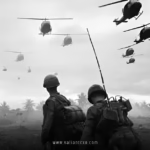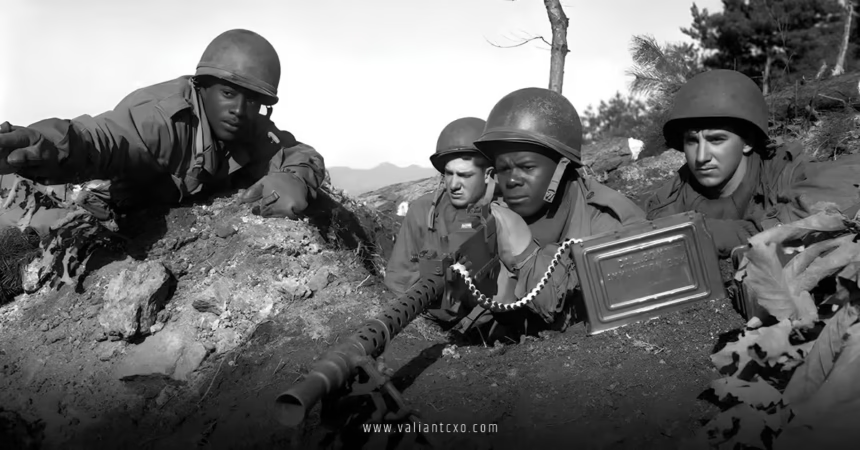
Korean War military terminology established the linguistic blueprint that would shape American military communication for decades to come. From 1950 to 1953, soldiers fighting in the “Forgotten War” developed a specialized vocabulary that bridged World War II traditions with emerging Cold War realities, creating the foundation for military jargon used throughout subsequent conflicts.
This comprehensive glossary serves historians, military enthusiasts, veterans’ families, and researchers seeking to decode Korean War documents, understand combat narratives, or trace the evolution of American military language. The terminology born in Korea’s frozen mountains and summer heat would directly influence communication patterns in later conflicts.
- Combat terminology that defined operations in mountainous terrain and extreme weather
- Air-ground coordination language that revolutionized close air support
- International cooperation terms reflecting UN coalition warfare
- Cold War strategic vocabulary marking America’s first ideological conflict
- Technical innovations in radio communication and jet aircraft operations
Historical Context: Why Korean War Military Language Mattered
The Korean conflict introduced American forces to several linguistic challenges that World War II hadn’t prepared them for. Unlike the clear objectives of defeating fascism, Korea presented ambiguous goals, international coalitions, and geographic constraints that demanded new terminology.
What made Korean War communication unique?
Three factors shaped this specialized language:
First, mountainous terrain required precise geographic terminology. Second, jet aircraft operations needed standardized air-ground communication protocols. Third, UN coalition forces demanded internationally understood military language.
This wasn’t just military efficiency—it was survival in a new type of warfare.
Essential Korean War Combat Terminology
Ground Operations and Tactics
Ridgeline – Elevated terrain feature crucial for defensive positions
Reverse Slope Defense – Positioning forces behind ridgelines to avoid direct fire
MLR – Main Line of Resistance (primary defensive position)
OPLR – Outpost Line of Resistance (forward defensive positions)
No Man’s Land – Contested area between opposing forces
Human Wave Attack – Mass infantry assault tactics used by Chinese forces
Meat Grinder – Prolonged attrition warfare periods
Bug Out – Rapid retreat or withdrawal (often unauthorized)
Dig In – Establish defensive positions with fieldworks
Probe – Small-scale attack to test enemy strength
Weather and Geographic Terms
Korean War military terminology reflected the peninsula’s challenging geography and extreme climate variations that significantly impacted operations.
Frozen Chosin – Battle of Chosin Reservoir in extreme winter conditions
MSR – Main Supply Route (critical for mountain warfare logistics)
Phase Line – Geographic boundary marking operational progress
Corridor – Narrow valley passage between mountains
Saddle – Low point between two hilltops
Monsoon – Seasonal heavy rains affecting operations
Mud Season – Spring thaw period limiting vehicle movement
White Out – Snow conditions limiting visibility
Wind Chill – Temperature factor crucial for equipment and personnel
Frostbite – Cold weather injury requiring medical evacuation
Air Power and Close Air Support Revolution
The Korean War marked the first extensive use of jet aircraft in combat, creating entirely new communication protocols that would influence military aviation terminology for generations.
Jet Aircraft and Air Operations
MiG Alley – Northwestern Korea where jet dogfights occurred
Sabre – F-86 fighter aircraft
MiG – Soviet-built fighter aircraft flown by Chinese/North Korean pilots
Bogey – Unidentified aircraft (potentially hostile)
Bandit – Confirmed enemy aircraft
Close Air Support (CAS) – Air attacks coordinating with ground forces
Forward Air Controller (FAC) – Ground officer directing air strikes
Target of Opportunity – Unexpected enemy target worth attacking
Danger Close – Air support extremely near friendly forces
Napalm – Incendiary weapon extensively used in Korea
Air-Ground Communication Protocols
Korean War air-ground coordination established communication standards that appear throughout subsequent conflicts, including the extensive terminology documented in our Vietnam War slang terms and military jargon glossary.
| Term | Definition | Usage Context |
|---|---|---|
| Final Attack Heading | Aircraft approach direction for target | Air strike coordination |
| IP (Initial Point) | Navigation reference for attack runs | Mission planning |
| BDA (Battle Damage Assessment) | Post-strike target evaluation | After-action reporting |
| Winchester | Aircraft out of ammunition | Combat status reporting |
| Bingo | Minimum fuel for safe return | Fuel management |
International Coalition Terminology
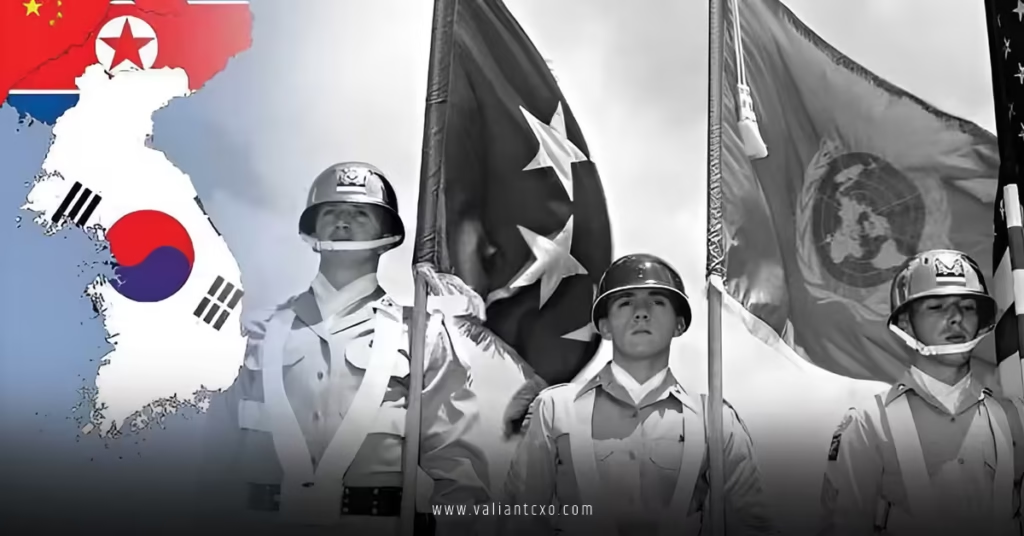
Unlike World War II’s predominantly American forces, Korea featured true multinational operations requiring standardized international military communication.
UN Coalition Terms
UN Command – Unified military command structure
ROK – Republic of Korea (South Korean forces)
Commonwealth Brigade – British-led international unit
Turkish Brigade – Turkish ground forces contingent
Thai Battalion – Thai military contribution
Katcom – Korean Augmentation to Commonwealth Forces
KMAG – Korean Military Advisory Group
Liaison Officer – International coordination specialist
Interpreter – Language specialist for coalition operations
Standing Operating Procedure (SOP) – Standardized international protocols
Enemy Forces and Intelligence Terminology
Korean War military terminology developed specific language for describing Communist forces, reflecting both tactical realities and Cold War propaganda needs.
Communist Forces Identification
CCF – Chinese Communist Forces
NKPA – North Korean People’s Army
Volunteer – Chinese soldier (officially “volunteer” forces)
Commissar – Political officer in Communist units
Regular – Professional military personnel (vs. militia)
Guerrilla – Irregular forces behind UN lines
Infiltration – Enemy movement through UN positions
Partisan – Local irregular forces supporting either side
Propaganda – Information warfare efforts
Indoctrination – Political education/motivation programs
Intelligence and Reconnaissance Terms
S-2 – Intelligence section at unit level
G-2 – Intelligence section at division/corps level
HUMINT – Human intelligence sources
Photo Reconnaissance – Aerial intelligence gathering
Order of Battle – Enemy unit identification and capabilities
Interrogation – Prisoner questioning procedures
Defector – Enemy personnel crossing to UN side
Agent – Intelligence operative behind enemy lines
Counter-Intelligence – Protection against enemy intelligence
Classification – Information security levels
Medical and Casualty Evacuation Innovations
Korean War medical terminology reflected revolutionary advances in battlefield medicine, particularly helicopter evacuation that saved thousands of lives.
Medical Evacuation Procedures
MASH – Mobile Army Surgical Hospital
Chopper – Helicopter (early usage of term)
Dust Off – Medical evacuation by helicopter
Corpsman – Navy medical personnel with Marines
Medic – Army medical personnel
Triage – Medical priority sorting system
Golden Hour – Critical first hour after wounding
Shock – Serious medical condition requiring immediate treatment
Plasma – Blood replacement therapy
Penicillin – Antibiotic preventing infection
Mental Health and Combat Stress
Korean War introduced formal recognition of combat stress reactions, creating terminology that acknowledged psychological casualties.
Combat Fatigue – Mental health condition from prolonged combat stress
Shell Shock – Psychological trauma from artillery bombardment
Battle Fatigue – Exhaustion from extended combat operations
Rest Center – Facility for combat stress recovery
Rotation – System for limiting individual combat exposure
Communication and Technology Terms
The Korean War marked significant advances in military communication technology, establishing terminology that would persist through the Vietnam era and beyond.
Radio and Signal Communications
COMM – Communications equipment/procedures
Radio Check – Testing communication clarity
Authentication – Security codes for radio verification
Frequency – Radio channel designation
Static – Radio interference affecting communication
Signal Corps – Military communication specialists
Wire – Telephone communication lines
Message Center – Communication hub for unit coordination
Crypto – Encrypted communication methods
Relay Station – Communication amplification point
Step-by-Step Guide to Interpreting Korean War Military Documents
Understanding historical records requires systematic approach to decode period-specific terminology:
- Identify document type – After-action reports use formal terms; personal letters contain informal slang
- Note the date and phase – Early war terminology differs from later periods
- Recognize unit designations – Regiment, battalion, company numbers provide context
- Understand geographic references – Hill numbers, phase lines, and MSRs indicate locations
- Decode military time formats – 24-hour clock was standard for all operations
- Identify weather impacts – Seasonal terminology affects operational understanding
- Cross-reference air-ground terminology** – Many documents involve close air support coordination
- Consider coalition context – International forces used slightly different terminology
Evolution from Korea to Vietnam: Linguistic Connections
Korean War military terminology directly influenced language development in subsequent conflicts. Many terms established in Korea’s mountains reappeared in Vietnam’s jungles, creating linguistic continuity across America’s Cold War military engagements.
Terminology That Survived and Evolved
Communication protocols, medical evacuation procedures, and air-ground coordination language developed in Korea provided the foundation for Vietnam War military jargon. Understanding Korean terminology helps decode the more extensive vocabulary documented in our comprehensive Vietnam War slang terms and military jargon glossary.
Radio procedures remained largely consistent
Medical evacuation terms expanded but kept core concepts
Air support coordination became more sophisticated but used Korean foundations
Intelligence terminology adapted to different enemy types and terrain
Coalition cooperation language simplified for predominantly American operations
Common Mistakes When Interpreting Korean War Military Language
Mistake #1: Confusing Korean War Terms with WWII Vocabulary
Problem: Many researchers assume continuity between conflicts
Solution: Recognize that Korea introduced new tactical concepts requiring fresh terminology
Mistake #2: Ignoring International Coalition Context
Problem: Overlooking British, Turkish, and other nations’ influence on terminology
Solution: Consider multinational sources when interpreting unfamiliar terms
Mistake #3: Missing Geographic Specificity
Problem: Applying general military terms without considering Korean terrain
Solution: Understand how mountains, weather, and geography shaped specialized language
Mistake #4: Overlooking Air Power Revolution
Problem: Underestimating how jet aircraft changed military communication
Solution: Recognize that many “new” terms actually originated in Korean air operations
Mistake #5: Ignoring Cold War Political Context
Problem: Missing how ideological warfare influenced terminology
Solution: Consider how anti-Communist language shaped military vocabulary
Key Takeaways for Korean War Military Terminology
- Geographic constraints shaped vocabulary – Mountainous terrain created specific tactical and logistical terminology
- Jet aircraft operations revolutionized air-ground communication – New technology demanded new language
- International coalitions required standardized terminology – UN cooperation created lasting communication protocols
- Medical innovations introduced life-saving vocabulary – Helicopter evacuation and MASH units changed battlefield medicine
- Cold War context influenced enemy identification terms – Ideological warfare shaped how forces were described
- Communication technology advances established lasting protocols – Radio procedures survived through subsequent conflicts
- Weather and seasonal terminology became operationally critical – Extreme climate variations demanded precise language
- Foundation for Vietnam-era military language – Korean terminology directly influenced later conflicts
Advanced Korean War Military Terminology for Researchers
Strategic and Political Terms
Police Action – Official US designation avoiding “war” declaration
38th Parallel – Pre-war border and eventual armistice line
Cease Fire – Temporary halt to hostilities
Armistice – Formal end to fighting (not peace treaty)
DMZ – Demilitarized Zone established by armistice agreement
Containment – US strategy to prevent Communist expansion
Rollback – Policy to reverse Communist territorial gains
Limited War – Conflict with restricted objectives and means
Escalation – Increasing intensity or scope of military operations
Stalemate – Military situation with neither side gaining advantage
Logistics and Supply Terminology
Korean War logistics faced unique challenges that created specialized vocabulary for supply operations in difficult terrain and weather.
Supply Route – Road or path for moving materials to front lines
Depot – Storage facility for military supplies
Airlift – Cargo delivery by aircraft
Airdrop – Supply delivery by parachute
Resupply – Replenishing unit materials and equipment
POL – Petroleum, Oil, and Lubricants
Ammunition Dump – Storage area for explosive materials
Ration – Individual food allowance
Cold Weather Gear – Specialized clothing for extreme temperatures
Winterization – Equipment preparation for cold weather operations
Conclusion
Korean War military terminology established the linguistic foundation for modern American military communication. These terms weren’t just tactical necessities—they represented America’s adaptation to Cold War realities, international coalition warfare, and technological advancement in jet aircraft and helicopter operations.
Understanding this vocabulary provides essential context for military historians, researchers, and anyone seeking to comprehend how American military language evolved from World War II traditions to the complex terminology that would later flourish in Vietnam and subsequent conflicts.
The language born in Korea’s mountains and valleys continues to influence military communication today, making this glossary an indispensable tool for understanding mid-20th-century American military history.
Start with the basic terminology, consider the international context, and remember: these words shaped how America fought the Cold War.
Frequently Asked Questions
Q: How did Korean War military terminology differ from World War II vocabulary?
A: Korea introduced jet aircraft terminology, international coalition language, and specific terms for mountain warfare and extreme weather operations. Unlike WWII’s total war vocabulary, Korean terms reflected limited war objectives and Cold War political constraints.
Q: Why did Korean War military language emphasize air-ground coordination terminology?
A: The extensive use of close air support in mountainous terrain required precise communication between aircraft and ground forces. This created standardized protocols that became foundational for all subsequent conflicts, including the Vietnam War.
Q: What Korean War terms directly influenced Vietnam War military jargon?
A: Radio communication protocols, medical evacuation terminology, and air support coordination language established in Korea provided the foundation for Vietnam War slang. Terms like “dustoff,” “danger close,” and standardized radio procedures originated in Korean operations.
Q: How can I verify Korean War military terminology found in family documents?
A: Cross-reference terms through the Korean War Veterans Memorial Foundation, National Archives Korean War records, and Truman Presidential Library collections. Unit histories and official after-action reports provide verification for technical terminology.
Q: What’s the significance of international coalition terminology in Korean War military language?
A: The UN coalition required standardized communication across multiple languages and military traditions. This created lasting international military terminology and communication protocols that influenced NATO operations and subsequent multinational conflicts.