Congressional war powers debate represents one of the most contentious constitutional issues in American politics, pitting executive branch flexibility against legislative oversight in military decisions. This ongoing tension between presidential authority and congressional war powers has shaped decades of foreign policy decisions and continues to influence how America engages militarily around the world.
Here’s what drives the Congressional war powers debate:
- Constitutional ambiguity between executive and legislative military authorities
- Presidents consistently expanding war powers beyond congressional intent
- Congress struggling to reassert constitutional oversight of military actions
- Modern warfare complexity challenging traditional authorization frameworks
- Political parties switching positions based on who controls the White House
Historical Foundation of Congressional War Powers
The Founding Fathers didn’t accidentally create confusion about war powers. They intentionally split military authority to prevent any single branch from dragging America into unnecessary conflicts.
Congress got the power to “declare war.” Presidents became “Commander in Chief.” Seems simple, right?
Wrong.
The Constitutional Convention debates reveal the founders’ real concern: preventing kings from starting wars on whims. They’d seen how European monarchs bankrupted nations pursuing personal glory through military adventures.
What the Constitution Actually Says
Article I gives Congress the power to declare war, raise armies, and control military funding. Article II makes the president commander in chief of armed forces. That’s where the clarity ends and the Congressional war powers debate begins.
The founders assumed—incorrectly—that these roles would naturally balance each other. Congress would decide whether to fight; presidents would decide how to fight.
Reality proved messier.
The War Powers Resolution of 1973: Congressional Pushback
Vietnam changed everything.
After watching presidents Johnson and Nixon escalate an undeclared war for over a decade, Congress finally said “enough.” The War Powers Resolution of 1973 tried to cage the imperial presidency that had emerged during the Cold War.
Here’s what the Congressional Research Service identifies as the Resolution’s key requirements:
- Presidential consultation with Congress before deploying troops
- 48-hour notification requirement after deployment begins
- 60-day limit on military action without congressional authorization
- 30-day withdrawal period if Congress doesn’t approve action
- Congressional ability to force troop withdrawal through resolution
Why It Doesn’t Work
Every president since 1973—Democrat and Republican—has argued the War Powers Resolution is unconstitutional. They comply with notification requirements while ignoring authorization limits.
The result? Presidents keep fighting undeclared wars while Congress complains but rarely acts decisively.
Modern Presidential War Powers Expansion
The Congressional war powers debate intensified after 9/11 when presidents began interpreting old authorizations as blank checks for global military action.
The 2001 AUMF Problem
The Authorization for Use of Military Force passed after 9/11 targeted “those nations, organizations, or persons” responsible for the attacks. Seems specific enough.
Except presidents have used this single authorization to justify military action in:
| Country | Years Active | Primary Justification |
|---|---|---|
| Afghanistan | 2001-2021 | Original Al-Qaeda target |
| Iraq | 2014-Present | ISIS connection to Al-Qaeda |
| Syria | 2014-Present | ISIS operations |
| Somalia | 2007-Present | Al-Shabaab Al-Qaeda ties |
| Yemen | 2010-Present | AQAP operations |
| Pakistan | 2004-2018 | Al-Qaeda leadership |
One authorization. Six countries. Two decades of warfare.
Executive Branch Legal Gymnastics
Presidential lawyers have developed creative interpretations to expand war powers without congressional approval:
Self-Defense Doctrine: Any threat to American interests justifies military response.
Imminent Threat Standard: Flexible definition allowing preemptive action based on classified intelligence.
Coalition Support: Joining allied military actions without independent congressional authorization.
Humanitarian Intervention: Military action to prevent civilian casualties, even without clear American interests.
Congressional War Powers Debate in Practice
Theory meets reality when actual military crises emerge. The Congressional war powers debate shifts from academic discussion to immediate political calculation.
Libya 2011: Obama’s Constitutional Creativity
President Obama’s Libya intervention perfectly illustrates modern war powers confusion. Obama argued he didn’t need congressional authorization because:
- NATO led the operation (American participation was “supporting”)
- No American ground troops were deployed
- The mission had humanitarian objectives
- Military action remained limited in scope and duration
Congress wasn’t buying it. Even Obama’s own Justice Department lawyers initially disagreed with the White House position.
Syria 2013: Congressional Authority Restored?
Obama’s request for congressional authorization to strike Syria after chemical weapons attacks seemed like a victory for legislative war powers. Finally, a president asking permission before attacking.
Then Congress balked. Faced with likely defeat, Obama accepted a Russian diplomatic solution instead of forcing a vote.
The lesson? Presidents ask congressional permission only when they’re confident of approval.
Constitutional Tensions and Court Decisions
Federal courts have largely refused to resolve the Congressional war powers debate, treating it as a “political question” between the other two branches.
Why Courts Stay Out
Judges cite several reasons for avoiding war powers cases:
Separation of Powers: Courts shouldn’t referee constitutional disputes between coordinate branches.
National Security Expertise: Judges lack military and intelligence knowledge for war decisions.
Political Question Doctrine: Some constitutional issues are better resolved through political rather than judicial processes.
Standing Issues: Individual lawmakers rarely have sufficient injury to challenge presidential war powers in court.
Rare Judicial Interventions
The Supreme Court has occasionally weighed in on war powers, usually supporting congressional authority:
Youngstown Steel (1952): Rejected Truman’s steel mill seizure during Korean War, establishing framework for analyzing presidential power.
Hamdi v. Rumsfeld (2004): Required congressional authorization for indefinite detention of American citizens.
Hamdan v. Rumsfeld (2006): Struck down military tribunals lacking congressional approval.
Recent Examples and Case Studies
The Congressional war powers debate gained new urgency during Trump’s presidency, when dramatic military actions sparked bipartisan constitutional concerns.
Iran Crisis 2020
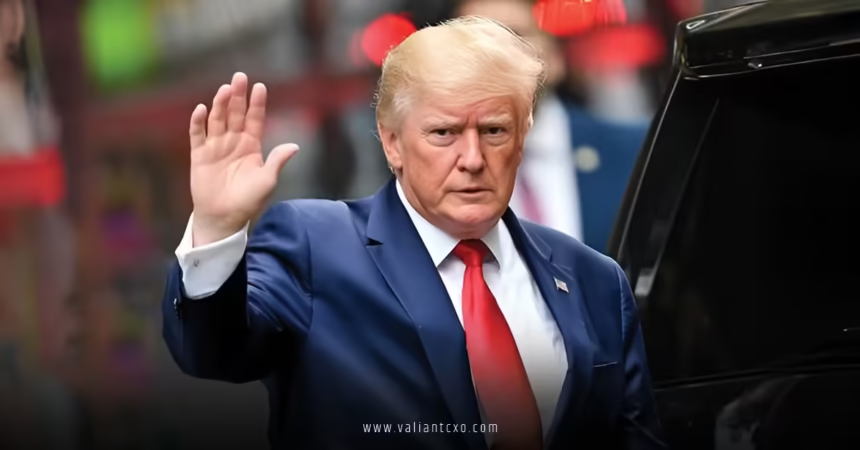
Trump’s assassination of Iranian General Soleimani in January 2020 crystallized modern war powers tensions. The president ordered the strike based on classified intelligence about imminent threats to American personnel.
Congressional leaders from both parties demanded briefings and raised constitutional objections. The criticism wasn’t about whether Soleimani deserved to die—it was about whether presidents can order such consequential military actions without legislative input.
This episode perfectly illustrates why figures like those discussed in analyses of Hakeem Jeffries on Trump reckless war in Middle East have consistently demanded stronger congressional oversight of presidential military decisions.
Ukraine 2022-Present
Biden’s response to Russian invasion of Ukraine showcases how presidents can support major military conflicts without technically fighting wars.
Billions in military aid, intelligence sharing, and weapons transfers flow to Ukraine while American troops remain officially uninvolved in combat. This approach satisfies War Powers Resolution requirements while enabling substantial military engagement.
Critics argue this distinction without difference allows presidents to fight proxy wars without congressional authorization.
Step-by-Step: How War Powers Should Work
Here’s the constitutional process for military action—what the founders intended versus modern reality:
- Threat Assessment: Executive branch identifies potential military need
- Congressional Consultation: President discusses situation with congressional leadership
- Authorization Request: President formally requests military authorization from Congress
- Legislative Debate: Congress publicly debates military action merits
- Authorization Vote: Both chambers vote on specific military authorization
- Presidential Action: If authorized, president directs military operations within congressional parameters
- Ongoing Oversight: Congress monitors military action through hearings and funding decisions
- Sunset Review: Authorization expires unless renewed through new congressional action
Reality: Steps 2-4 usually get skipped. Presidents act first, then seek retroactive congressional blessing.
Common Mistakes in Understanding War Powers
- Mistake: Thinking the Constitution clearly divides war powers
- Reality: Founders created intentional ambiguity requiring ongoing political negotiation
- Mistake: Believing the War Powers Resolution solved the problem
- Reality: Presidents routinely ignore or reinterpret Resolution requirements
- Mistake: Assuming party positions on war powers remain consistent
- Reality: Republicans and Democrats switch positions based on which party controls the presidency
- Mistake: Expecting courts to resolve war powers disputes
- Reality: Federal judges usually refuse to adjudicate political questions between branches
- Mistake: Thinking modern warfare fits 18th-century constitutional frameworks
- Reality: Cyber attacks, drone strikes, and proxy conflicts challenge traditional war/peace distinctions
International Perspectives on Legislative War Powers
America isn’t unique in struggling with executive versus legislative military authority, but our approach differs significantly from other democracies.
Parliamentary Systems
Countries like Britain and Canada require legislative confidence for sustained military action. Prime ministers can act quickly in crises but need parliament’s ongoing support.
Constitutional Requirements
Germany’s constitution strictly limits military action to defensive purposes and requires parliamentary approval for deployments abroad. This reflects post-WWII determination to prevent executive war-making.
Hybrid Approaches
France splits military authority similar to America but with clearer executive dominance. The president can deploy troops for limited periods while the legislature controls longer-term commitments.
Technology and Future War Powers Challenges
The Congressional war powers debate grows more complex as warfare evolves beyond traditional models the founders could never have imagined.
Cyber Warfare
When does cyber attack constitute an act of war requiring congressional authorization? Presidents argue cyber operations fall below traditional warfare thresholds while critics worry about escalation risks.
Autonomous Weapons
Should Congress authorize artificial intelligence systems to make targeting decisions? This question will likely dominate future war powers debates as military technology advances.
Space-Based Conflicts
Military operations in space challenge territorial assumptions underlying current war powers frameworks. Congressional authorization written for terrestrial conflicts may not apply to orbital military actions.
Key Takeaways on Congressional War Powers
- The Constitution intentionally splits war powers between branches without clear boundaries
- Every president since WWII has expanded executive military authority beyond congressional intent
- The 1973 War Powers Resolution has failed to restore meaningful legislative oversight
- Courts rarely intervene in war powers disputes, treating them as political questions
- Modern warfare challenges traditional war/peace distinctions that guided constitutional framers
- Party positions on war powers consistently shift based on which party controls the White House
- Congressional funding power remains the most effective check on presidential military action
- International law and alliance obligations increasingly influence American war powers debates
Future of War Powers Authorization
The Congressional war powers debate isn’t ending anytime soon. If anything, evolving military technology and international threats will intensify constitutional tensions.
Potential Reforms
Sunset Clauses: Automatic expiration of military authorizations requiring regular congressional renewal.
Scope Limitations: Specific geographic and temporal boundaries on presidential military authority.
Enhanced Notification: Real-time congressional briefings on military operations, not just post-action reports.
Judicial Review: Modified standing rules allowing congressional challenges to presidential war powers in federal court.
Political Reality Check
Constitutional reforms require broad bipartisan support that rarely exists on war powers issues. More likely, the debate will continue through informal political accommodation rather than formal legal changes.
The party controlling the White House will defend broad presidential war powers while the opposition party demands congressional oversight. Then they’ll switch positions after the next election.
Regional Security Implications
Congressional war powers debates affect how America responds to global crises, influencing everything from alliance relationships to deterrence effectiveness.
Alliance Coordination
NATO and other allies often move faster than American congressional deliberation allows. This speed gap can weaken alliance coordination during rapid-developing crises.
Deterrence Effects
Adversaries monitor Congressional war powers debates for signs of American political division. Public disputes between branches can signal weakness or resolve, depending on interpretation.
Humanitarian Interventions
Congressional authorization requirements may slow American responses to humanitarian crises where rapid action could save lives but political consensus takes time to develop.
The Role of Public Opinion
Congressional war powers debates ultimately reflect deeper questions about democratic accountability in military decision-making.
War Weariness Factor
After decades in Iraq and Afghanistan, American public opinion increasingly supports congressional oversight of military actions. Voters want legislative input before committing to new conflicts.
Rally Around the Flag
During crises, public opinion initially supports presidential action regardless of congressional authorization. This rally effect gives presidents political cover for unilateral military decisions.
Long-Term Legitimacy
Military actions with congressional backing maintain public support longer than presidential initiatives. Authorization provides democratic legitimacy that sustains difficult conflicts.
Conclusion
The Congressional war powers debate reflects fundamental tensions in American democracy between effective governance and constitutional accountability. Presidents need flexibility to respond quickly to threats, while Congress must maintain oversight to prevent unnecessary wars.
No perfect solution exists to balance these competing requirements. The founders created intentional ambiguity that forces ongoing political negotiation between branches rather than rigid constitutional rules.
Understanding these dynamics helps explain why America continues fighting wars Congress never formally declared while legislators complain but rarely act decisively to stop them.
The debate will continue because it touches core questions about democratic governance: Who decides when America fights? How much oversight can democracy afford during military crises? What role should public opinion play in war decisions?
These aren’t just constitutional law questions—they’re fundamental choices about what kind of republic we want to be.
The next time you hear politicians arguing about war powers, remember they’re really debating whether America should be more democratic or more effective in military affairs. That tension has existed since 1787 and shows no signs of resolution.
Frequently Asked Questions
Q: Can Congress actually stop a president from conducting military operations?
A: Congress has the constitutional power to stop presidential military action through funding restrictions, but this requires majority votes in both chambers and political will to confront the president directly. In practice, Congress rarely exercises this power decisively.
Q: Why don’t courts resolve Congressional war powers debate disputes?
A: Federal courts typically treat war powers as “political questions” that should be resolved between the executive and legislative branches rather than through judicial interpretation. Courts cite separation of powers concerns and lack of expertise in military affairs.
Q: Has the Congressional war powers debate changed since 9/11?
A: Yes, significantly. The 2001 Authorization for Use of Military Force has been stretched to justify military action far beyond its original scope, while presidents argue that modern threats require more flexible response authorities than traditional congressional authorization allows.
Q: Do other democracies have similar war powers debates?
A: Most parliamentary democracies have clearer executive authority for military action, though they require ongoing legislative confidence. Countries like Germany have stricter constitutional limits on military action, reflecting different historical experiences with executive war-making.
Q: What role does public opinion play in the Congressional war powers debate?
A: Public opinion strongly influences congressional willingness to challenge presidential military action. During crises, “rally around the flag” effects support presidential authority, while war-weary voters increasingly demand congressional oversight of long-term military commitments.