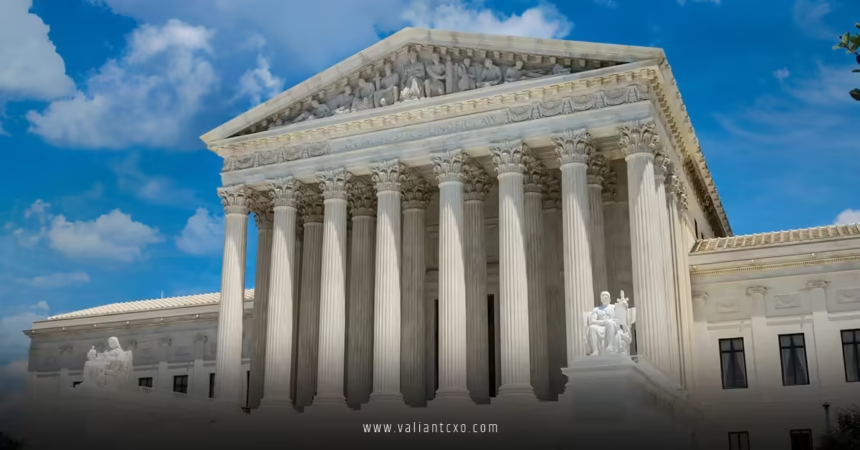
Supreme Court immigration precedents have fundamentally shaped America’s approach to deportation, asylum, and citizenship for over a century. From the Chinese Exclusion Cases of the 1880s to today’s heated debates about judicial discretion, the nation’s highest court has consistently grappled with balancing federal power against individual rights—a tension that continues to play out in cases like the recent Sonia Sotomayor swipe at Brett Kavanaugh immigration case.
Understanding these precedents isn’t just academic exercise. They’re the foundation upon which every immigration decision gets made, affecting millions of lives and determining how America defines itself as a nation.
Here’s what shapes modern immigration law:
- Plenary Power Doctrine: Congress has nearly unlimited authority over immigration decisions
- Due Process Requirements: Even non-citizens retain certain constitutional protections
- Judicial Review Limits: Courts have restricted ability to overturn executive immigration decisions
- Humanitarian Exceptions: Supreme Court has carved out protections for specific vulnerable groups
- Statutory Interpretation Rules: How courts read immigration laws when Congress’s intent isn’t clear
The Foundation: Early Supreme Court Immigration Precedents That Still Matter
The Chinese Exclusion Cases (1880s-1900s)
The Supreme Court’s immigration jurisprudence began with some of its most shameful decisions. The Chinese Exclusion Cases established what lawyers call the “plenary power doctrine”—the idea that Congress has virtually unlimited authority to decide who can enter or remain in America.
Chae Chan Ping v. United States (1889) set the devastating precedent. The Court ruled that Congress could exclude immigrants based on race, and that such decisions were largely beyond judicial review. Justice Stephen Field wrote that immigration control was essential to national sovereignty.
This wasn’t just legal theory. Real families were torn apart. Chae Chan Ping himself had lived in San Francisco for twelve years before being denied re-entry after a brief trip to China.
The precedent stuck. Even today, courts cite these 19th-century cases when limiting their ability to review immigration decisions.
Why These Old Cases Still Control Modern Immigration Law
Here’s the thing about Supreme Court precedents: they don’t expire. Unless explicitly overruled, decisions from 1889 carry the same legal weight as ones from 2023. The plenary power doctrine established in the Chinese Exclusion Cases continues to limit how federal courts can review immigration enforcement.
Immigration attorneys deal with this reality daily. When challenging deportation orders, they can’t simply argue that removal would be unfair or harsh. They must find specific constitutional or statutory violations—a much higher bar.
Due Process Revolution: Expanding Rights for Non-Citizens
The Goldberg Era (1970s)
The Warren and Burger Courts began chipping away at absolute federal power over immigration. Goldberg v. Kelly (1970) didn’t directly involve immigration, but its due process principles revolutionized how courts approach government benefit terminations—including deportation proceedings.
The Court established that due process requires:
- Adequate Notice: People facing government action must understand what they’re accused of
- Opportunity to Be Heard: A meaningful chance to present their case
- Impartial Decision-Maker: Someone without conflicts of interest deciding the outcome
- Right to Representation: At least in cases involving fundamental rights
Landon v. Plasencia (1982): Due Process Comes to Immigration
This case involved a lawful permanent resident who was detained upon returning from a brief trip to Mexico. The Supreme Court ruled that even non-citizens with ties to America deserve due process protections before deportation.
Justice O’Connor’s majority opinion was groundbreaking: “Once an alien gains admission to our country and begins to develop the ties that go with permanent residence, his constitutional status changes accordingly.”
The decision established different tiers of protection based on someone’s connection to America:
| Immigration Status | Due Process Protection Level | Practical Impact |
|---|---|---|
| Recent Border Crosser | Minimal | Limited hearing rights |
| Temporary Visa Holder | Moderate | Notice and basic hearing |
| Lawful Permanent Resident | Substantial | Full deportation hearing with attorney |
| U.S. Citizen | Complete | Cannot be deported |
Modern Era: Balancing Security and Humanitarian Concerns
The Anti-Terrorism and Effective Death Penalty Act Cases
After 9/11, Congress dramatically expanded immigration enforcement powers. The Supreme Court has spent two decades determining constitutional limits on this expansion.
Zadvydas v. Davis (2001) addressed indefinite detention. The Court ruled that the Constitution prevents holding deportable immigrants indefinitely when their home countries won’t accept them back. Justice Breyer’s opinion emphasized that “freedom from imprisonment lies at the heart of the liberty protected by the Due Process Clause.”
But the Court also upheld significant government powers. Demore v. Kim (2003) allowed mandatory detention of certain immigrants during deportation proceedings, even for minor crimes committed years earlier.
The Chevron Doctrine and Immigration Law
One of the most significant developments in immigration precedents involves how courts review agency decisions. Under Chevron U.S.A. Inc. v. Natural Resources Defense Council (1984), courts must defer to reasonable agency interpretations of ambiguous statutes.
This matters enormously for immigration law, where agencies like Immigration and Customs Enforcement regularly interpret complex statutory language. The doctrine generally favors government enforcement over individual challenges.
However, the Supreme Court has been reconsidering Chevron’s scope. Recent decisions suggest less deference to agency interpretations, which could give immigration attorneys new tools for challenging deportation decisions.
Humanitarian Exceptions: When the Supreme Court Protects Vulnerable Groups
Children and Family Unity
The Supreme Court has carved out special protections for certain vulnerable populations, even within the restrictive plenary power framework.
Plyler v. Doe (1982) established that states cannot deny public education to undocumented children. Justice Brennan’s opinion recognized that punishing children for their parents’ actions violated equal protection principles.
Moore v. City of East Cleveland (1977), while not directly an immigration case, established constitutional protection for extended families living together. This precedent has been crucial in family-based immigration cases.
Asylum and Non-Refoulement
The Supreme Court has generally upheld America’s obligations under international law not to return people to countries where they face persecution. INS v. Cardoza-Fonseca (1987) established that asylum seekers need only show a “well-founded fear” of persecution, not that persecution is more likely than not.
This standard has protected thousands of refugees, though its application remains contentious in specific cases.
Recent Developments: The Trump Era and Beyond
Travel Ban Litigation
Trump v. Hawaii (2018) upheld the administration’s travel restrictions affecting several Muslim-majority countries. The 5-4 decision emphasized presidential authority over immigration policy while requiring that such policies have legitimate national security justifications.
Justice Kennedy’s concurrence was telling: he stressed that religious animus could never justify immigration restrictions, but found insufficient evidence that the travel ban was primarily motivated by anti-Muslim sentiment.
Administrative Changes and Judicial Review
The Supreme Court has increasingly emphasized that immigration policy changes must follow proper administrative procedures. Department of Homeland Security v. Regents of the University of California (2020) struck down the Trump administration’s attempt to end DACA, not because the policy was wrong, but because DHS failed to consider all relevant factors when making the change.
This procedural emphasis gives immigration advocates new strategies for challenging policy shifts, even when the underlying policies might be legally permissible.
Key Supreme Court Immigration Precedents Every American Should Know
- Chae Chan Ping v. United States (1889): Established congressional plenary power over immigration
- Landon v. Plasencia (1982): Extended due process rights to long-term residents facing deportation
- Plyler v. Doe (1982): Protected undocumented children’s right to public education
- Zadvydas v. Davis (2001): Limited indefinite detention of deportable immigrants
- INS v. Cardoza-Fonseca (1987): Established “well-founded fear” standard for asylum cases
- Trump v. Hawaii (2018): Upheld presidential authority over immigration policy with national security justifications
- DHS v. Regents (2020): Required proper administrative procedures for major policy changes
- Pereira v. Sessions (2018): Clarified notice requirements for deportation proceedings
How Supreme Court Immigration Precedents Shape Today’s Cases
The philosophical tensions visible in recent Supreme Court immigration precedents directly connect to contemporary debates. When Justice Sotomayor challenged Justice Kavanaugh’s approach in their recent immigration case exchange, she was drawing on decades of precedent about balancing textual interpretation against humanitarian concerns.
Sotomayor’s position reflects the due process expansion that began in the 1970s, emphasizing that constitutional protections extend beyond citizenship status. Kavanaugh’s approach echoes the plenary power doctrine, prioritizing congressional authority and uniform rule application.
This isn’t just academic debate. These competing interpretations of Supreme Court immigration precedents will determine outcomes for hundreds of thousands of people in deportation proceedings.
Common Misconceptions About Immigration Precedents
Misconception #1: Old Cases Don’t Matter Anymore
Reality: Supreme Court precedents remain binding until explicitly overruled. Cases from the 1880s still influence modern immigration law.
Misconception #2: Immigration Law Is Separate from Constitutional Law
Reality: Immigration cases regularly involve fundamental constitutional principles like due process, equal protection, and separation of powers.
Misconception #3: The Supreme Court Always Favors Government Enforcement
Reality: While the Court often defers to federal immigration authority, it has also established significant protections for vulnerable groups and procedural rights.
Misconception #4: Precedents Apply Uniformly to All Immigrants
Reality: The Court has created different protection levels based on immigration status, length of residence, and other factors.
Misconception #5: Recent Cases Override All Historical Precedents
Reality: New decisions typically build on existing precedents rather than completely replacing them, creating complex layers of legal authority.
The Future of Supreme Court Immigration Precedents
Several factors suggest significant changes ahead in how the Supreme Court approaches immigration law:
Changing Court Composition
With three Trump appointees now on the Court, the conservative majority might be more willing to revisit precedents that expanded immigrant rights. However, they’ve also shown respect for established procedural requirements and institutional limitations on judicial power.
Congressional Gridlock
As Congress remains unable to pass comprehensive immigration reform, more policy gets made through executive action and judicial interpretation. This pushes courts into roles they’ve traditionally avoided, potentially leading to new precedents about institutional boundaries.
International Law Integration
Younger justices have shown more willingness to consider international legal obligations when interpreting domestic immigration law. This could lead to precedents that better integrate America’s treaty commitments with constitutional requirements.
Step-by-Step: How Supreme Court Immigration Precedents Get Applied
Understanding how these precedents work in practice helps clarify their real-world impact:
- Case Filed in Immigration Court: Individual faces deportation proceedings based on specific statutory violations
- Legal Challenge Raised: Attorney argues that enforcement violates constitutional rights or exceeds statutory authority
- Precedent Research: Lawyers identify relevant Supreme Court cases that support their position
- Lower Court Decision: Immigration judge or federal district court applies precedents to specific facts
- Appeals Process: Higher courts review whether precedents were correctly applied
- Supreme Court Review: If circuits disagree on precedent application, Supreme Court may grant review
- New Precedent Created: Supreme Court decision becomes binding authority for all future similar cases
This process can take years, during which individuals often remain in legal limbo. The human cost of precedent-setting gives urgency to Supreme Court immigration decisions.
Regional Variations in Applying Immigration Precedents
One fascinating aspect of Supreme Court immigration precedents is how different federal circuits interpret the same decisions. The Ninth Circuit (covering West Coast states) has generally applied precedents more favorably to immigrants. The Fifth Circuit (covering Texas and surrounding states) typically interprets the same precedents more restrictively.
This creates what lawyers call “forum shopping”—where identical cases can have different outcomes depending on geographic location. Only Supreme Court review can resolve these splits, making precedent-setting cases even more crucial.
The Role of Dissenting Opinions in Future Immigration Law
Don’t overlook dissenting opinions when studying Supreme Court immigration precedents. Today’s dissent often becomes tomorrow’s majority position as Court composition changes.
Justice Sotomayor’s dissents in recent immigration cases, for example, provide roadmaps for future challenges to restrictive enforcement policies. Her emphasis on humanitarian considerations and constitutional protections for vulnerable populations could influence how future Courts approach these issues.
Similarly, conservative dissents in cases that expanded immigrant rights offer previews of how the current Court majority might narrow those protections.
Key Takeaways About Supreme Court Immigration Precedents
- Historical precedents from the 1880s continue to limit judicial review of immigration decisions through the plenary power doctrine
- Due process protections have expanded significantly since the 1970s, particularly for long-term residents and vulnerable groups
- The Court has balanced national security concerns against individual rights, generally deferring to executive authority while maintaining procedural protections
- Recent precedents emphasize proper administrative procedures for immigration policy changes, giving advocates new tools for legal challenges
- Regional circuit court variations in interpreting precedents create inconsistent outcomes until Supreme Court provides clarification
- Current Court composition suggests potential narrowing of immigrant protections, but respect for institutional procedures may limit dramatic changes
- Contemporary cases like the Sonia Sotomayor and Brett Kavanaugh exchange reflect ongoing tensions between textual interpretation and humanitarian considerations
- Future precedents will likely address congressional gridlock, international law integration, and evolving security challenges
What These Precedents Mean for Current Immigration Policy
Supreme Court immigration precedents don’t just sit in law books—they actively shape every immigration decision made across America. When an immigration judge decides whether to grant asylum, they’re applying precedents like Cardoza-Fonseca. When ICE determines detention policies, they must follow limits established in Zadvydas.
The precedents also influence congressional debates about immigration reform. Lawmakers know that any new legislation must comply with existing Supreme Court decisions, which constrains possible policy options.
Most importantly, these precedents affect real people’s lives daily. Understanding them helps explain why immigration law seems so complex and why similar cases sometimes have different outcomes.
Looking Ahead: The Next Generation of Immigration Precedents
Several emerging issues are likely to generate new Supreme Court immigration precedents in the coming years:
Digital Age Challenges: How do constitutional protections apply to electronic surveillance of immigrants? What privacy rights exist for immigration-related data?
Climate Migration: As environmental factors force more people to seek new homes, how will asylum law adapt to recognize climate-based persecution?
Family Separation: What constitutional limits exist on government policies that separate immigrant families, particularly involving U.S. citizen children?
State vs. Federal Authority: As states pass varying immigration policies, the Court will need to clarify the boundaries between federal and state power.
These issues will require the Supreme Court to extend existing precedents into new contexts, potentially creating significant new protections or restrictions for immigrants.
Conclusion
Supreme Court immigration precedents represent more than just legal history—they’re the living framework that determines America’s approach to one of our most defining challenges. From the shameful exclusions of the 19th century to the due process expansions of the modern era, these precedents reflect our evolving understanding of constitutional principles and human dignity.
The recent exchange between Justice Sotomayor and Justice Kavanaugh illustrates how these precedents continue to evolve, with each generation of justices bringing new perspectives to age-old tensions between security and compassion, federal power and individual rights.
Understanding these precedents helps us make sense of current immigration debates and anticipate future developments. More importantly, it reminds us that behind every legal precedent are real people seeking safety, opportunity, and the chance to build better lives.
As America continues grappling with immigration challenges, Supreme Court precedents will remain the foundation upon which we balance our values, our security, and our constitutional commitments. The next chapter in this precedent-setting story is being written right now, one case at a time.
Frequently Asked Questions
Q: Can the Supreme Court overturn its own immigration precedents?
A: Yes, the Supreme Court can overrule its previous decisions, though it rarely does so. The Court prefers to distinguish or narrow previous precedents rather than explicitly overturning them, particularly in immigration law where stability is important for both individuals and government planning.
Q: How do Supreme Court immigration precedents affect state immigration laws?
A: Federal immigration precedents generally supersede state laws due to the Constitution’s supremacy clause. However, states retain some authority over issues like driver’s licenses, in-state tuition, and law enforcement cooperation, as long as they don’t conflict with federal precedents.
Q: Why do some immigration attorneys cite very old Supreme Court cases?
A: Unlike many areas of law, immigration precedents have remarkable staying power. Cases from the 1880s established fundamental principles about federal power over immigration that remain binding today, making historical precedents directly relevant to modern cases.
Q: How do Supreme Court immigration precedents compare to those in other countries?
A: American immigration law is unique in its emphasis on congressional plenary power and limited judicial review. Many other democracies give their courts broader authority to review immigration decisions on humanitarian grounds, making U.S. precedents relatively restrictive by international standards.
Q: Will the current Supreme Court composition significantly change immigration precedents?
A: While the conservative majority might interpret existing precedents more restrictively, dramatic precedent changes require explicit overruling, which the Court does rarely. More likely are gradual shifts in how precedents get applied to new factual situations.