Roth IRA vs Traditional IRA comparison is one of the most important decisions you’ll make in your retirement plan. Same annual contribution limit. Totally different tax outcomes.
In my experience, people don’t get stuck on the math. They get stuck on the “what if” questions:
What if taxes go up? What if I retire early? What if I need the money sooner?
Let’s break this down in a way that’s easy to scan, easy to act on, and actually useful for real‑world decisions.
Quick overview: Roth IRA vs Traditional IRA at a glance
If you just want the fast answer, start here.
- Traditional IRA: Possible tax deduction now, taxes later on withdrawals.
- Roth IRA: No deduction now, tax‑free withdrawals later (if rules are met).
- Key decision: Pay tax now at today’s rate (Roth) or later at your future rate (Traditional).
- Shared rule: Both follow the same annual IRA contribution limits and catch‑up rules under current IRS guidelines, which tie into broader 2026 retirement planning rules and contribution limits.
- Big picture: You’re not locked into one forever—most people benefit from using both over time.
Core mechanics: how each IRA actually works
Traditional IRA: tax break now, taxes later
With a Traditional IRA:
- You contribute pre‑tax or partially pre‑tax money if you qualify for a deduction.
- Your investments grow tax‑deferred.
- Withdrawals in retirement are taxed as ordinary income.
- Required minimum distributions (RMDs) kick in at the age set by law.
Who it usually helps most:
- Higher earners in 2026 who qualify for at least a partial deduction.
- People who expect their retirement tax rate to be lower than today.
- Anyone needing an immediate tax deduction to free up cash flow.
Deductibility depends on whether you or your spouse are covered by a workplace plan and your income. The official IRA contribution limit and deduction tables are maintained on the IRS site, and they update each year for inflation.
Roth IRA: tax now, flexibility and tax‑free later
With a Roth IRA:
- You contribute after‑tax money (no deduction upfront).
- Growth is tax‑free.
- Qualified withdrawals in retirement are tax‑free.
- No RMDs for the original owner.
Who it usually helps most:
- People in lower tax brackets now who expect higher income or higher tax rates later.
- Younger savers with long time horizons.
- Anyone who wants tax‑free flexibility in retirement (or earlier) and hates future tax unknowns.
Roth IRAs have income limits, so higher earners may be partially or fully phased out of direct contributions under current IRS rules.
Side‑by‑side Roth IRA vs Traditional IRA comparison
Here’s the clean, scannable comparison you can come back to anytime.
| Feature | Traditional IRA | Roth IRA |
|---|---|---|
| Contribution Source | Pre‑tax or after‑tax (deduction may apply) | After‑tax only |
| Tax Benefit Timing | Tax break now via deduction (if eligible) | Tax benefit later via tax‑free withdrawals |
| Tax on Growth | Tax‑deferred | Tax‑free (if qualified) |
| Tax on Withdrawals | Taxed as ordinary income | Qualified withdrawals tax‑free |
| Income Limits for Contributions | No limit to contribute; deduction phased out based on income and workplace plan status | Income limits for contribution eligibility |
| RMDs (Required Minimum Distributions) | Yes, starting at IRS‑defined age | No RMDs for original owner |
| Early Withdrawal Rules | Generally subject to tax + penalty on pre‑tax portion before 59½ (with exceptions) | Contributions can usually be withdrawn tax‑ and penalty‑free; earnings have stricter rules |
| Best Fit Scenario | Higher tax rate now, lower expected in retirement | Lower tax rate now, higher expected in retirement |
Both account types share the same annual IRS contribution limit (plus catch‑up at age 50+), which is part of overall 2026 retirement planning rules and contribution limits. You just split that limit between Roth and Traditional as you see fit.
How the contribution rules work in 2026 (and why they matter)
Even though this is a Roth IRA vs Traditional IRA comparison, the underlying rules are identical in a few key ways:
- One combined limit: Your total contribution to all IRAs (Roth + Traditional) cannot exceed the IRS limit for 2026.
- Catch‑up at 50+: If you’re age 50 or older by the end of 2026, you can add an extra catch‑up contribution.
- Earned income required: You must have earned income at least equal to what you contribute (with limited exceptions like spousal IRAs).
The nuances:
- Deduction rules for Traditional IRA
- If you or your spouse are covered by a workplace plan, deductibility phases out as income rises.
- If neither of you is covered, you may be able to deduct up to the full limit regardless of income.
- Income limits for Roth IRA
- Direct Roth contributions are phased out at higher income levels.
- Above the top threshold, you can’t contribute directly (though advanced strategies exist that require professional guidance).
These rules sit inside the broader framework of 2026 retirement planning rules and contribution limits, which also govern your 401(k), 403(b), and other accounts. Getting the IRA piece right means you’re using your personal limit efficiently alongside everything else.
When a Traditional IRA usually wins
There’s no one‑size‑fits‑all, but patterns show up repeatedly. Traditional IRA tends to look better when:
- You’re in a high tax bracket right now
Getting the deduction today saves you more actual dollars. If you expect to be in a lower bracket in retirement, deferring tax can be smart. - You need the deduction to make saving possible
In real life, cash flow wins. If deducting Traditional contributions is what lets you save at all, that beats the “ideal” but unused Roth. - You’re not eligible for Roth contributions
High income and no access to Roth at the IRA level? A deductible Traditional IRA may still be available, depending on workplace coverage. - You expect a much simpler, lower‑income retirement
If retirement income will be modest relative to your working years, paying tax later could mean lower rates and a smaller overall tax bill.
What I’d do if I were in a high bracket, maxing a 401(k), and still wanting IRA space:
Check whether I qualify for a Traditional IRA deduction, use it if allowed, then revisit later for potential Roth conversions in lower‑income years.
When a Roth IRA usually wins
Roth IRAs shine in scenarios where future flexibility and tax‑free income matter more than shaving this year’s bill.
Roth often comes out ahead when:
- You’re in a relatively low tax bracket today
Paying tax at a low rate now to lock in tax‑free growth is generally attractive, especially early in your career. - You expect higher income or higher tax rates later
Promotions, business growth, or general concern about future tax policy all tilt toward Roth. - You want more control in retirement
No RMDs for the original owner means you’re not forced to pull money out on the government’s schedule. That’s huge for tax planning. - You like having access to contributions
Roth IRA contributions (not earnings) can often be withdrawn without tax or penalty. That doesn’t mean you should treat it like a checking account, but it’s a safety valve.
In my experience, younger savers and those who hate tax uncertainty often feel a lot more relaxed with solid Roth balances built over time.
Blended strategy: why “both” is often the smartest answer
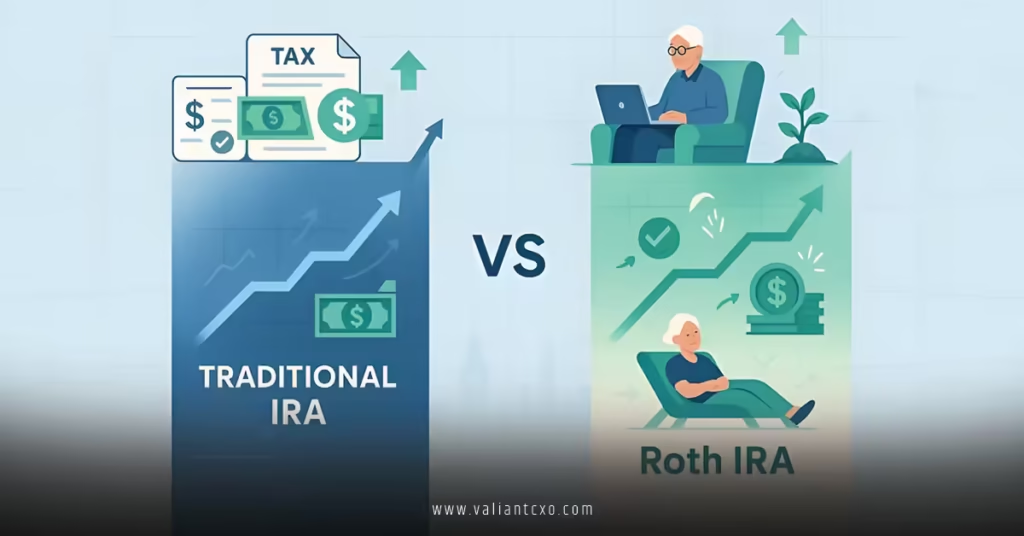
Here’s the thing: the Roth IRA vs Traditional IRA comparison is not a cage match. You don’t have to pick a permanent winner.
A blended approach can give you:
- Tax diversification: Some pre‑tax money, some tax‑free money, and some taxable investments.
- Withdrawal flexibility: In retirement, you can choose where to pull from based on that year’s tax picture.
- Legislative risk management: Spreading between tax buckets reduces your exposure to any one future tax change.
Simple ways to blend:
- Use a Traditional IRA when your income spikes (or during years you especially need deductions).
- Favor Roth IRA in lower‑income years or early in your career.
- If you’re married, one spouse might lean more Roth, the other more Traditional, depending on income and benefits.
The smartest savers don’t obsess over perfect forecasts. They build options.
How IRAs fit into your broader 2026 retirement plan
IRAs don’t live in a vacuum. They sit alongside:
- Workplace plans like 401(k)s and 403(b)s
- Health Savings Accounts (HSAs)
- Taxable brokerage accounts
- Social Security and potential pensions
The question isn’t just “Roth IRA vs Traditional IRA?” It’s also:
- How do these IRA choices complement my 401(k) contributions?
- Am I over‑concentrated in pre‑tax accounts that will all be taxable later?
- Am I taking full advantage of annual limits under 2026 retirement planning rules and contribution limits, or leaving space unused?
A common real‑world pattern that works well:
- Contribute enough to your workplace plan to get the full employer match.
- Fund a Roth or Traditional IRA based on your current tax bracket.
- If you still have capacity, increase your workplace contributions and, if eligible, add to an HSA.
- Use taxable accounts for extra investing and flexibility.
Common mistakes with Roth vs Traditional (and how to fix them)
Even experienced savers trip over these. The key is catching and correcting early.
Mistake 1: Only thinking about “now”
People obsess over this year’s refund and ignore what life might look like at 60+. That’s short‑sighted.
Fix:
Sketch a rough retirement picture: Social Security, possible pensions, business income, rental income, and required distributions from pre‑tax accounts. If everything is pre‑tax, future tax bills can explode. That’s a sign you should favor more Roth.
Mistake 2: Assuming Roth is always “better” for young people
Yes, Roth often makes sense early. But if a young high earner is already in a very high bracket, a Traditional IRA deduction might still be more valuable.
Fix:
Check your actual marginal tax rate, not just your total income. Use that as your starting point, not generic age rules of thumb.
Mistake 3: Ignoring income limits and deduction phase‑outs
This one bites people who think they’re doing everything right, but their contributions aren’t fully deductible or their Roth contributions aren’t allowed.
Fix:
Each year, confirm your eligibility using the latest income tables on the IRS IRA contribution limits page. Adjust contributions if you cross into new thresholds.
Mistake 4: Never revisiting the decision
What usually happens is someone picks Roth or Traditional in their 20s and never reviews it, even when their income, family situation, or tax law changes.
Fix:
Reassess your Roth vs Traditional mix every few years or after big life events: marriage, kids, major promotions, business changes, or approaching retirement.
Simple decision framework: which IRA should you prioritize?
Use this as a practical, non‑perfect but very workable guide.
- You’re in a low or moderate tax bracket now
- Default: Roth IRA.
- Especially if you’re early in your career or expect meaningful raises.
- You’re in a high tax bracket and qualify for a deduction
- Default: Traditional IRA for the deduction.
- Then consider future Roth conversions in lower‑income years.
- You’re in the middle and unsure about future taxes
- Strategy: Split contributions between Roth and Traditional.
- You’ll give up perfect optimization for much better flexibility.
- You’re 50+ and in catch‑up territory
- Look not only at this year’s taxes but at your future RMD picture.
- Heavy pre‑tax balances and big future RMDs? Consider more Roth.
- Light pre‑tax balances and low expected retirement income? Traditional may still be your friend.
Key takeaways
- Roth IRA vs Traditional IRA comparison is fundamentally about when you pay tax: now (Roth) or later (Traditional).
- Both account types share the same annual IRA contribution limits and catch‑up structure under 2026 retirement planning rules and contribution limits; they just differ in tax timing and flexibility.
- Traditional IRAs tend to favor higher earners today who expect lower retirement tax rates and need deductions.
- Roth IRAs tend to favor those in lower brackets now, people expecting higher income later, and anyone who values tax‑free flexibility.
- You don’t have to choose one forever—splitting contributions across Roth and Traditional helps manage future tax risk.
- Reviewing your choice periodically as income, law, and life change is far more important than trying to be perfectly precise on day one.
Smart move now: check your current marginal tax rate, confirm your IRA eligibility on the IRS site, and decide whether this is a Roth‑heavy year, a Traditional‑heavy year, or a split year. Then actually set up the automatic contributions so the plan runs without you babysitting it.
FAQ :
What is the main difference between a Roth IRA and a Traditional IRA?
A Roth IRA uses after-tax contributions and offers tax-free qualified withdrawals, while a Traditional IRA may give you a tax deduction now but taxes withdrawals later.schwab+1
Which IRA is better for me?
A Roth IRA often fits people who expect to be in a higher tax bracket later, while a Traditional IRA may suit those who want a tax break now or expect a lower tax bracket in retirement.finance.yahoo+1
Do Roth and Traditional IRAs have required minimum distributions?
Roth IRAs do not require minimum distributions during the original owner’s lifetime, but Traditional IRAs generally require them starting at age 73.fidelity+1