james webb space telescope recent exoplanet discoveries are rewriting what we thought we knew about planets beyond our Solar System. New atmospheres. Exotic weather. Possible building blocks of life. The bar just moved.
Here’s the fast version up top.
- The James Webb Space Telescope (JWST) is now giving high‑precision spectra of exoplanet atmospheres, revealing water vapor, carbon dioxide, methane, and exotic molecules.
- Several recent exoplanet discoveries hint at potentially habitable conditions, including temperate rocky worlds in the TRAPPIST‑1 system and other M‑dwarf stars.
- Webb has confirmed complex chemistry on hot gas giants, including carbon-bearing molecules and possible photochemical hazes.
- Data from NASA, ESA, and major observatories show Webb is sharpening estimates of planet temperature, clouds, and atmospheric structure.
- For beginners and enthusiasts, the key is learning how to follow observations, read spectra, and separate solid science from hype about “second Earths.”
What the james webb space telescope recent exoplanet discoveries actually are
The James Webb Space Telescope was built to do a few big things very well: look back in time, see through dust, and decode the light of exoplanets.
When people say “james webb space telescope recent exoplanet discoveries”, they’re mostly talking about three buckets:
- Atmospheric detections – water vapor, carbon dioxide, methane, carbon monoxide, sulfur dioxide, and more on distant planets.
- Characterization of potentially habitable planets – especially small, rocky planets in the temperate zones of cool stars.
- Unexpected chemistry and clouds – strange atmospheres, heat distributions, and clouds that don’t match older models.
In my experience, the most important shift isn’t “we found life” (we haven’t). It’s that Webb is turning fuzzy guesses into measurable properties: composition, temperature profiles, cloud decks, and even hints of weather patterns.
Snapshot of key james webb space telescope recent exoplanet discoveries
Here’s a quick comparison of some widely discussed targets Webb has observed, with a focus on what makes each one interesting.
Note: Mission data and interpretations come from NASA, ESA, and peer‑reviewed studies through 2025.
| Exoplanet / System | Type & Orbit | What Webb Detected | Why It Matters | Habitability Potential |
|---|---|---|---|---|
| WASP‑39 b | Hot Saturn; very close to star | CO₂, H₂O, CO, SO₂, clouds/hazes | First clear CO₂ detection in an exoplanet; evidence of photochemistry | Effectively zero – too hot and irradiated |
| WASP‑96 b | Hot Jupiter | Water vapor, clouds; detailed transmission spectrum | Proof of Webb’s precision and wavelength coverage for gas giants | None – extreme temperatures |
| WASP‑18 b | Ultra‑hot Jupiter | Thermal map; strong day‑night contrast; unusual chemistry | Tests models of tidal locking, heat circulation, and atmospheric physics | None – thousands of degrees |
| TRAPPIST‑1 planets | Compact system of 7 Earth‑size worlds | Upper limits on atmospheres; searches for CO₂, H₂O, etc. | Key lab for studying potentially temperate rocky planets | Several in habitable zone; atmospheres still under investigation |
| K2‑18 b | “Mini‑Neptune” / sub‑Neptune in habitable zone | CO₂, CH₄, H₂O signatures; possible clouds | Tests idea of “Hycean” (ocean + H₂ envelope) worlds | Intriguing but uncertain; likely not Earth‑like |
| LHS 475 b and similar | Rocky, Earth‑size planets around red dwarfs | Very tight constraints on thick atmospheres | Shows how hard it is for some small worlds to keep atmospheres | Depends on atmosphere retention; not yet confirmed |
Why Webb’s exoplanet discoveries matter (even without “aliens found” headlines)
Here’s the thing: the real impact isn’t flashy clickbait. It’s the step‑change in precision.
1. Turning spectra into “weather reports”
With older telescopes, an exoplanet spectrum looked like a noisy barcode. You could squint and say, “Probably some water.”
Now? With the james webb space telescope recent exoplanet discoveries, we’re seeing:
- Clear molecular fingerprints for multiple gases at once.
- Evidence of cloud layers and hazes that block or scatter light.
- Hints of day‑night temperature differences and heat transport.
It’s like moving from a blurry weather radar to a high‑res satellite image.
2. Testing how planets form and evolve
What usually happens in planetary science is this: someone builds a model, and nature cheerfully breaks it.
Webb’s results are stress‑testing models of:
- Planet formation (how much heavy element content do gas giants really have?).
- Migration (how did hot Jupiters like WASP‑39 b end up parked so close to their stars?).
- Atmospheric escape for small planets near active stars.
Each mismatch between model and observation is a clue. That’s how the field moves.
3. Reframing “habitability”
Instead of “Is this planet habitable? Yes/No,” Webb is nudging things toward:
- What is the actual radiation environment?
- Can the planet hold an atmosphere?
- What is the likely surface temperature range?
Is that less romantic than “Earth 2.0 discovered”? Maybe. Is it more honest and scientifically useful? Absolutely.
Deep dive: The headline james webb space telescope recent exoplanet discoveries
Let’s walk through a few flagship cases and what they actually mean.
WASP‑39 b: The chemistry playground
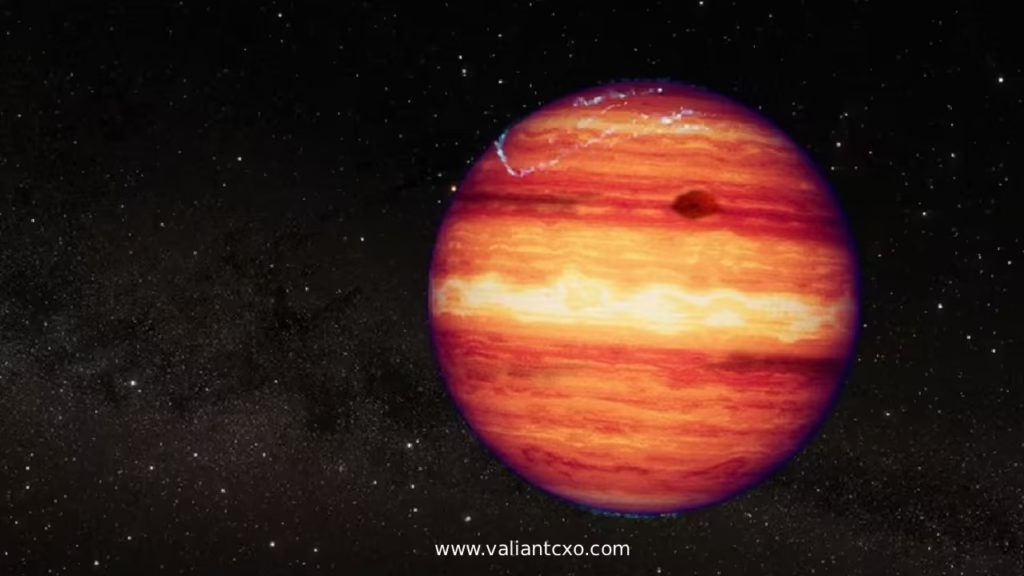
WASP‑39 b is a hot Saturn‑mass gas giant that orbits extremely close to its star. Terrible for life. Fantastic for spectroscopy.
Webb detected:
- Carbon dioxide (CO₂) with very distinct spectral features.
- Water vapor (H₂O) and carbon monoxide (CO).
- Sulfur dioxide (SO₂), which points to photochemistry – high‑energy starlight changing molecules in the upper atmosphere.
Agencies like NASA and ESA highlighted this as a milestone because it proves Webb can dissect exoplanet atmospheres in detail, not just say “something is there.”
The kicker is: if you can pick out SO₂ in a roaring hot gas giant, you’re building the toolbox for picking out fainter biosignature candidates later on cooler planets.
TRAPPIST‑1: The “seven planets” system under the microscope
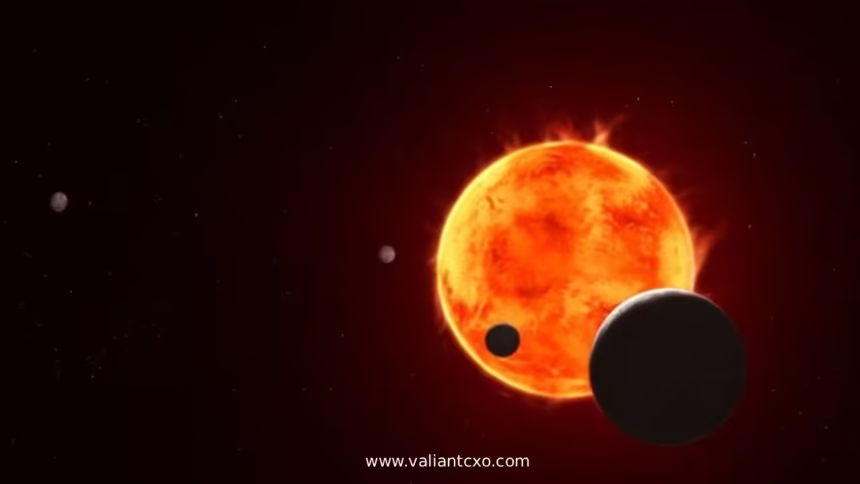
TRAPPIST‑1 is an ultra‑cool red dwarf star with seven Earth‑size planets. Several sit in the habitable zone.
Webb observations so far have:
- Started placing upper limits on thick hydrogen‑rich atmospheres.
- Looked for strong CO₂ features and found either very thin atmospheres or ones that are hard to detect with current data.
- Raised real questions: are these planets stripped by the star’s activity, or do they hold onto denser, secondary atmospheres?
This is where a lot of the “could this be habitable?” speculation lives. Agencies like NASA’s Exoplanet Exploration Program treat TRAPPIST‑1 as a long‑term project, not a one‑and‑done announcement.
Is TRAPPIST‑1e a blue‑marble twin of Earth? We don’t know yet, and anyone claiming otherwise is jumping the gun.
K2‑18 b: The “Hycean world” debate
K2‑18 b orbits in the habitable zone of a red dwarf and is bigger than Earth but smaller than Neptune.
Webb spectra have suggested:
- Strong signs of CO₂ and methane (CH₄).
- Possible water vapor and clouds.
- A composition that fits a hydrogen‑rich atmosphere over either a rocky or icy interior.
Some researchers have proposed it as a candidate “Hycean world” – a planet with an ocean under a hydrogen envelope. That’s a fascinating potential habitat class, but it’s also not Earth‑like. Surface pressure and temperature could be very non‑human‑friendly.
What I’d do if you’re trying to track this topic: follow updates from NASA, ESA, and major journals, and watch how the interpretation shifts as more data comes in. Early results are often refined.
How the james webb space telescope recent exoplanet discoveries actually work
The magic isn’t the telescope sitting in space; it’s how it uses light.
1. Transit spectroscopy
When a planet passes in front of its star:
- Some starlight filters through the planet’s atmosphere.
- Molecules in that atmosphere absorb specific wavelengths.
- Webb’s instruments (like NIRSpec and NIRISS) measure the tiny changes.
That yields a transmission spectrum, which is essentially the planet’s atmospheric barcode.
2. Emission and phase curves
For very hot planets, when the planet moves behind the star or around its orbit, Webb can:
- Measure the planet’s day‑side emission.
- Build thermal maps and see how heat is redistributed.
- Test predictions for winds, jets, and circulation patterns.
With the james webb space telescope recent exoplanet discoveries, these methods are being pushed harder and at higher precision than before.
3. Why infrared matters
Webb specializes in infrared wavelengths where:
- Key molecules (H₂O, CO₂, CH₄, CO) have strong absorption bands.
- Cool stars and temperate planets emit more of their energy.
- Dust and gas are more transparent.
In practical terms, that means Webb can pick up signals that were either too weak or completely inaccessible to Hubble and many ground‑based telescopes.
Step‑by‑step action plan for beginners who want to follow Webb’s exoplanet science
You don’t need a PhD to keep up. You just need a process.
1. Anchor yourself with trusted sources
Start with high‑authority, public science hubs:
- Go to the NASA James Webb Space Telescope mission site for official mission updates and press releases.
- Use NASA’s Exoplanet Catalog to look up planets like WASP‑39 b or TRAPPIST‑1e and see how their profiles change over time.
- Check ESA’s science pages when Webb results involve European instruments or teams.
These sites keep technical accuracy high and hype relatively low.
2. Learn how to read a simple exoplanet spectrum
You don’t need to decode every wiggle, but learn the basics:
- Identify the x‑axis (usually wavelength) and y‑axis (transit depth or flux).
- Look for labeled absorption features like H₂O, CO₂, or CH₄.
- See how model curves are compared to the data points.
Once you’ve done this with a couple of well‑explained cases, every new james webb space telescope recent exoplanet discoveries press release becomes easier to parse.
3. Track repeat observations, not one‑off headlines
Here’s what usually happens: early observations are noisy and uncertain, then multiple teams re‑observe, re‑analyze, and argue. That’s healthy.
So:
- Notice when a planet gets multiple Webb observation programs.
- Pay attention when results show up in peer‑reviewed journals tied to NASA, ESA, or reputable universities.
- Watch for consensus trends, not single dramatic claims.
4. Build your own “watchlist” of targets
Pick 3–5 exoplanets and follow them:
- A gas giant (e.g., WASP‑39 b).
- A hot Jupiter or hot Saturn.
- A temperate M‑dwarf system (e.g., TRAPPIST‑1).
- A sub‑Neptune or mini‑Neptune (e.g., K2‑18 b).
Over a year or two, you’ll see how interpretations evolve as more Webb data lands.
Common mistakes & how to fix them
When people first dive into james webb space telescope recent exoplanet discoveries, there are a few predictable traps.
Mistake 1: Treating “potentially habitable” as “Earth 2.0”
“Potentially habitable” usually means “could have liquid water under some conditions”, not “has oceans, continents, and breathable air.”
How to fix it:
- Always ask: What do we actually know about the atmosphere and temperature?
- Look for measured properties, not just the phrase “habitable zone.”
Mistake 2: Over‑weighting single preliminary studies
One dramatic preprint drops, social media explodes, and suddenly “life detected” trends for 24 hours.
How to fix it:
- Check if the result is confirmed by more than one team.
- See if it’s covered by NASA or major observatories rather than only personal blogs.
- Be patient with controversial claims until they survive peer review.
Mistake 3: Ignoring uncertainties and error bars
Those little vertical lines on a plot? They matter. A lot.
How to fix it:
- Notice whether the signal (say, methane) is clearly above noise across multiple data points.
- Read the summary: are scientists using cautious language (“consistent with,” “suggests”) or strong statements?
Mistake 4: Confusing models with direct measurements
Spectra are real measurements; the atmospheric composition, temperature profile, and cloud structure often rely on models.
How to fix it:
- Separate “we detected CO₂ at this wavelength” from “our model suggests this temperature structure.”
- Treat modeled details as best‑fit interpretations, not absolute facts.
Mistake 5: Assuming faster = better
Webb has a big backlog of targets. Not every hint becomes a formal result overnight.
How to fix it:
- Expect major exoplanet results to take months or years from observation to publication.
- See the pacing as a feature, not a bug: careful analysis beats rushed conclusions.
How these discoveries shape the search for life
So where does this all go?
The james webb space telescope recent exoplanet discoveries are laying the groundwork for future life‑detection missions, even if Webb itself isn’t likely to hand us a “life found” smoking gun.
In practical terms:
- Webb is narrowing down which planet types are promising: temperate, rocky, with atmospheres that are neither too thick nor stripped away.
- It’s telling designers of the next generation of space telescopes which wavelengths and instruments are worth the investment.
- It’s teaching scientists how to distinguish biological signals from abiotic processes, by studying weird but lifeless worlds in detail.
Think of it like scouting: Webb is mapping the terrain so the next missions know exactly where to dig deeper.
Key takeaways
- Webb’s exoplanet work is about precision, not sensationalism. The james webb space telescope recent exoplanet discoveries give detailed spectra, chemistry, and atmospheric properties rather than simple yes/no answers about life.
- Gas giants are the training ground. Planets like WASP‑39 b and WASP‑96 b let scientists perfect techniques that can later be applied to smaller, cooler worlds.
- TRAPPIST‑1 and similar systems are long games. They’re central to the habitability conversation, but answers about their atmospheres will come slowly and carefully.
- Spectra and models are different things. Webb measures the light; scientists build models to translate that into composition, temperature, and clouds.
- “Potentially habitable” is cautious language. It usually means “worth studying more,” not “confirmed Earth twin.”
- Beginners can follow along. By using trusted sources, learning to read simple spectra, and tracking a handful of planets, it’s possible to stay grounded and informed.
- The true payoff is future‑focused. Webb’s data is shaping how the next telescopes will be built to search for clear signs of life.
In my experience, the smartest way to approach all of this is with curious skepticism: excited by the possibilities, but anchored in what the data can actually support. The universe is under no obligation to hand us a second Earth quickly—and that’s exactly what makes each solid discovery worth paying attention to.
FAQs about james webb space telescope recent exoplanet discoveries
1. Has the james webb space telescope recent exoplanet discoveries found direct evidence of life?
No. The james webb space telescope recent exoplanet discoveries have revealed detailed atmospheric compositions—like CO₂, H₂O, CH₄, and SO₂—but none of these, on their own, count as proof of life. They are important building blocks for assessing habitability and planning future life‑detection missions.
2. Which planets are the most promising from the james webb space telescope recent exoplanet discoveries for potential habitability?
Right now, the most closely watched candidates include temperate, Earth‑size planets in systems like TRAPPIST‑1 and sub‑Neptunes such as K2‑18 b. The james webb space telescope recent exoplanet discoveries are helping scientists constrain whether these worlds have atmospheres and what those atmospheres might contain, but none are confirmed as truly Earth‑like.
3. How can non‑experts keep up with james webb space telescope recent exoplanet discoveries without getting misled by hype?
The best strategy is to lean on trusted organizations like NASA, ESA, and major research universities and to notice when multiple teams and instruments confirm a result. When reading about james webb space telescope recent exoplanet discoveries, always check whether the claim is based on published spectra, whether uncertainties are discussed, and whether cautious language is used instead of bold, unsupported declarations.