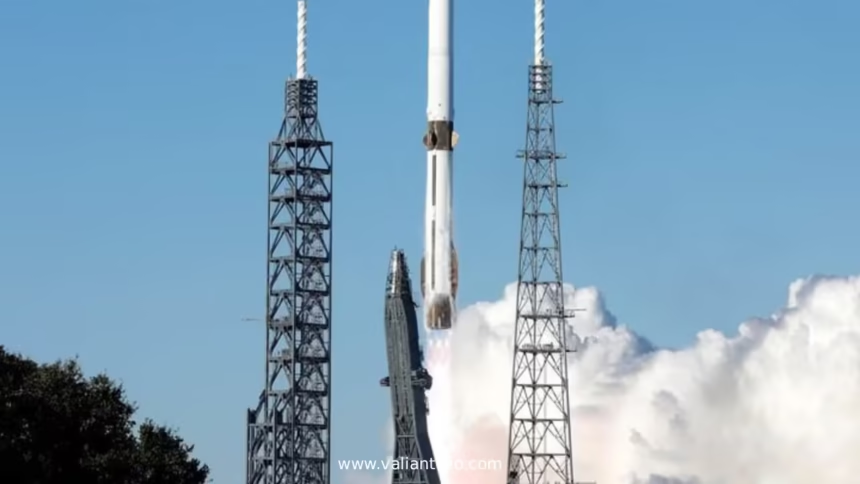
Blue Origin New Glenn rocket specifications and payload capacity define one of the most ambitious heavy-lift vehicles in the commercial space race right now.
Blue Origin New Glenn rocket specifications and payload capacity position it as a direct challenger to existing workhorses, offering massive fairing volume and reusable first-stage operations for lower costs on big payloads.
Here’s the quick rundown:
- 45 metric tons to low Earth orbit (LEO) in reusable mode for the baseline 7×2 version.
- 13.6 metric tons to geostationary transfer orbit (GTO).
- 7-meter diameter fairing with twice the volume of traditional 5-meter designs.
- First stage powered by seven BE-4 methalox engines, designed for 25+ flights.
This matters because it opens doors for larger satellites, lunar missions, and constellation deployments without breaking the bank on every launch.
Why New Glenn Stands Out in 2026
The rocket towers 98 meters tall—like a 32-story building—with a 7-meter diameter. Blue Origin built it for partial reusability from day one. The first stage lands back on a droneship or pad, cutting turnaround time and expenses.
Blue Origin New Glenn rocket specifications and payload capacity shine brightest for customers needing serious volume. That wide fairing swallows bulky payloads that smaller rockets force engineers to fold or segment. Think massive space telescopes, crewed lunar landers, or stacked satellite constellations.
In my experience covering heavy-lift programs, volume often bottlenecks more than pure mass. New Glenn flips that script.
Detailed Blue Origin New Glenn Rocket Specifications
The baseline New Glenn 7×2 uses seven BE-4 engines on the booster. Each produces around 2,846 kN of sea-level thrust, burning liquid oxygen and methane for cleaner, high-performance burns. The second stage relies on two BE-3U engines running liquid hydrogen and oxygen for efficient vacuum work.
Key specs:
- Height: 98 m (322 ft)
- Diameter: 7 m (23 ft)
- First stage thrust: Approximately 19,900 kN total
- Reusability: First stage targeted for 25+ flights
- Fairing: 7 m diameter, ~22 m tall, offering massive internal space
A newer 9×4 variant ups the ante with nine BE-4s on the first stage and four BE-3Us on the second. It promises over 70 metric tons to LEO and bigger fairings up to 8.7 meters. Blue Origin plans both versions to fly side-by-side depending on mission needs.
Blue Origin New Glenn Rocket Specifications and Payload Capacity: The Numbers That Count
Payload capability varies by orbit and recovery mode. Here’s the breakdown for the primary 7×2 configuration:
| Orbit/Mission | Payload Capacity (Reusable) | Notes |
|---|---|---|
| Low Earth Orbit (LEO) | 45,000 kg | Fully reusable first stage |
| Geostationary Transfer Orbit (GTO) | 13,600 kg | High-energy delivery |
| Trans-Lunar Injection (TLI) | ~7,000 kg | Lunar trajectory support |
| Direct GEO | Lower than GTO | Requires more delta-v |
The 9×4 variant jumps these figures significantly: >70,000 kg to LEO and >20,000 kg to TLI.
The kicker is reusability. Recovering that massive booster repeatedly changes the economics for operators tired of throwing away hardware.
How New Glenn Compares to the Competition
Put it next to SpaceX’s Falcon 9. New Glenn hauls roughly double the payload to LEO while offering way more internal room. Falcon Heavy gets close on some metrics but lacks the fairing volume for certain mega-payloads.
For national security or deep-space work, that extra capacity means fewer launches and simpler spacecraft designs. No more origami-style folding of solar arrays or antennas.
What would you rather do—launch three medium rockets or one New Glenn that carries everything intact?
Step-by-Step Guide: Getting Your Payload on New Glenn
Beginners and intermediate teams often feel lost in the launch provider maze. Here’s what I’d do:
- Define requirements. Calculate your satellite’s mass, dimensions, orbit, and timeline. Check against New Glenn’s 7m fairing envelope.
- Reach out early. Visit Blue Origin’s New Glenn payload page and submit your mission profile. They respond faster than you might expect.
- Work the interface. Collaborate on payload adapters, vibration specs, and separation systems. Blue Origin provides detailed user guides.
- Plan for reusability. Factor in the first stage recovery profile—it affects available performance margins.
- Schedule and manifest. Secure a slot. With increasing flight cadence in 2026, dedicated or rideshare options exist, especially for Amazon Leo or similar constellations.
- Test and integrate. Use Blue Origin’s facilities near Kennedy Space Center for final checks.
Follow this and you’ll avoid 90% of rookie headaches.
Common Mistakes & How to Fix Them
Teams new to heavy-lift often underestimate fairing dynamics. They design payloads assuming tight 5m constraints and end up with last-minute redesigns. Fix: Use the full 7m volume from concept stage.
Another pitfall: Ignoring recovery impacts on performance. Reusable flights trade a bit of payload for booster return. Solution—run trade studies early with Blue Origin’s team.
Overlooking integration timelines kills schedules. Start payload-to-rocket interface work 18-24 months out. What usually happens is rushed testing leads to costly delays.
Finally, some assume Starship-level capacity today. New Glenn delivers proven heavy lift now while Starship matures.
Blue Origin New Glenn Rocket Specifications and Payload Capacity in Action
By mid-2026, New Glenn has flown multiple missions, including Amazon Leo satellite deployments. The first stage reuse milestone marked a big win for cost reduction. Upper stage teething issues appeared on one flight, but that’s typical for new vehicles—Blue Origin fixed and pressed on.
This rocket targets everything from mega-constellations to lunar infrastructure. Its methalox first stage and hydrolox upper stage balance performance and operability.
Key Takeaways
- Blue Origin New Glenn rocket specifications and payload capacity deliver 45t to LEO and 13.6t to GTO in the baseline version.
- The 7m fairing provides unmatched volume for complex payloads.
- First-stage reusability drives down costs over multiple flights.
- Both 7×2 and upcoming 9×4 variants give customers flexibility.
- Ideal for commercial, civil, and national security missions needing scale.
- Integration starts with clear requirements and early engagement.
- 2026 marks growing operational maturity with higher flight rates.
- It fills a critical gap between medium and super-heavy lift options.
New Glenn isn’t just another rocket. It represents a practical leap toward reliable, high-capacity access to space—like upgrading from a pickup truck to a heavy hauler when your business outgrows the old rig.
Ready to explore options? Head to Blue Origin’s site and start the conversation with their payload team today.
FAQs
What are the main Blue Origin New Glenn rocket specifications and payload capacity highlights for 2026?
The baseline vehicle stands 98m tall with a 7m fairing, seven BE-4 first-stage engines, and delivers 45 metric tons to LEO reusable plus 13.6 metric tons to GTO.
How does New Glenn’s payload capacity compare for different mission types?
It excels at LEO for constellations and GTO for communications satellites. The larger 9×4 version boosts numbers for lunar or deep-space work exceeding 70 tons to LEO.
Can smaller teams or startups use Blue Origin New Glenn rocket specifications and payload capacity for their missions?
Yes. Rideshare opportunities and dedicated slots accommodate various sizes. Early engagement with Blue Origin helps fit unique payloads within the massive fairing.