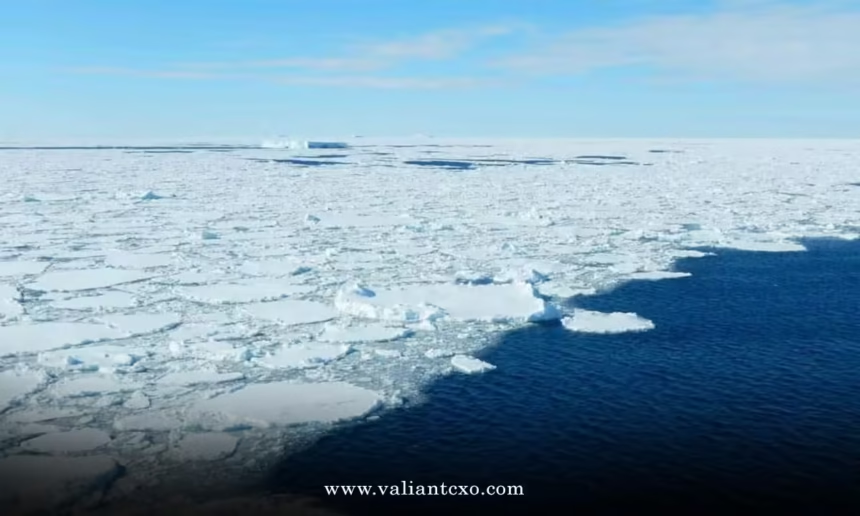
Southern Ocean sea ice decline 2025 causes and impacts isn’t just another climate headline; it’s a hard pivot point in how Earth’s climate system behaves.
Antarctic sea ice used to be the “weird exception” in climate charts—kind of stable, sometimes even growing a bit, while the Arctic tanked. That story flipped fast between 2016 and 2025, and by 2023–2025 scientists were openly calling some of the recent lows “unprecedented” in the observational record.
Here’s the quick-hit version for busy brains:
- What it is: A sharp, sustained drop in Antarctic sea ice extent and seasonal coverage in the Southern Ocean, especially since mid‑2010s, with extreme lows in 2022–2023 and weak recovery toward 2025.
- Why it matters: Sea ice helps regulate global temperature, stabilizes weather patterns, and protects Antarctic ice shelves; losing it speeds up warming and sea-level rise.
- Key drivers: Ocean warming, shifts in Southern Hemisphere winds, changes in sea-ice–ocean feedbacks, plus natural variability layered on top of human‑driven climate change.
- Main impacts: Stronger ocean heat uptake, stress on krill and penguin habitats, more exposed coastlines and vulnerable ice shelves, and knock‑on effects for global weather and fisheries.
- What to do: Support aggressive emissions cuts, monitor credible data sources, reduce ocean-related risks in business planning, and back adaptation measures in polar and coastal systems.
The Southern Ocean sea ice decline 2025 causes and impacts: the big picture
The Southern Ocean sea ice decline 2025 causes and impacts story starts with a simple fact: Antarctic sea ice is shrinking faster and more erratically than most scientists expected a decade ago.
Historically, Antarctic sea ice showed high year‑to‑year variability. Some years up, some years down. But:
- 2016 marked the start of a sharp downturn.
- 2022 and 2023 saw record‑low winter maximums, according to the U.S. National Snow and Ice Data Center (NSIDC).
- Early to mid‑2025 data suggest only partial recovery, not a return to the old “normal.”
In my experience, when a system that’s noisy but broadly stable suddenly shifts into a new range and stays there, you don’t ignore it. You treat it like a warning light on the dashboard.
So what changed?
Quick climate context
Sea ice in the Southern Ocean:
- Reflects sunlight back to space (high albedo).
- Insulates the relatively warm ocean from the cold atmosphere.
- Influences wind patterns and ocean circulation, including deep‑water formation.
When that ice disappears earlier in the season, or doesn’t grow back as much:
- Darker ocean absorbs more heat.
- Surface waters warm and stratify.
- It becomes harder to rebuild thick, resilient ice the following year.
That’s where the feedback loops kick in.
Breaking down the Southern Ocean sea ice decline 2025 causes and impacts
Main drivers (what’s pushing the decline)
1. Ocean warming: heat from below
The Southern Ocean has been absorbing a big chunk of the planet’s excess heat from greenhouse gas emissions. Multiple studies and assessments (including those summarized by the Intergovernmental Panel on Climate Change) show:
- Southern Ocean waters are warming, especially at intermediate depths.
- Warm water is getting closer to the surface in some regions, undercutting sea ice from below.
Think of it like turning up the underfloor heating while trying to keep an ice rink frozen. You can chill the air all you want; if the slab is warming, the ice loses.
2. Shifting winds and the Southern Annular Mode
Winds are a big deal for Antarctic sea ice. They push ice outward, open gaps (leads), and help freeze new ice.
Two key pieces:
- Southern Annular Mode (SAM): A major pattern in Southern Hemisphere climate, influenced by ozone depletion and greenhouse gases. Positive phases tend to shift westerly winds poleward and change how heat and moisture move.
- Regional wind anomalies: Changes in storm tracks and persistent pressure systems can compact ice, break it up, or push it into warmer waters where it melts faster.
In the last decade, more frequent positive SAM phases and altered wind patterns have lined up with reduced ice in key sectors of the Southern Ocean.
3. Ocean stratification and feedback loops
Less ice means more open water, which:
- Absorbs more solar radiation.
- Warms the upper ocean.
- Strengthens stratification (layering between warmer surface water and colder deep water).
Once that stratification sets in, mixing cold water up to the surface becomes harder. That undercuts the “reset” that used to happen each winter, when the ocean cooled enough to rebuild thick ice.
In practice, you get thinner, more fragile ice that’s easier to break and melt.
4. Natural variability on top of human‑driven change
Agencies like NSIDC and the British Antarctic Survey have been clear about this: part of the recent slump in Antarctic sea ice is natural variability—things like El Niño–Southern Oscillation (ENSO), the Pacific Decadal Variability, and chaotic regional weather.
But that variability is now sitting on a warmer background climate. So what used to be a “bad year” for ice can become a record‑shattering year.
Objective fact:
- Greenhouse gas concentrations (CO₂, methane, nitrous oxide) have continued to climb, as documented by NOAA’s Global Monitoring Laboratory.
Professional take:
- The baseline has shifted. Natural swings are now more likely to drive sea ice into extreme low territory than they were 30–40 years ago.
Southern Ocean sea ice decline 2025 causes and impacts on the climate system
So what does this actually do to the planet?
1. Faster ocean heat uptake and feedbacks
With less ice:
- The Southern Ocean absorbs more solar energy.
- More heat gets stored at depth, contributing to long‑term warming.
- Surface conditions change in ways that can alter cloud formation and storm development.
This matters because the Southern Ocean has been a major buffer, slowing the pace of atmospheric warming. If that buffer shifts behavior, global temperature trajectories and regional climate patterns can change in ways models are still catching up to.
2. Pressure on ice shelves and sea-level rise
Sea ice doesn’t directly raise sea level when it melts—just like an ice cube melting in your glass doesn’t overflow the drink.
But there’s a catch.
Sea ice:
- Damps wave energy.
- Reduces direct wave attack on ice shelves (the floating extensions of the Antarctic ice sheet).
When sea ice cover shrinks:
- Ice shelves face more wave action and warmer waters.
- They can weaken and calve more often.
If ice shelves thin or collapse, grounded ice behind them can accelerate toward the ocean. That’s where long‑term sea-level rise risk lives.
Objective fact:
- Ice shelf thinning and grounding line retreat have been observed in parts of West Antarctica, documented by NASA and multiple peer‑reviewed studies.
Opinion:
- Sea ice loss doesn’t cause sea-level rise on its own, but it’s part of the stress network that makes big ice sheet changes more likely over decades.
3. Weather and circulation knock‑on effects
Antarctic sea ice influences:
- Temperature gradients between the pole and mid‑latitudes.
- Position and strength of Southern Hemisphere storm tracks.
- Deep water formation that helps drive global ocean circulation.
Changes here can ripple outward, contributing to:
- Shifts in rainfall belts in the Southern Hemisphere.
- Changes in the frequency or position of blocking highs and storm systems.
- Longer‑term adjustments in how heat and carbon move through the global ocean.
Will the Southern Ocean sea ice decline 2025 causes and impacts directly trigger a single storm in the U.S.? No. But it does load the climate dice over seasons and years.
Ecosystems and human systems: who feels it first?
Impacts on marine life
Sea ice in the Southern Ocean is like a mobile neighborhood for life.
When it shrinks or changes:
- Krill habitat shifts. Antarctic krill feed under sea ice and rely on sea-ice–associated algae early in life.
- Penguins and seals lose reliable platforms and feeding patterns tied to ice edges.
- Food webs wobble, affecting everything from seabirds to whales.
Organizations like the Commission for the Conservation of Antarctic Marine Living Resources (CCAMLR) track these dynamics because they directly affect fisheries and conservation strategies.
In my experience, ecosystem disruptions show up as mismatches: breeding seasons out of sync with peak food, migration routes no longer lined up with sea ice, and higher mortality in sensitive species.
Impacts on fisheries and resource planning
For U.S. and global stakeholders, the Southern Ocean sea ice decline 2025 causes and impacts matter because:
- Antarctic krill and related species feed into global seafood supply chains, directly or indirectly.
- Changes in Southern Ocean conditions can influence broader ocean circulation, which is tied to fisheries productivity in mid‑latitudes.
- Science-based management strategies rely on historical patterns; those patterns are now shifting.
If your world touches seafood, shipping, or marine conservation, ignoring Antarctic sea ice trends is like planning a harvest without looking at the weather forecast.
Quick reference: Southern Ocean sea ice decline 2025 causes and impacts at a glance
| Aspect | What’s Changing | Main Causes | Key Impacts | Who Should Care Most |
|---|---|---|---|---|
| Sea Ice Extent | Lower seasonal maximums and minimums vs. late 20th century average | Ocean warming, wind shifts, natural variability | More open water, higher heat absorption | Climate scientists, policymakers |
| Ice Thickness & Duration | Thinner ice, shorter season in some regions | Warmer surface waters, stratification, feedback loops | Reduced albedo, fragile ice cover | Polar researchers, modelers |
| Ecosystems | Shifts in krill, penguin, and seal habitats | Loss of stable ice platforms, food-web changes | Stress on marine biodiversity, fishery uncertainty | Conservation groups, fisheries managers |
| Ice Shelves & Sea Level | Increased exposure of ice shelves to waves and warmth | Less coastal sea ice protection, warm water incursions | Potential acceleration of ice shelf thinning and ice flow | Coastal planners, insurance, national governments |
| Global Climate System | Altered heat and carbon uptake patterns | Reduced ice cover, circulation changes | Shifts in weather patterns over decades | Energy, agriculture, infrastructure sectors |
Step-by-step action plan for beginners: how to track and respond to this shift
Let’s get practical. If you’re not a polar scientist but you want to be smart about the Southern Ocean sea ice decline 2025 causes and impacts, here’s how to approach it.
Step 1: Ground yourself in trusted data
- Start with reputable, public datasets and summaries.
- Regularly check:
- NSIDC Antarctic sea ice updates for current extent and anomalies.
- NOAA climate summaries for global context and greenhouse gas trends.
- IPCC assessment reports for synthesized science on polar change.
- Treat social media charts as conversation starters, not final truth.
Step 2: Learn the basic terms
Focus on a small vocabulary that unlocks most discussions:
- Sea ice extent vs. area vs. thickness.
- Albedo, stratification, Southern Annular Mode (SAM).
- Difference between Antarctic sea ice and the Antarctic ice sheet.
Once these click, journal articles and news coverage stop sounding like another language.
Step 3: Understand the time scales
What usually happens is people either panic over a single record year or dismiss the whole thing because “it bounced back a bit.”
Better mindset:
- Track multi‑year trends, not just one season.
- Recognize that natural variability can mask or amplify the underlying trend for a few years.
- Ask: “Is the baseline shifting?” more than “Did this year set a record?”
Step 4: Map it to your world
If you’re in the U.S., how do Southern Ocean sea ice decline 2025 causes and impacts touch you?
Examples:
- Climate‑linked business risk (insurance, agriculture, logistics).
- Long‑term coastal planning and sea-level rise assumptions.
- Conservation and fisheries policy stances.
What I’d do if I were building strategy content, a business plan, or educational material:
- Include Antarctic sea ice trends as a supporting signal in climate risk sections.
- Use trusted sources (IPCC, NOAA, NSIDC) for visuals and references.
- Avoid overclaiming (“this storm was caused by X”) and focus on probabilities and long‑term shifts.
Step 5: Support mitigation and adaptation
You don’t control the Southern Ocean, but you can influence climate outcomes indirectly and support adaptation:
- Back policies that reduce greenhouse gas emissions at federal, state, and local levels.
- Support funding for polar research, Earth observation satellites, and long‑term monitoring.
- Encourage institutions you’re part of (universities, companies, cities) to include polar feedbacks in risk assessments.
This isn’t about guilt; it’s about informed, targeted leverage.
Common mistakes about Southern Ocean sea ice decline 2025 causes and impacts (and how to fix them)
Mistake 1: Treating one bad year as proof of “collapse”
Sea ice can have a terrible year and then partially rebound. That doesn’t mean the system is fine, and it doesn’t mean instant catastrophe either.
Fix:
Look at 10‑ to 15‑year trends and compare them to the previous few decades. Use NSIDC or similar long‑term datasets instead of just viral graphs.
Mistake 2: Confusing sea ice with ice sheets and icebergs
In conversations, “Antarctic ice” often gets lumped together.
Sea ice:
- Floats on the ocean.
- Doesn’t raise sea level when it melts.
Ice sheets and glaciers:
- Sit on land.
- Raise sea level when they lose mass.
Fix:
Be precise. When talking about Southern Ocean sea ice decline 2025 causes and impacts, call it sea ice, and separately reference ice shelves or ice sheet mass loss when relevant.
Mistake 3: Ignoring natural variability or, conversely, blaming it for everything
Some people talk like it’s all natural; others act like nature just left the chat once CO₂ rose.
Reality:
- Both human‑driven warming and natural variability shape Antarctic sea ice.
- The warming baseline makes extreme lows more likely and persistent.
Fix:
Use language like: “Human‑driven warming sets the stage; natural variability shapes the year‑to‑year drama.”
Mistake 4: Assuming Antarctic sea ice doesn’t matter for non‑polar regions
It’s thousands of miles away, so it must be irrelevant… right?
Not really.
Sea ice shifts:
- Alter heat uptake and ocean circulation.
- Affect long‑term patterns in temperature and rainfall.
Fix:
Frame Antarctic sea ice as part of the global climate plumbing. You may not see it daily, but you feel its influence over time.
Mistake 5: Over‑simplifying the cause as “just global warming”
Yes, greenhouse gases are a big driver. But the mechanism matters: winds, ocean stratification, feedback loops, ozone changes, and regional patterns.
Fix:
When explaining Southern Ocean sea ice decline 2025 causes and impacts, mention at least:
- Ocean warming
- Wind changes (SAM, storm tracks)
- Feedback loops (albedo, stratification)
- Natural variability
That’s a more honest, useful story.
How this connects to wider climate policy and public understanding
If you work in policy, education, or communications, the Southern Ocean story is a strong case study.
You can use it to:
- Show that climate change isn’t linear—it has thresholds and surprises.
- Explain why long‑term monitoring and satellites are non‑negotiable infrastructure.
- Highlight the importance of including polar processes in climate models and risk tools.
One sharp question to ask in any planning or policy meeting:
“If the Southern Ocean continues on this lower sea ice trajectory for the next 20 years, what assumptions in our current plans become outdated?”
That question alone can surface hidden vulnerabilities in coastal projects, fisheries management, and even national security planning.
For deeper technical background, the climate sections of the latest IPCC reports, the NOAA climate pages, and NSIDC data portals are excellent starting points for serious readers.
Key Takeaways
- The Southern Ocean sea ice decline 2025 causes and impacts signal a real shift, not just a one‑off fluke; recent lows are unprecedented in the modern satellite record.
- Ocean warming and changing winds are the primary drivers, with natural variability amplifying or muting the decline year to year.
- Sea ice loss doesn’t directly raise sea level, but it exposes Antarctic ice shelves to more stress, increasing long‑term sea‑level risk.
- Ecosystems built around sea ice—krill, penguins, seals—are under pressure, with potential knock‑ons for fisheries and conservation.
- The Southern Ocean controls a big slice of Earth’s heat and carbon uptake, so changes there shape global climate patterns over decades.
- Common mistakes include overreacting to single years, ignoring natural variability, and confusing sea ice with ice sheets; precise language and multi‑year data fix that.
- For beginners, the practical play is simple: follow trusted data sources, learn core terms, link trends to your sector, and support emissions cuts plus polar research.
- For planners and strategists, Antarctic sea ice should be treated as a key climate risk indicator, not a niche scientific curiosity.
When a system this remote starts flashing big signals, smart people pay attention early—because by the time it shows up clearly at your doorstep, the options are narrower and more expensive.
FAQs
1. How does Southern Ocean sea ice decline 2025 causes and impacts relate to Arctic sea ice loss?
Both poles are losing ice, but the patterns differ. Arctic sea ice has shown a steady, long‑term decline, while Antarctic sea ice was variable and even grew slightly before dropping sharply from around 2016 onwards. The southern decline is now catching more attention because it suggests Antarctic sea ice is entering a new, warmer regime, reinforcing global feedbacks already driven by Arctic loss.
2. Does the Southern Ocean sea ice decline 2025 causes and impacts directly affect U.S. weather?
Not in a simple one‑to‑one way—no single storm or heatwave can be pinned solely on Antarctic sea ice. But over seasons to decades, reduced Southern Ocean sea ice influences ocean heat uptake and circulation, which in turn shape global temperature patterns and atmospheric circulation. That broader reshaping feeds into the background conditions that affect U.S. weather, coastal risk, and long‑term climate trends.
3. What’s the most important thing non‑experts should remember about Southern Ocean sea ice decline 2025 causes and impacts?
The key is that it’s both a symptom and a feedback of a warming planet. It confirms that parts of the climate system once considered relatively stable are now shifting, and that these shifts can quietly “rewire” how heat and carbon move around the globe. If you remember that Antarctic sea ice is part of the planet’s cooling system—and that we’re weakening that system—you’re already ahead of most conversations.