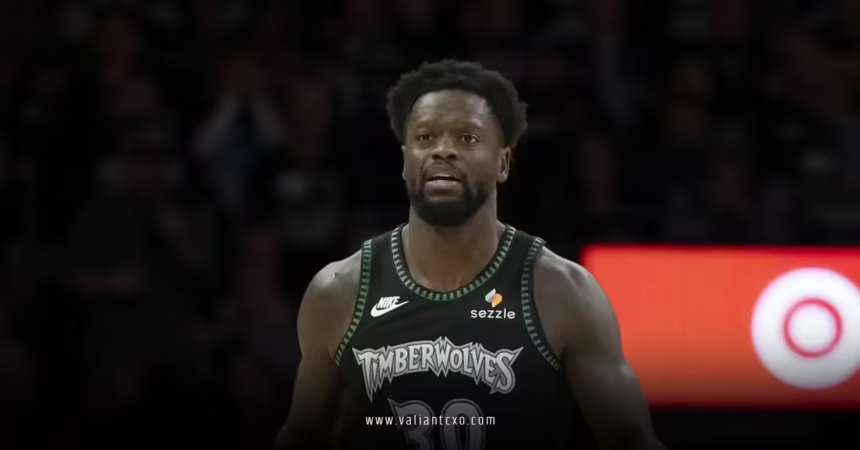
Julius Randle traded to Nets—just hours before the 2026 NBA Draft tipped off, the Brooklyn Nets, Minnesota Timberwolves, and Chicago Bulls pulled off one of the most talked-about trades of the offseason. It reshaped three rosters in one move and sent shockwaves across the Eastern Conference.
Quick-hit overview — what you need to know right now:
- 🏀 The deal: Minnesota sends Julius Randle + the No. 28 pick to Brooklyn; Brooklyn sends Nic Claxton to Chicago; the Timberwolves receive the No. 33 pick
- 💰 The money play: Minnesota dumps Randle’s $33.3M salary for 2026–27, creating a sizable trade exception to go after better fits around Anthony Edwards
- 📍 Brooklyn’s angle: The Nets land a three-time All-Star and a first-round pick as they try to accelerate their rebuild
- 📈 Randle’s recent production: 21.1 points, 6.7 rebounds, and 5.0 assists per game in 79 regular-season games in 2025–26, shooting 48.1% from the field
- 🔄 The Claxton subplot: Chicago scoops up a rim-protecting center at no asset cost—arguably the sneaky-best value in the whole deal
Julius Randle Traded to Nets: Breaking Down the Full Trade
Let’s set the scene. It’s the eve of the 2026 NBA Draft. Teams are finalizing their boards, agents are burning phone lines, and then — boom. Shams Charania drops the trade on ESPN: Julius Randle is headed to Brooklyn.
This is a three-team trade, and that matters because each franchise is solving a completely different problem.
Here’s the complete breakdown:
| Team | Receives | Gives Up |
|---|---|---|
| Brooklyn Nets | Julius Randle, No. 28 Pick (2026 Draft) | Nic Claxton, No. 33 Pick |
| Minnesota Timberwolves | No. 33 Pick (2026 Draft) | Julius Randle, No. 28 Pick |
| Chicago Bulls | Nic Claxton | Nothing |
Three
teams. Three different motivations. One deal that made sense for everyone — at least on paper.
Why Minnesota Pulled the Trigger
The Timberwolves aren’t rebuilding. They’re trying to win right now with Anthony Edwards. Carrying Randle’s $33.3 million cap hit into 2026–27 — and potentially $35.8 million in 2027–28 if he exercised his player option — was becoming a strategic anchor around their neck.
The kicker is this: Randle struggled badly in the playoffs this past season. When the games slowed down and defenses keyed in, his limitations were exposed. Minnesota’s front office saw the writing on the wall and moved decisively.
By offloading Randle (and sweetening the deal with the No. 28 pick), the Wolves create roughly a $33 million trade exception — enough room to retain guard Ayo Dosunmu and continue building the supporting cast around Edwards. You don’t win championships with a mismatched roster, no matter how good your star is.
What Brooklyn Gets Out of Julius Randle Traded to Nets
A three-time All-Star and a first-round pick on the same night? Not bad for a franchise that’s been in rebuild purgatory for what feels like forever.
Here’s the thing about Randle: when he’s locked in, he’s one of the most complete offensive forwards in the league. His regular-season numbers this past year — 21.1 points, 6.7 boards, and 5.0 assists — weren’t a fluke. He’s a legitimate No. 1 scoring option who can post up, hit mid-range shots, and run pick-and-roll with authority.
Brooklyn now enters the 2026–27 season holding both the No. 6 pick and the newly acquired No. 28 pick from this deal. Pair those young assets with Randle’s veteran presence, and you’ve got the bones of something real.
The projected starting lineup gets interesting fast. According to Sports Illustrated’s Nets coverage, Brooklyn is expected to slot Randle at power forward alongside Day’Ron Sharpe and Michael Porter Jr. — a frontcourt that can score, rebound, and develop together.
Think of it like this: Randle is the seasoned chef being dropped into a kitchen full of talented young cooks. He can show them how it’s done while the restaurant figures out its long-term menu.
Julius Randle Traded to Nets — What It Means for Every Fan Base
For Nets Fans: Measured Optimism Is the Right Call
Brooklyn isn’t suddenly a playoff lock. Let’s be honest about that. But this move signals something critical — the front office is done tanking.
Randle gives the Nets exactly what they’ve lacked: a proven isolation scorer who demands defensive attention. Younger players like Danny Wolf, Egor Dëmin, and Nolan Traoré now have a veteran presence in the locker room who has been through deep playoff runs and high-pressure moments.
Is he the final piece? No. But he’s the first meaningful veteran building block in a while.
For Timberwolves Fans: Short-Term Pain, Long-Term Gain
Dropping from pick No. 28 to No. 33 stings a little, but in the grand scheme? That’s a rounding error on a $33M cap relief. Minnesota is in win-now mode, and flexibility is more valuable than a late first-rounder when Anthony Edwards is in his prime.
Watch for the Wolves to be active in free agency now. This trade cleared the runway.
For Bulls Fans: Nic Claxton Is Pure Upside
Chicago gets Claxton — a legitimate rim protector with two years left on his contract — without giving up a single asset. Under new head coach Tiago Splitter, Claxton’s athleticism and shot-blocking could transform their interior defense overnight. Don’t sleep on this piece of the deal.
Step-by-Step: How to Follow This Trade and What Happens Next
New to NBA trades and not sure how to track what happens after? Here’s a simple action plan:
- Verify the trade is official. The deal was reportedly still pending NBA approval as of Monday night. Check the official NBA transactions page for confirmation.
- Track Randle’s roster spot in Brooklyn. Once approved, the trade officially processes and Randle’s number/jersey information will appear on the Nets’ official roster.
- Watch the 2026 NBA Draft (Tuesday night). Brooklyn now holds both the No. 6 and No. 28 picks. Who they select will tell you a lot about their direction.
- Monitor Minnesota’s free agency moves. The whole point of this trade was to create room. If the Wolves sign a key free agent in the next 48–72 hours, that validates the entire strategy.
- Check Randle’s player option deadline. He holds a $35.8M player option for 2027–28. Whether he picks it up will depend heavily on how his first season in Brooklyn goes — circle that date.
Common Mistakes Fans Make Reading This Trade (And How to Think About It Correctly)
Mistake #1: Treating this as a pure “win” for Brooklyn Randle had genuine playoff struggles in 2025–26. Absorbing a 31-year-old on a $33M+ deal isn’t without risk for a rebuilding team. He needs to show he can elevate his game when it matters most — not just in the regular season.
Fix: Judge this move 12 months from now, after you see how he fits with Brooklyn’s young core.
Mistake #2: Assuming Minnesota lost the trade Giving up a late first-rounder to clear $33M in cap space isn’t a loss — it’s a calculated sacrifice. Minnesota’s priority is maximizing the window around a franchise player in his prime. That math checks out.
Fix: Evaluate the Wolves’ trade by what they do with the freed-up money, not by the Randle deal in isolation.
Mistake #3: Ignoring the Claxton piece Chicago quietly wins this deal if Claxton stays healthy. Two years of a quality rim protector at no asset cost is legitimate value.
Fix: Watch the Bulls’ 2026–27 defensive metrics. If they improve significantly in the paint, the Bulls’ front office deserves credit for identifying value in this three-way swap.
Julius Randle — Career Snapshot at the Time of the Trade
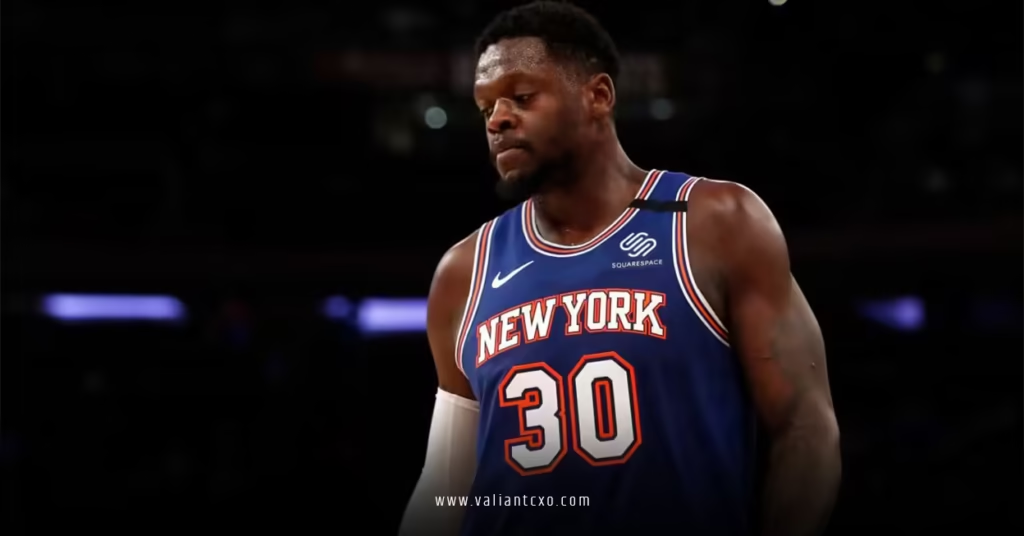
Before calling this a “risky” move for Brooklyn, zoom out on the full career arc. Randle was the 7th overall pick in the 2014 NBA Draft out of Kentucky. He’s worn the jerseys of the Los Angeles Lakers, New Orleans Pelicans, New York Knicks, Minnesota Timberwolves — and now the Brooklyn Nets.
His peak with the Knicks in 2020–21 — when he made the All-NBA First Team and averaged 24.1 points — is still the standard people hold him to. Is that version coming back? Maybe not. But his 2025–26 regular season numbers per ESPN suggest there’s still plenty left in the tank.
Can a change of scenery — back in the New York metro area, no less — unlock the best version of Julius Randle? That’s the billion-dollar question Brooklyn is betting on.
Key Takeaways
Here’s what matters most when you step back from all the noise:
- 📌 The trade is a three-team deal: Nets get Randle + No. 28 pick; Wolves get No. 33 pick; Bulls get Nic Claxton
- 📌 Minnesota’s primary goal was salary relief — not a rebuild — creating ~$33M in cap space to retain and recruit talent around Anthony Edwards
- 📌 Randle had a strong regular season in 2025–26 (21.1 PPG, 6.7 RPG, 5.0 APG) but struggled badly in the playoffs
- 📌 Brooklyn holds two first-round picks in the 2026 Draft (No. 6 and No. 28) plus a veteran All-Star — a significant rebuild acceleration
- 📌 Nic Claxton moves to Chicago at no cost to the Bulls — quietly the best value in the entire deal
- 📌 Randle has a $35.8M player option in 2027–28 — his performance next season will determine whether he stays in Brooklyn long-term
- 📌 This trade was finalized on draft eve — watch Brooklyn’s draft night picks to understand their full vision
- 📌 For beginners: Three-team trades happen when no two-team swap works perfectly — everyone gets something they need
The league moves fast. Randle is a Net now, Brooklyn has real pieces to work with heading into 2026–27, and Minnesota’s got the flexibility to make a serious push. Whether this goes down as a savvy pivot or a costly mistake will play out over the next two seasons. Stay tuned.
FAQs
Q: Why was Julius Randle traded to the Nets instead of another team?
The Brooklyn Nets had the cap space to absorb Randle’s $33.3 million salary without taking on significant risk to their long-term plans. They also held Nic Claxton’s contract, which Chicago wanted — making a three-team deal the cleanest path to getting everyone what they needed. Brooklyn’s willingness to part with a first-round pick (No. 33) made Minnesota say yes.
Q: How does the Julius Randle trade to the Nets affect the 2026 NBA Draft for Brooklyn?
Significantly. Before the deal, the Nets held the No. 6 pick. After acquiring Randle, they also gained the No. 28 pick from Minnesota. That gives Brooklyn two first-round selections on draft night — a rare position that lets them target both a high-ceiling prospect and a more polished, near-ready player in the same night.
Q: What happens if Julius Randle declines his player option in 2027–28?
If Randle opts out of his $35.8 million player option, he becomes an unrestricted free agent after the 2026–27 season. That would free up significant cap space for Brooklyn. Given his age (he’ll be 32 going into 2027–28), the decision will likely hinge on how well he performs alongside Brooklyn’s young core — and whether a team offers him a longer or more lucrative deal on the open market.