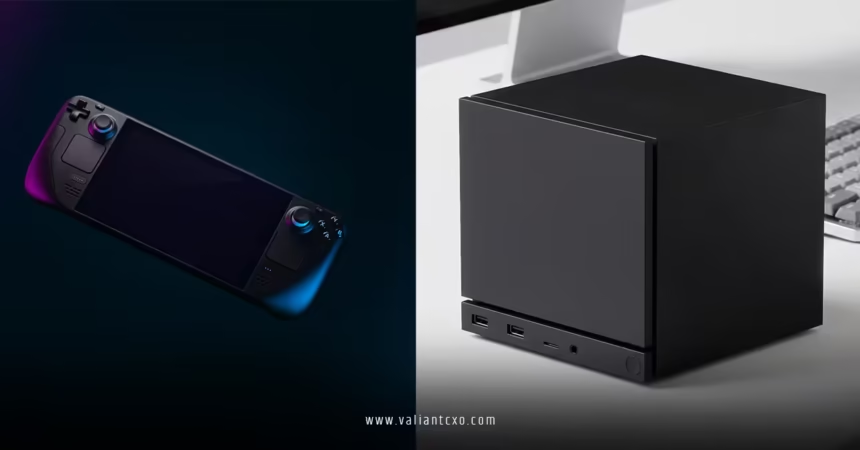
Steam Deck vs Steam Machine is one of the hottest debates in PC gaming right now — and honestly, it’s not even close to an apples-to-apples comparison once you dig past the surface.
Both devices run SteamOS. Both carry the Valve badge. But stop right there. These two machines are built for completely different kinds of gamers, and buying the wrong one could leave you with serious buyer’s remorse.
Here’s the 30-second summary before we go deep:
- 🎮 Steam Deck — A portable handheld gaming PC. Play anywhere. Lower price (~$549 OLED). AMD Zen 2 CPU + RDNA 2 GPU. Built-in 7″ screen.
- 🖥️ Steam Machine — A living-room mini PC console. Stationary. Starts at $1,049. AMD Zen 4 CPU + RDNA 3 GPU with discrete 8GB GDDR6 VRAM.
- ⚡ Power Gap — Valve officially claims the Steam Machine is over 6× more powerful than the Steam Deck.
- 📋 Availability — The Steam Machine launches via a randomized reservation queue (more on that below).
- 🎯 The Bottom Line — Portability vs raw power. They serve different gaming lifestyles entirely.
Let’s break down every dimension that actually matters.
Steam Deck vs Steam Machine: The Full Spec Breakdown
No fluff. Just the numbers.
| Feature | Steam Deck (OLED) | Steam Machine (2026) |
|---|---|---|
| CPU | AMD Zen 2, 4-core / 8-thread | AMD Zen 4, 6-core / 12-thread, up to 4.8 GHz |
| GPU | AMD RDNA 2, 8 Compute Units | AMD RDNA 3, 28 Compute Units, 110W TDP |
| System RAM | 16GB LPDDR5 (shared) | 16GB DDR5 (dedicated) |
| VRAM | ~4GB (shared from system pool) | 8GB GDDR6 (dedicated) |
| Storage | 512GB NVMe SSD | 512GB or 2TB NVMe SSD |
| Display Output | 7.4″ OLED built-in | DisplayPort 1.4 (4K@240Hz), HDMI 2.0 (4K@120Hz) |
| Target Resolution | 800p–1080p native | 4K @ 60fps with FSR upscaling |
| Ray Tracing | Limited / marginal | ✅ Supported |
| Wi-Fi | Wi-Fi 6E | Wi-Fi 6E |
| Portability | ✅ Fully portable | ❌ Stationary (desk/TV setup) |
| Battery | Yes (~8–12 hours light gaming) | ❌ Plugged-in only |
| Starting Price (USD) | ~$549 (OLED) | $1,049 |
| OS | SteamOS 3 | SteamOS 3 |
| Form Factor | Handheld | 152mm compact cube (2.6 kg) |
| Availability | In stock via Steam store | Randomized reservation queue |
Sources: TechRadar’s Steam Machine vs Steam Deck breakdown, GosuGamers official specs, Tom’s Hardware reservation coverage
The Performance Gap Is Massive — Here’s What It Actually Means
Valve’s “6× more powerful” claim sounds like marketing copy. It isn’t.
The Steam Deck runs a 4-core Zen 2 chip with integrated RDNA 2 graphics pulling from a shared memory pool. The Steam Machine uses a discrete Zen 4 CPU paired with a fully separate RDNA 3 GPU rocking 8GB of dedicated GDDR6 VRAM. That memory separation alone is a fundamental architectural leap — your games stop competing with the OS for RAM bandwidth.
Real-world benchmarks from early testing show the Steam Machine hitting around 65 FPS in Cyberpunk 2077 at medium settings with FSR — a game the Steam Deck struggles to push past 30fps even with aggressive upscaling and dropped settings. That’s not a minor gap. That’s a different class of machine entirely.
What does this mean practically?
- Steam Deck territory: indie games, older titles, light AAA gaming at 40–60fps in 800p/1080p. Perfect for the couch, the commute, the bed.
- Steam Machine territory: 1440p and 4K gaming, modern AAA titles with visual fidelity intact, home theater setups, consistent high-frame-rate gameplay.
The kicker is that both machines run the same SteamOS and share your Steam library. You’re not picking a different ecosystem — you’re picking a different experience layer on top of the same one.

Steam Deck vs Steam Machine: Who Should Buy Which?
Buy the Steam Deck If…
This one is simple. If portability is non-negotiable, the Steam Deck wins by default. No contest.
The Steam Machine has zero battery. It doesn’t come with a built-in screen. It won’t fit in a bag. If you travel frequently, commute, game in multiple rooms, or just like the freedom of picking up and playing anywhere — the Steam Deck is the only answer here.
The Steam Deck is also dramatically more accessible right now. No randomized queue, no waitlist, no 72-hour purchase window pressure. You go to the Steam store and you buy one.
Price matters too. At ~$549 for the OLED model, you’re getting a remarkable machine at roughly half the cost of the Steam Machine’s base configuration.
The Steam Deck is the right call for:
- Portable / on-the-go gamers
- Budget-conscious buyers
- Players who mostly run indie games, older AAA titles, or casual gaming sessions
- Anyone who doesn’t have a 4K TV or high-refresh monitor setup at home
- New Steam users who haven’t cleared the April 27, 2026 purchase requirement for the Machine’s reservation queue
Buy the Steam Machine If…
Here’s the thing — the Steam Machine isn’t trying to replace the Steam Deck. It’s targeting a completely different seat in your home.
If your primary gaming happens on a big screen TV or a high-refresh monitor, and you want console-like simplicity without the console walled-garden restrictions, the Steam Machine is a genuinely compelling piece of hardware. You get access to Steam’s full library — over 50,000 games — running on an OS that’s leaner and more gaming-optimized than Windows.
The 28 compute unit RDNA 3 GPU is roughly equivalent in performance to an RTX 4060 or RX 7600 mobile card, according to multiple hardware analyses. For a compact cube that fits inside a TV stand, that’s respectable firepower.
Ray tracing works. 4K gaming at 60fps with FSR is a realistic target for most modern titles. A 4K@240Hz DisplayPort output is there if you run a high-refresh monitor.
The Steam Machine is the right call for:
- Living-room / home theater gamers who want console simplicity with PC flexibility
- Gamers who primarily play at a desk or TV setup, never on the go
- Players who want 4K, ray tracing, and higher graphical fidelity
- Anyone willing to navigate the Steam Machine reservation queue and budget $1,049+
- PC gaming enthusiasts who want an open SteamOS ecosystem without building a full desktop rig
The Reservation Problem Nobody’s Talking About
This is where things get real.
You can walk into (or browse to) a Steam store right now and buy a Steam Deck. Done. Easy.
The Steam Machine? It lives behind Valve’s new randomized Steam Machine reservation queue — a lottery system Valve designed specifically to combat scalpers and bots. Sign-ups were open until June 25, 2026 at 10 a.m. PT. Miss that window and you’re on the waitlist, likely looking at a 2027 purchase date.
If you haven’t signed up yet and you want one, go learn everything about how the Steam Machine reservation queue works before assuming you can just “buy one.” The process involves eligibility checks, a 72-hour purchase window once your invite arrives, and strict one-per-household rules.
This friction is a real consideration. If you need a gaming setup now, the Steam Deck removes all of that friction entirely.
Gaming Library & Software: Closer Than You Think
Both devices run SteamOS 3, built on Arch Linux with KDE Plasma as the desktop environment. Both use Proton — Valve’s compatibility layer that lets you run Windows-native Steam games on Linux.
The practical difference? The Steam Machine’s more powerful hardware means a bigger slice of the Proton-compatible library runs well, not just technically. Games that ran at borderline-playable settings on the Steam Deck become genuinely smooth experiences on the Steam Machine.
What you won’t get on either device: native Windows. If certain games use aggressive anti-cheat software (like Easy Anti-Cheat or BattlEye) without Linux support, they won’t run on SteamOS — on either machine. That’s a shared limitation you should check game-by-game on ProtonDB before committing to either device.
Common Mistakes People Make When Choosing Between Them
Mistake #1: Assuming the Steam Machine replaces a gaming PC
It doesn’t — and it doesn’t try to. The GPU caps out around RX 7600 mobile performance. For most living-room gaming scenarios, that’s great. For someone eyeing an RTX 5080 build for 4K native gaming without upscaling, it’s not a replacement.
Mistake #2: Buying the Steam Deck thinking it handles 4K gaming
The Steam Deck’s screen is 7.4 inches and tops out at 1280×800 resolution natively. Hooking it to a TV via USB-C dock is possible, but the RDNA 2 GPU struggles at 4K. Don’t buy a Steam Deck expecting a big-screen powerhouse.
Mistake #3: Ignoring the reservation queue timeline for the Steam Machine
If you’re planning around a holiday gift or a specific date, the Steam Machine’s queue is a real variable. Waitlisters from after June 25 are likely looking at 2027. Budget accordingly and plan ahead.
Mistake #4: Overlooking the price-to-performance context
At $549, the Steam Deck is exceptional value. At $1,049, the Steam Machine needs to be evaluated against alternatives — a PS5 ($499), an Xbox Series X ($499), or even a budget gaming PC. The Steam Machine’s edge is its open ecosystem and SteamOS flexibility, not raw specs-per-dollar against consoles.
Quick Decision Framework
Still not sure? Run through this:
- Do you game mostly at home on a TV or monitor? → Steam Machine
- Do you game on the go, commute, or travel? → Steam Deck
- Is your budget under $700? → Steam Deck
- Do you want 4K gaming and ray tracing? → Steam Machine
- Do you need the device within weeks? → Steam Deck (no queue)
- Are you comfortable waiting through the reservation queue into 2026/2027? → Steam Machine
Think of the Steam Deck as a Swiss Army knife — versatile, portable, handles nearly everything reasonably well. The Steam Machine is a chef’s knife — purpose-built, more powerful for its specific job, but you’re not taking it to the park.
Key Takeaways
- 🏆 The Steam Machine is ~6× more powerful than the Steam Deck by Valve’s own benchmarks — a real, measurable gap.
- 🎒 Steam Deck is the only option if portability matters to you at all; the Steam Machine is strictly a stationary setup.
- 💰 Price gap is significant: Steam Deck OLED at ~$549 vs Steam Machine starting at $1,049 — nearly double.
- 🔑 Access is very different: Steam Deck is available to buy now; the Steam Machine requires navigating the randomized Steam Machine reservation queue.
- 📺 4K gaming is a Steam Machine feature, not a Steam Deck one — the Deck tops out at 800p natively and struggles at high resolutions externally.
- 🧩 Both share the same Steam library and SteamOS — your games, saves, and purchases follow you across both devices.
- ⏳ Waitlisters for the Steam Machine are likely looking at 2027 delivery — factor that into any purchase planning.
- 🔍 Always check ProtonDB for your specific game library before committing to either device.
The decision comes down to where you game, not which device is “better.” The Steam Machine wins in the living room. The Steam Deck wins everywhere else. If you’re primarily a couch or desk gamer who wants console simplicity with an open PC ecosystem, the Steam Machine is worth the wait — but you need to understand the queue first.
Your immediate next step: If you haven’t already, check your eligibility and get into the Steam Machine reservation queue now. If you missed the June 25 randomization window, sign up for the waitlist anyway — cancellations happen, and being on the list beats being off it.
FAQs
Q: Can I own both a Steam Deck and a Steam Machine, and do they share the same library?
Absolutely. Both devices are tied to your Steam account, so your entire game library, cloud saves, and playtime carry over seamlessly. Many players use the Steam Deck for portable sessions and the Steam Machine for home gaming — they complement each other well rather than compete.
Q: In the Steam Deck vs Steam Machine comparison, which one is better for emulation?
The Steam Machine wins handily here. Its Zen 4 CPU and dedicated RDNA 3 GPU handle demanding emulation targets — PS3, Xbox 360, Switch — with far more headroom than the Steam Deck’s Zen 2 chip. That said, the Steam Deck already handles most emulators through RPCS3 and Yuzu forks reasonably well for less demanding titles.
Q: If I’m on the Steam Machine reservation queue waitlist, should I just buy a Steam Deck in the meantime?
That’s a legitimate strategy — and one worth considering seriously. If you need a gaming device now and you’re sitting on a 2027 waitlist for the Steam Machine, the Steam Deck is a capable stop-gap with real long-term value. Just know that if your reservation invite eventually arrives, you’ll have 72 hours to decide whether you still want to follow through on the purchase.