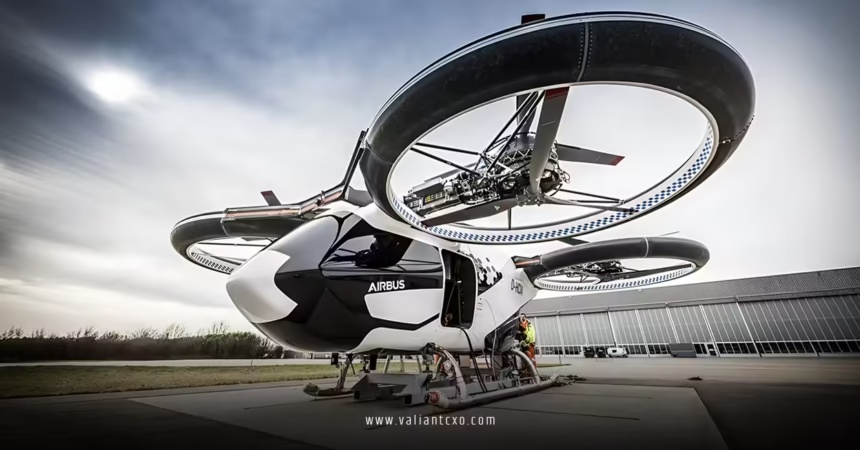
Urban air mobility business models are quickly moving from whiteboard sketches to live experiments in major cities around the world. For entrepreneurs and business owners, this isn’t just about futuristic aircraft; it’s about new ways to move people, create value, and build high‑margin services. The shift from crowded roads to quiet, electric air taxis opens up space for new platforms, partnerships, and premium experiences.
In this article, we’re going to be taking a look at urban air mobility business models, and how you can position your business to benefit from services like the Virgin Atlantic Joby air taxi Heathrow to central London. If you would like to find out more, feel free to read on.
Pic – CC0 License
What Urban Air Mobility Actually Means For Your Business
When we talk about urban air mobility, we’re talking about short‑range, on‑demand flights within and around cities, typically using electric vertical takeoff and landing (eVTOL) aircraft. These aircraft are designed to carry a handful of passengers quietly and efficiently, connecting airports, business districts, and key hubs. For your business, the aircraft themselves matter less than what they enable: faster trips, new routes, and new customer expectations.
The Virgin Atlantic Joby air taxi Heathrow to central London concept is a good example. Instead of a long, uncertain car ride, you get a predictable, fast, premium transfer. That change in the journey creates new business models around booking, bundling, membership, and integration. As urban air mobility spreads to hubs in the USA, Australia, Singapore, and Dubai, you’ll see similar service models take shape.
If you want to understand the broader ecosystem, the World Economic Forum and NASA have useful primers on advanced air mobility and the kinds of services cities are planning. Industry bodies like IATA also offer insight into how airlines are preparing to integrate air taxis and eVTOL operations into their networks.
Core Urban Air Mobility Business Models You Should Know
We’re going to focus on the models that matter most to entrepreneurs and mid‑size businesses, not just aerospace giants. Here are the main types of urban air mobility business models emerging today.
On‑Demand Air Taxi Services
This is the model most people picture first: app‑based bookings for short flights across the city. Think of it as “ride‑hailing in the sky,” where customers choose routes and times based on real‑time availability and pricing.
Revenue comes from:
- Per‑trip fares
- Dynamic pricing during peak demand
- Optional add‑ons like luggage handling or ground transfer
This is where services like the Virgin Atlantic Joby air taxi Heathrow to central London sit—high‑value, time‑saving trips that can be booked or bundled as part of a wider travel experience.
Scheduled Shuttle Routes
Some providers will operate fixed routes, like airport‑to‑city or city‑to‑business‑park shuttles at set times. This looks more like a premium bus or train service, but in the air.
Revenue sources include:
- Ticket sales on specific routes
- B2B deals with corporate clients
- Long‑term contracts with event venues or business districts
This model can be easier to plan around and integrate into existing travel and commuter patterns.
Membership and Subscription Models
For frequent users—executives, high‑net‑worth individuals, or corporate teams—membership plans make urban air mobility predictable and budget‑friendly.
Common elements:
- Monthly or annual fees for a set number of flights
- Priority booking and better cancellation terms
- Access to exclusive lounges or services
Entrepreneurs can build products around these memberships, such as corporate travel packages, lifestyle concierge services, or loyalty‑driven experiences.
Platform and Aggregator Models
Not every business needs to own aircraft to play in urban air mobility. Some of the biggest opportunities are in platforms that connect passengers with multiple operators, routes, and related services.
Revenue here often comes from:
- Commission on bookings
- SaaS fees for corporate clients
- Data and analytics services
If you already run booking engines, travel tech, or mobility apps, integrating routes like Virgin Atlantic Joby air taxi Heathrow to central London into your platform could add a new, premium layer.
Where Entrepreneurs Can Plug Into These Models
You might be thinking, “We’re not an aviation company; how do we actually benefit from urban air mobility?” The answer is that most of the value is created at the edges: booking, packaging, service, and experience.
Here are practical roles your business can play:
- Service Bundler
You wrap air taxi routes into end‑to‑end offers: airport transfer plus hotel, conference access, or city tours. - Experience Designer
You turn “a quick flight” into “a premium arrival experience” with meet‑and‑greet, luggage handling, and local guidance. - Technology Integrator
You build or adapt software to include urban air mobility options alongside cars, trains, and flights. - Corporate Travel Partner
You help companies adopt air taxi services into their travel policies, budgets, and planning.
In each case, you’re not building aircraft—you’re building value on top of them.
Key Revenue Streams To Focus On
To make urban air mobility business models work for your company, we need to think clearly about how money will flow. Most businesses will tap into a mix of these revenue streams:
- Margin on bundled services (e.g., package price minus partner costs)
- Commissions from airlines, air taxi operators, or platforms
- Service fees for coordination, concierge, or support
- Subscription fees from clients who want ongoing access and management
- Data‑driven add‑ons, such as insights for corporate clients on travel time, cost, or emissions
A route like Virgin Atlantic Joby air taxi Heathrow to central London can be thought of as a premium “component” you add to packages, rather than the entire product.
Regional Differences: USA, UK, AUS, Singapore, Dubai
Urban air mobility will not look identical in every city, and your business model should respect that.
- USA
Expect diverse operators and strong app‑based platforms, especially around New York, Los Angeles, and Silicon Valley. There will be room for aggregators and corporate travel specialists. - UK
London will be shaped heavily by airport routes, like Heathrow and Gatwick, plus links to business hubs. The Virgin Atlantic Joby air taxi Heathrow to central London model will likely inspire similar corridors. - Australia
Sydney and Melbourne will pair tourism with business travel, creating chances for package‑driven models that combine air taxis, hotels, and experiences. - Singapore
Highly planned rollouts and tight integration with public transport and smart city systems. There’s strong potential for tech platforms and premium corporate products. - Dubai
Dubai already experiments with innovative transport, which means luxury‑focused services, real estate‑linked offers, and high‑visibility experiences around urban air mobility.
By tuning your offers to each region’s strengths and regulations, you make your business model more resilient.
First Steps To Build Your Own Urban Air Mobility Play
If you want to move beyond ideas and into action, we can keep the starting plan simple and focused:
- Map where your customers touch airports and city transfers today.
- Identify one or two segments (like executives or tourists) who would pay for faster, smoother journeys.
- Design a pilot package that treats advanced air mobility as a future component, but uses current premium transport now.
- Reach out to potential partners—airlines, travel tech firms, or mobility startups—to explore integrations.
- Create clear messaging about your focus on smart, time‑saving, low‑emission travel options.
That way, when services like Virgin Atlantic Joby air taxi Heathrow to central London and similar routes go live, you’re not scrambling—you’re simply upgrading an offer you already tested.
The Takeaway For Your Business
We hope that you have found this article enlightening in some way and that urban air mobility business models now feel less abstract and more actionable for you. The aircraft and regulations are complex, but your job is simpler: understand how these new routes will change customer journeys and build services that make those journeys better.
If you treat urban air mobility as a new layer you can add to your existing strengths—whether that’s tech, hospitality, events, or corporate services—you put your business in a position to benefit as this market grows. Start small, stay informed, and design offers that let your clients enjoy the upside of innovations like the Virgin Atlantic Joby air taxi Heathrow to central London without having to figure out the details themselves. That’s where real, sustainable value lives for entrepreneurs like you.