
Central bank gold reserves diversification strategies are no longer a quiet back-office exercise. They have become a core part of how monetary authorities manage geopolitical risk, liquidity access, and long-term balance-sheet resilience. The recent Dutch central bank moves 86 tonnes gold from US Canada to London 2026 is a textbook example of the shift already underway.
- Geographic spread reduces single-jurisdiction risk.
- Liquidity location (London vs New York vs domestic) now ranks as high as pure safety.
- Most central banks still treat gold as a separate strategic asset rather than a pure portfolio weight.
- World Gold Council surveys show rising plans to both increase domestic holdings and diversify overseas vaults.
- Hybrid methods—selling bars in one location and buying market-standard bars in another—have become standard practice.
Here’s the practical reality. Gold does not pay interest. It does not generate cash flow. Its value sits in the fact that it carries no counterparty risk and can be moved, pledged, or sold when other assets freeze. That only works if the metal is stored where it can actually be reached under stress. That single operational truth drives nearly every modern diversification decision.
Why central banks still bother with gold at all
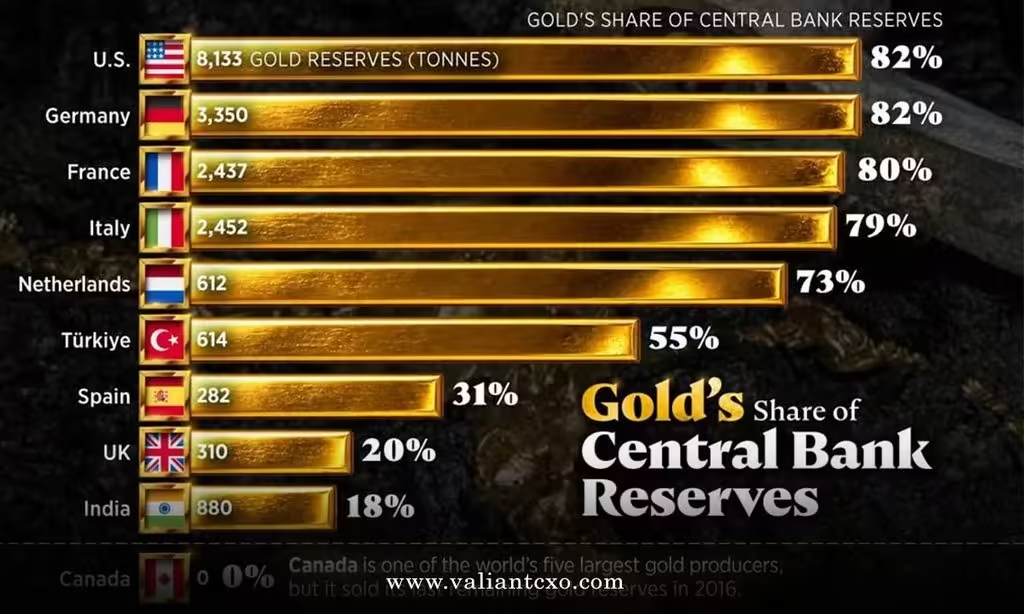
Gold’s share of global official reserves has climbed sharply in value terms. Price gains explain part of the rise, yet active buying continues. Emerging-market central banks in particular treat the metal as insurance against sanctions risk, currency pressure, and dollar concentration. Western European institutions, already sitting on large historical stockpiles, focus more on refining the storage map than on adding new tonnes.
The World Gold Council’s 2026 Central Bank Gold Reserves Survey captured the mood clearly. A record share of respondents expected their own gold holdings to rise. Geopolitical hedging and reserve diversification ranked among the top reasons. At the same time, vaulting preferences are shifting. The Bank of England remains the most popular foreign location, yet more banks report plans to increase domestic storage or spread metal across additional overseas sites.
Core pillars of modern diversification strategies
1. Geographic distribution
No single vault, no single legal system. Typical mixes combine domestic holdings for ultimate control, London for market depth, New York for historical and financial-market proximity, and sometimes the BIS or other neutral locations. The Dutch central bank moves 86 tonnes gold from US Canada to London 2026 rebalanced exactly this way—raising the London share while keeping domestic holdings steady and cutting the North American overweight.
2. Liquidity tiering
Bars that meet London Good Delivery standards can be traded faster and with less friction. Older or non-standard bars often require upgrading or remelting. Many recent operations therefore combine physical shipment of a portion with sell-and-buy transactions that upgrade the rest.
3. Crisis-access planning
What happens if a major corridor closes or sanctions block access? Domestic metal stays under national control. London metal sits inside the deepest physical market. The combination matters more than pure volume.
4. Active vs passive management
A growing minority of central banks now actively manage their gold—lending, swapping, or rotating bars—to generate modest returns or improve risk metrics. Most still hold it as a strategic, non-traded reserve.
Practical table: common storage approaches
| Approach | Primary benefit | Main drawback | Typical users |
|---|---|---|---|
| Heavy domestic | Maximum control and political autonomy | Lower immediate tradability | Poland, some emerging markets |
| London-centric | Highest market liquidity | Exposure to UK legal and operational risk | Many European and Asian banks |
| Multi-jurisdiction mix | Balanced risk and access | Higher logistical and custody costs | Netherlands, Germany, Italy |
| Sell-and-repurchase upgrade | Improves bar quality without large physical moves | Transaction costs and temporary market exposure | France (2025–26), Netherlands (2026) |
Step-by-step action plan for beginners tracking these strategies
- Start with official statements and annual reports, not headlines.
- Map current storage locations against the bank’s stated risk priorities.
- Note any hybrid transfer methods—sell/buy plus physical movement.
- Compare the new geographic split with peers of similar size.
- Watch for follow-on moves. One relocation often precedes a broader review.
- For personal gold holders, ask the same question central banks ask: how fast can I actually access this metal under stress?
What I’d do if I were reviewing a mid-sized central bank’s gold book tomorrow: stress-test every storage location against a 30-day access blackout in the largest foreign jurisdiction. Then decide whether the current mix still passes.
Common mistakes & how to fix them
Mistake one: treating every relocation as a political signal of distrust.
Fix: Read the operational language first. Most statements emphasize tradability and crisis readiness, not ideology.
Mistake two: assuming more domestic gold is always safer.
Fix: Domestic metal is harder to sell quickly in volume. A pure home bias can reduce, not increase, usable liquidity.
Mistake three: ignoring bar quality.
Fix: London Good Delivery standards exist for a reason. Non-compliant bars carry friction that shows up exactly when you need speed.
Mistake four: viewing gold in isolation from the rest of the reserve portfolio.
Fix: Diversification works only when gold’s role—store of value, crisis hedge, sanctions buffer—is defined clearly against the currency and bond holdings.
The Dutch central bank moves 86 tonnes gold from US Canada to London 2026 sits inside this broader framework. It was not an isolated decision. It was one more data point in a multi-year shift toward storage that prioritizes deployability over historical convenience.
Key Takeaways
- Central bank gold reserves diversification strategies now centre on location as much as volume.
- Liquidity and crisis access rank alongside pure safety.
- Hybrid sell-and-buy methods reduce physical risk while upgrading bar standards.
- World Gold Council data shows rising interest in both more domestic storage and wider overseas diversification.
- London remains the preferred foreign vault for tradability.
- The Dutch central bank moves 86 tonnes gold from US Canada to London 2026 is a clear, recent illustration of the trend.
- For market watchers, these moves offer cleaner signals than headline gold purchases alone.
- Practical next step: track vaulting changes in the next round of official surveys and annual reports.
Reserve managers are not chasing fashion. They are solving a practical problem—how to keep an asset that carries no counterparty risk actually usable when the system comes under pressure. Geographic and quality diversification is simply the current solution. Anyone following official gold flows should treat storage maps with the same seriousness as purchase volumes.
FAQs
How do central bank gold reserves diversification strategies differ from private investor approaches?
Central banks prioritise jurisdictional control, market-standard bars, and multi-year crisis scenarios. Private investors usually focus on cost, insurance, and personal access convenience.
Does the Dutch central bank moves 86 tonnes gold from US Canada to London 2026 change the overall European storage picture?
It raises London’s share for one of the larger European holders and reinforces the preference for market-ready bars in the deepest trading centre. Other large holders continue their own gradual adjustments.
Where can readers find primary data on these strategies?
Start with the World Gold Council’s annual Central Bank Gold Reserves Survey and the individual central banks’ press releases and annual reports. Those sources remain the cleanest available.