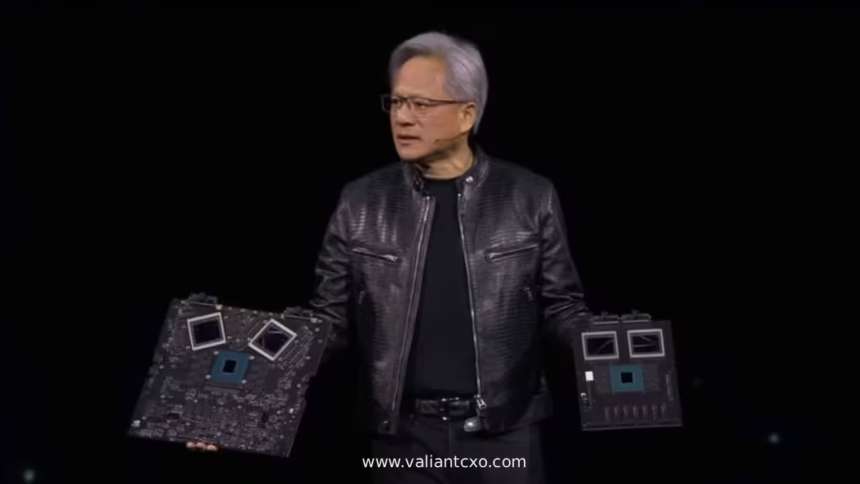
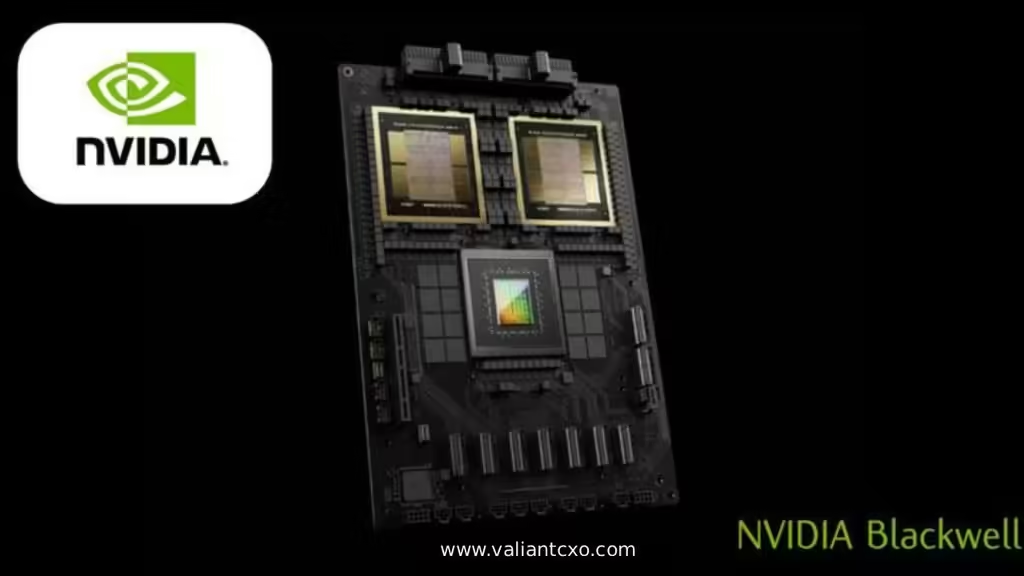
NVIDIA Blackwell NVL72 Comparison NVIDIA Blackwell NVL72 set the standard for rack-scale AI in 2025–2026. It packed 72 Blackwell (or Blackwell Ultra/GB300) GPUs and 36 Grace CPUs into one liquid-cooled domain, delivering strong gains over Hopper for large-model training and reasoning inference. But the jump to the next platform changes the math, especially for multi-step agent workloads.
This comparison focuses on the practical differences that matter for real deployments: memory bandwidth, interconnect scale, power efficiency, and token economics. The biggest shift appears when you move from single-turn or short-context inference into sustained agentic work—exactly where nvidia vera rubin nvl72 agentic inference pulls ahead.
Quick Specs Snapshot
| Metric | Blackwell NVL72 (GB200/GB300) | Vera Rubin NVL72 | Practical Impact |
|---|---|---|---|
| GPUs + CPUs | 72 Blackwell + 36 Grace | 72 Rubin + 36 Vera | Stronger CPU orchestration for tool calls |
| GPU Memory | ~20 TB HBM3e | 20.7 TB HBM4 | Similar capacity, much higher bandwidth |
| Per-GPU Memory Bandwidth | ~8 TB/s | Up to 22 TB/s | Memory-bound phases (decode, long context) speed up dramatically |
| Rack NVLink Bandwidth | ~130 TB/s (NVLink 5) | ~260 TB/s (NVLink 6) | Better expert parallelism and KV distribution |
| NVFP4 Inference (rack) | ~1.1–1.4 EFLOPS range (gen-dependent) | 3,600 PFLOPS (3.6 EFLOPS) | Higher sustained generation rate |
| Reported Agentic Throughput/MW | Strong baseline vs Hopper | Up to 10–30x vs Blackwell (workload dependent) | More concurrent agents inside the same power envelope |
| Token Cost Trend | Solid improvement over prior gens | Claims of ~10x lower vs Blackwell for interactive agentic work | Continuous agents become far more affordable |
Sources: NVIDIA product pages and published AgentX / early silicon results as of 2026. Exact FLOPS vary slightly between GB200 and GB300 Ultra variants.
Where Blackwell NVL72 Still Holds Its Own
NVIDIA Blackwell NVL72 Comparison Blackwell NVL72 is no slouch. It remains a high-performing, production-proven platform. Many facilities already have it installed, cooled, and networked. For pure training of large mixture-of-experts models or shorter-context inference, it continues to deliver excellent results.
It also showed clear generational leaps over Hopper. On agentic-style workloads, GB300 NVL72 delivered up to 15x higher throughput per megawatt than H200-class systems in some SemiAnalysis AgentX traces. That made it the go-to rack for the first wave of reasoning and multi-turn agents in 2025–early 2026.
If your data center is already live on Blackwell, finishing the build-out with additional NVL72 racks can still make sense for near-term capacity. The software stack (TensorRT-LLM, Dynamo, vLLM, SGLang) is mature, and operators know how to tune it.
Where the Gap Opens Wide
Three areas create the largest differences.
Memory bandwidth. HBM4 on Rubin roughly triples the per-GPU bandwidth compared with HBM3e. Decode phases and long-context attention are memory-bound. Higher bandwidth keeps the Tensor Cores fed and reduces the need for aggressive KV-cache offloading. That shows up immediately in tokens-per-second at interactive latency targets.
Scale-up fabric. NVLink 6 doubles the per-GPU bandwidth and lifts the full-rack domain to ~260 TB/s. Mixture-of-experts routing and distributed attention benefit directly. The rack behaves more like a single coherent accelerator, which matters when models grow into the multi-trillion-parameter range and agent sessions spawn sub-agents.
System-level efficiency for agents. Early measured results (CoreWeave silicon data and NVIDIA’s AgentX submissions) show Vera Rubin NVL72 delivering 10x tokens per megawatt at matched interactivity on models like DeepSeek-R1, with some agentic coding traces reaching as high as 30x throughput per megawatt versus GB300 NVL72. Token-cost reductions of roughly 10x (and higher in specific AgentX comparisons) follow from that efficiency. For teams running agents continuously—coding assistants, research agents, multi-tool workflows—the economics flip.
NVIDIA Blackwell NVL72 Comparison Power density rises with the newer rack (roughly 190–230 kW range versus ~120–130 kW for many Blackwell NVL72 deployments), but the useful work extracted per megawatt climbs faster. Intelligent Power Smoothing and liquid-cooling design help operators push higher sustained utilization inside existing facility limits.
Decision Framework: When to Stay on Blackwell vs Move
Stay with or expand Blackwell NVL72 if:
- You already have live capacity and need more seats quickly.
- Your dominant workloads are still shorter-context or heavily compute-bound rather than memory- and communication-bound.
- Facility power and cooling are locked in and you prefer lower per-rack draw in the near term.
Prioritize Vera Rubin NVL72 (and specifically its strengths in nvidia vera rubin nvl72 agentic inference) if:
- You are designing a new AI factory or major expansion with a 2027+ horizon.
- Agent workloads with growing context, tool use, and multi-step reasoning form a meaningful share of your traffic.
- Token cost and concurrent agents per megawatt are the primary success metrics.
In practice, many operators will run both for a period. Blackwell handles established production traffic while Rubin ramps on the newest agent fleets and longest-context models.
What to Measure in a Side-by-Side Test
NVIDIA Blackwell NVL72 Comparison Ignore the headline FLOPS for a moment. Pull real agent traces—sessions that include tool calls, context growth, and sub-agent handoffs. Run them at the same target tokens-per-second per user on both platforms. Track three numbers:
- Total tokens delivered per megawatt
- Fully loaded cost per million tokens
- Maximum concurrent sessions that stay inside your latency SLA
Those three decide the upgrade case more cleanly than any slide deck.
Bottom Line
NVIDIA Blackwell NVL72 remains a capable, battle-tested rack for large-scale AI. It raised the bar significantly over Hopper and still serves many production environments well. The next step, however, is not a modest refresh. Vera Rubin NVL72 brings substantially higher memory bandwidth, a faster scale-up domain, and system-level optimizations that translate into large gains on the exact workloads agents create.
NVIDIA Blackwell NVL72 Comparison If your roadmap includes continuous, high-concurrency agentic inference, the comparison points strongly toward the newer platform. Start with a controlled pilot on your own traces. The numbers will tell you how quickly the higher efficiency pays back the investment.
Common Mistakes & How to Fix Them
Assuming Blackwell NVL72 is “good enough” for agentic workloads
Many teams stick with existing Blackwell racks because they already work. The problem: agent sessions with growing context, tool calls, and sub-agents quickly hit memory-bandwidth and interconnect limits.
Fix: Run the same real agent traces on both platforms at identical tokens-per-second targets. Measure tokens per megawatt and cost per million tokens. The gap usually appears within the first test cycle.
Focusing only on peak FLOPS
Headline compute numbers look impressive on both racks, but agentic inference is often memory- and communication-bound.
Fix: Prioritize HBM bandwidth, NVLink domain size, and sustained tokens-per-second under realistic concurrency. Ignore pure peak FLOPS when comparing for agents.
Ignoring software and disaggregation maturity
Early software stacks on a new platform can leave performance on the table.
Fix: Lock the same framework versions (Dynamo, TensorRT-LLM, vLLM, or SGLang) and enable disaggregated prefill/decode on both systems before measuring.
Underestimating power and cooling differences
Vera Rubin racks draw more power per rack. Facilities sometimes assume the higher draw cancels the efficiency gains.
Fix: Calculate useful work (tokens or concurrent agents) per megawatt, not just rack power. The efficiency advantage usually more than offsets the higher draw.
Treating the upgrade as an all-or-nothing decision
Some operators delay because they cannot replace every Blackwell rack at once.
Fix: Run a hybrid fleet. Keep Blackwell for shorter-context or established workloads and move the heaviest agentic traffic to Vera Rubin first.
Key Takeaways
- Blackwell NVL72 remains a strong, production-ready platform and still delivers solid gains over Hopper.
- Vera Rubin NVL72 significantly widens the gap on memory bandwidth (HBM4), scale-up fabric (NVLink 6), and agentic efficiency.
- Early measured results show up to 10–30x higher throughput per megawatt and roughly 10x lower token costs on demanding agentic workloads.
- The biggest advantages appear in long-context, multi-step, tool-using agent sessions.
- Token economics and concurrent agents per megawatt matter more than peak FLOPS for agent fleets.
- A side-by-side test on your own agent traces is the fastest way to quantify the upgrade case.
- Many operators will run both platforms during the transition period.
- New AI factory designs with a 2027 horizon should prioritize Vera Rubin for agentic inference capacity.
FAQs
Is Blackwell NVL72 still worth buying in late 2026?
Yes, if you need capacity quickly, already have Blackwell infrastructure, or run workloads that are less memory- and communication-bound. It remains a capable production platform.
Should I replace all Blackwell racks at once?
No. Most teams run a mixed fleet. Move the heaviest multi-step agent workloads first while keeping Blackwell for established shorter-context traffic.
How much better is Vera Rubin NVL72 for agentic inference?
On real agentic coding and reasoning traces, early results show up to 10–30x higher throughput per megawatt and substantially lower cost per million tokens compared with GB300 NVL72, depending on the model and interactivity target.
What is the single most important metric when comparing the two?
Tokens delivered per megawatt (or concurrent agents per megawatt) at your required latency target. That number directly drives both capacity and cost.