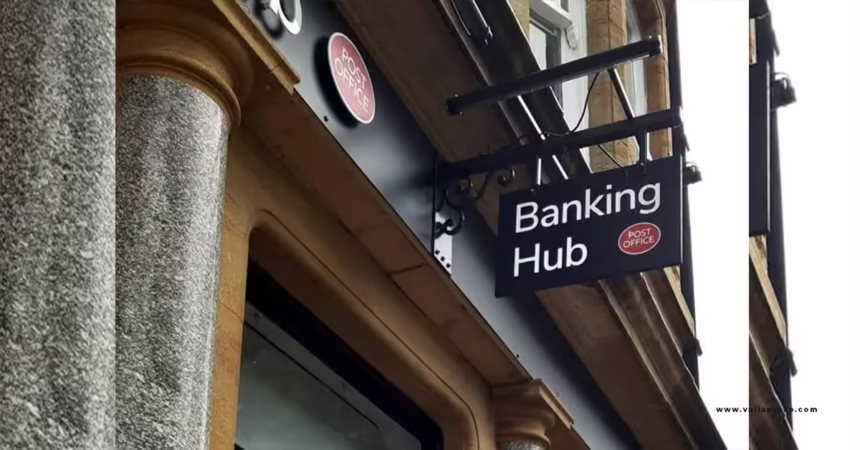
Banking hubs UK explained simply: they are shared high-street spaces that give customers of most major banks a place to handle everyday cash transactions and speak face-to-face with a banker even after traditional branches disappear.
- Owned by Cash Access UK and run by the Post Office in partnership with the banks.
- Counter service for cash in/out, balance checks and bill payments, open Monday–Friday.
- Community bankers from participating banks rotate through on set days for more complex queries.
- Already past 250 open sites by late 2026, with a government target of 350 this Parliament.
- Designed precisely for towns hit by branch closures, including those covered in the Lloyds Banking Group branch closures 2026 2027 full list.
Think of them as the practical middle ground between a full bank branch and pure digital banking. One counter serves almost everyone. A private room handles the conversations that still need a human.
How banking hubs actually work
You walk in. Post Office staff run the counter. You use your debit card and PIN for most cash services—deposits, withdrawals, balance enquiries—regardless of which major bank holds your account. Limits exist and can differ by bank, so check yours in advance. Business customers get change-giving and higher deposit options in many hubs.
Need more than a quick transaction? Check the rota. Different banks send community bankers on different days. Lloyds, Halifax and Bank of Scotland often share days. NatWest, HSBC, Santander and others take their turns. These sessions cover account issues, bereavement, fraud concerns, power of attorney and digital banking help. Most operate on a walk-in basis.
Opening hours are typically 9am–5pm, Monday to Friday. Locations appear in former bank premises, libraries, retail parks or purpose-built spots. Temporary hubs often open quickly while a permanent site is fitted out so service does not vanish overnight.
Why banking hubs exist and who decides where they go
Branch networks have shrunk hard. When the last bank in a town announces closure, LINK (the cash-access network) assesses the gap. Community requests can also trigger a review. Cash Access UK then delivers the hub. The model is funded by the major banks themselves as a collective response to the Access to Cash rules and political pressure to protect face-to-face services.
This is exactly why hubs matter in the context of the Lloyds Banking Group branch closures 2026 2027 full list. Many towns losing a Lloyds, Halifax or Bank of Scotland site have already received, or are scheduled to receive, a hub recommendation so the high street does not go completely dark.
What you can (and cannot) do at a banking hub
| Service | Available at counter? | Community banker needed? | Notes |
|---|---|---|---|
| Cash withdrawal | Yes | No | Card + PIN; daily limits apply |
| Cash / cheque deposit | Yes | No | Instant availability for most |
| Balance enquiry | Yes | No | — |
| Utility / bill payments | Yes | No | Common household bills |
| Change for businesses | Often | No | Register first in many cases |
| Complex account queries | No | Yes | On your bank’s rota day |
| New accounts / full lending | No | Limited | Not a full branch |
Services and exact limits vary by bank. Always confirm with your own provider.
Step-by-step: how to use a banking hub
- Find your nearest hub on the Cash Access UK site or Post Office banking hub pages.
- Note the community banker rota if you need a private conversation.
- Take your debit card, any relevant documents and photo ID if the query is complex.
- Use the counter for routine cash work any weekday.
- Arrive early on your bank’s day if the hub is busy—walk-ins rule.
- Ask staff about temporary locations while permanent sites are prepared.
If no hub exists yet, every Post Office still offers basic everyday banking under the wider framework. You can also request an Access to Cash review via LINK if your area feels underserved.
Common mistakes and how to avoid them
Assuming a hub replaces every branch function. It does not. Complex lending, full relationship management and certain specialised services still need the bank’s own channels or remaining branches.
Turning up on the wrong day for a community banker. Check the rota first—many hubs publish it in the window or online.
Ignoring deposit and withdrawal limits. Exceed them and the transaction fails. Know your bank’s rules before you queue.
Leaving it until the last branch closes. Temporary hubs often open first, but planning ahead removes the scramble.
Forgetting that Post Office branches already handle a lot of the same cash work. Use them while waiting for a dedicated hub.
Key Takeaways
- Banking hubs UK explained: shared Post Office-operated counters plus rotating community bankers.
- Built for towns losing their last bank branch.
- Counter services cover the cash basics for most major bank customers.
- Community bankers handle the conversations that still need privacy.
- Over 250 open by autumn 2026; target is 350 this Parliament.
- Directly relevant to places affected by the Lloyds Banking Group branch closures 2026 2027 full list.
- Check location, rota and your bank’s specific limits before you go.
- No hub yet? Use any Post Office and request a review if needed.
The high street has changed. Banking hubs are the practical bridge that keeps cash and face-to-face help available without every bank maintaining its own costly branch. Find the nearest one, test it once, and add it to your options list. That single step turns a potential problem into a workable routine.
FAQs
Are banking hubs free to use?
Yes for standard cash services at the counter. Your own bank’s normal fees and limits still apply. Community banker sessions are also free.
Can I use a banking hub if my bank still has branches nearby?
Yes. Any customer of a participating bank can use the counter and, on the right day, the community banker.
How do I know if a new banking hub is coming to my town after a branch closes?
LINK recommendations and Cash Access UK announcements are public. Check both sites or ask at your local Post Office. Many hubs open before or shortly after the final branch shuts.