Gamma-ray burst science explained starts with one hard fact: these are the most violent explosions in the universe after the Big Bang itself. In a few seconds a gamma-ray burst can pour out more energy than our Sun will produce in its entire 10-billion-year lifetime.
Here’s the quick version of what you need to know:
- Gamma-ray bursts (GRBs) are brief, extremely bright flashes of the highest-energy light in the electromagnetic spectrum.
- Two main classes exist: long-duration (usually from collapsing massive stars) and short-duration (usually from neutron-star mergers).
- The energy is funneled into narrow jets, so we only see the ones pointed roughly toward Earth.
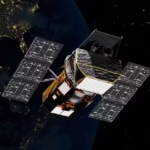
- NASA’s Neil Gehrels Swift Observatory transformed the field by catching more than 2,000 of them in real time before the recent 3,200-pound NASA Swift Observatory reentry Earth’s atmosphere ended its 22-year run.
- Afterglows across X-ray, optical, and radio wavelengths let astronomers study the environment and the physics for days or weeks afterward.
That’s the core. Now let’s unpack how these cosmic monsters actually work.
What exactly is a gamma-ray burst?
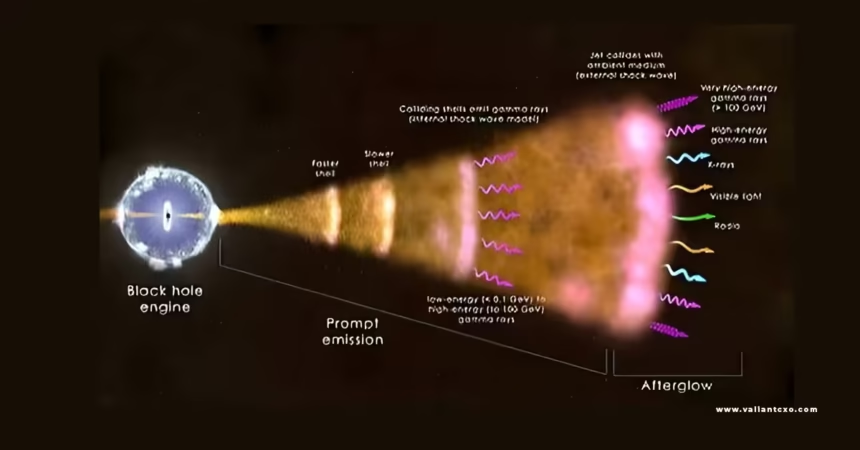
Picture a stellar corpse or a dying giant star suddenly converting a large fraction of its mass into pure energy and flinging it outward in two opposite beams at nearly the speed of light. Those beams are the gamma-ray burst.
The prompt emission—the initial flash of gamma rays—lasts from a fraction of a second to several minutes. Then comes the afterglow: lower-energy radiation produced as the jet slams into the surrounding gas and dust. The afterglow fades over hours to months and is visible across the entire spectrum if you catch it fast enough.
The energy scale is almost absurd. A typical long GRB releases the equivalent of a million trillion trillion Hiroshima bombs, according to researchers who model these events. Most of that energy is concentrated in a narrow beam, which is why we detect only a small fraction of the total population.
Long versus short: the two main flavors of gamma-ray bursts
Astronomers split GRBs by duration, and the split tracks real physical differences.
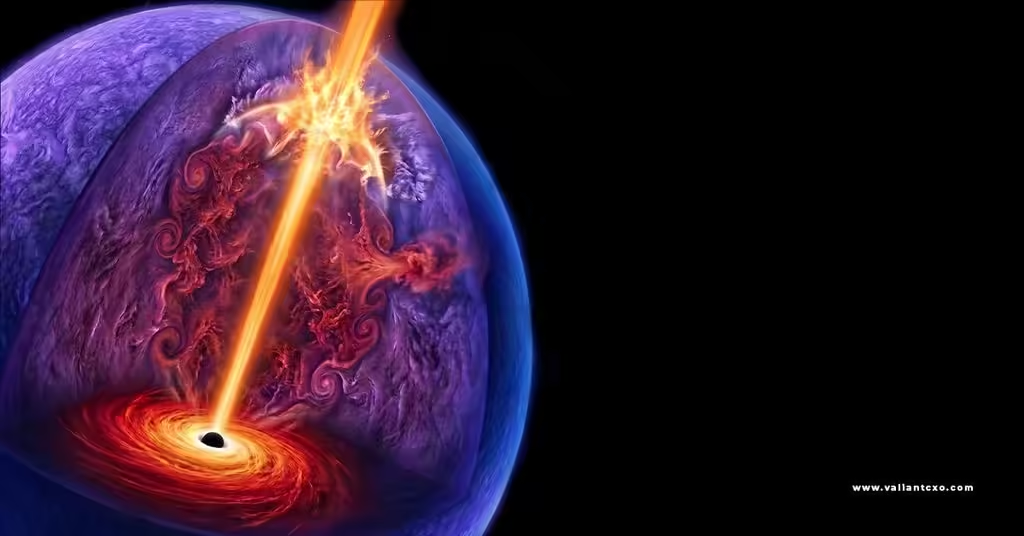
Long-duration GRBs last more than about two seconds (sometimes many minutes). Most come from the core collapse of a rapidly rotating massive star—a collapsar. The star’s core forms a black hole or a magnetar while the outer layers explode as a supernova. Jets punch through the remaining star and produce the gamma rays. These events are usually found in star-forming galaxies.
Short-duration GRBs last less than two seconds. The leading explanation is the merger of two neutron stars (or a neutron star and a black hole). The collision creates a black hole and flings out a jet plus a cloud of heavy elements. These mergers also produce gravitational waves and kilonovae—the optical/infrared glow from radioactive decay of newly forged gold, platinum, and other heavy elements.
The classification is useful but not perfect. A few events blur the line, and rare ultra-long bursts keep theorists busy. Still, the duration cut at roughly two seconds remains the workhorse distinction.
Long vs short gamma-ray bursts at a glance
| Feature | Long GRBs | Short GRBs |
|---|---|---|
| Typical duration | > 2 seconds | < 2 seconds |
| Primary origin | Collapse of massive star | Neutron-star merger |
| Associated phenomena | Supernova, star-forming host | Kilonova, gravitational waves |
| Host galaxies | Often young, star-forming | Older stellar populations possible |
| Jet opening angle | Narrower on average | Can be wider |
| Detection rate (Swift era) | Majority of observed bursts | Minority but scientifically rich |
How we actually catch these fleeting events
Earth’s atmosphere blocks gamma rays, so detection requires space telescopes. Early instruments in the 1960s and 1970s discovered GRBs by accident while looking for nuclear tests. Modern understanding exploded once satellites could both detect the burst and rapidly point other telescopes at the same spot.
Swift was built for exactly that job. Its Burst Alert Telescope watched a large fraction of the sky. When a GRB triggered it, the spacecraft could slew in under a minute and start observing with its X-ray and ultraviolet/optical telescopes while simultaneously texting coordinates to astronomers on the ground. That speed turned afterglow science from a rare lucky catch into routine multiwavelength follow-up.
The result: more than 2,000 GRBs localized, distances measured for a large fraction of them, and the first clear afterglow of a short GRB in 2005. That single detection helped cement the neutron-star merger model. For the full story of how that remarkable machine finally came home, see the detailed account of the 3,200-pound NASA Swift Observatory reentry Earth’s atmosphere.
Other missions—Fermi, INTEGRAL, and ground-based arrays that catch the highest-energy photons—have added pieces, but Swift’s combination of rapid response and multiwavelength coverage remains unmatched for the time being.
Why gamma-ray bursts matter beyond pure spectacle
These events are cosmic laboratories. They probe physics under conditions we cannot recreate on Earth: extreme gravity, magnetic fields, particle acceleration near black holes, and the production of the heaviest elements.
Short GRBs linked to neutron-star mergers have confirmed that a large fraction of the universe’s gold, platinum, and uranium is forged in these collisions. Long GRBs give us a window into the final moments of the most massive stars and the birth of stellar-mass black holes.
Because GRBs are so luminous, they can be seen across most of the observable universe. The most distant ones act as lighthouses that let us study the early cosmos when the first generations of stars were dying.
They also test fundamental physics. The slight differences in arrival time of photons of different energies from the same burst have been used to place limits on quantum-gravity effects and violations of Lorentz invariance.
Open questions that still keep researchers up at night
Despite two decades of Swift data and thousands of papers, several puzzles remain. What powers the rare ultra-long GRBs that stay active for hours or even days? How common are the off-axis jets that we only see when the beam is pointed slightly away from us? What fraction of short GRBs come from neutron-star–black-hole mergers rather than double neutron-star systems? And how exactly does the jet itself form and stay collimated?
Recent oddballs—such as a short and a long burst appearing just minutes apart from nearly the same direction—suggest the classification may still need refinement. Nature keeps surprising us.
Practical takeaways for anyone following the field
If you want to stay current without drowning in technical papers:
- Watch for announcements from NASA’s Goddard Space Flight Center and the Swift archive while the data remain publicly available.
- Gravitational-wave alerts from LIGO/Virgo/KAGRA paired with a short GRB are the gold standard for confirming a neutron-star merger.
- Afterglow observations from large ground-based telescopes (and soon the next generation of space telescopes) still deliver the richest science after the initial gamma-ray flash.
The hardware that made routine GRB science possible has now reentered, but the archive and the scientific questions it opened will keep producing results for years.
Gamma-ray bursts remain one of the cleanest windows we have into the most extreme physics the universe can offer. Understanding them means understanding how black holes are born, how the heaviest elements are made, and how the cosmos looked when it was only a few hundred million years old. The explosions themselves last seconds. The scientific payoff lasts decades.
FAQs
What causes a gamma-ray burst?
Long bursts are usually produced when a massive, rapidly rotating star collapses and forms a black hole or magnetar while launching jets. Short bursts are usually produced when two neutron stars spiral together and merge.
Why can’t we see gamma-ray bursts with our eyes or ordinary telescopes?
Gamma rays do not penetrate Earth’s atmosphere. Space-based detectors are required for the prompt emission. The lower-energy afterglow, however, can be followed from the ground once a satellite provides the coordinates.
How did the 3,200-pound NASA Swift Observatory reentry Earth’s atmosphere affect gamma-ray burst research?
Swift’s rapid-response capability was unique. Its loss removes the best all-sky monitor and quick-slew multiwavelength platform currently available, creating a temporary gap until a successor can match its combination of speed and coverage.