Interstellar—a word that sparks visions of starships gliding through the vastness of space, cosmic mysteries unfolding, and humanity’s dreams of reaching beyond our solar system. It’s a term that captures the imagination, blending science, adventure, and the unknown. But what does interstellar really mean, and why does it hold such a grip on our collective curiosity? In this deep dive, we’ll explore the concept of interstellar travel, its scientific roots, cultural impact, and the tantalizing possibilities it holds for our future. Buckle up, because we’re about to launch into the cosmic unknown!
What Does Interstellar Mean?
At its core, interstellar refers to anything occurring or existing between stars. Derived from Latin, “inter” means between, and “stellar” pertains to stars. So, interstellar space is the vast expanse that separates the stars in our galaxy and beyond. Unlike the relatively cozy confines of our solar system, interstellar regions are immense, cold, and filled with mysteries waiting to be unraveled. Imagine it like an endless ocean, with stars as distant islands and interstellar space as the uncharted waters between them.
But interstellar isn’t just a scientific term—it’s a gateway to dreaming big. It evokes thoughts of space exploration, alien worlds, and the possibility of humanity becoming a multi-star civilization. From the interstellar medium (the sparse gas and dust floating between stars) to the idea of interstellar travel, this concept bridges hard science with the stuff of science fiction.
The Interstellar Medium: The Stuff Between Stars
Interstellar: Exploring the Cosmic Wonders:Let’s get a bit nerdy for a moment. The interstellar medium isn’t just empty space—it’s a thin soup of particles, including hydrogen, helium, and trace amounts of heavier elements. Picture it like a cosmic fog, so sparse that a single cubic centimeter might contain just a few atoms. Yet, this medium plays a critical role in the universe. It’s the raw material for new stars and planets, formed when dense pockets collapse under gravity.
The interstellar medium also contains magnetic fields, cosmic rays, and tiny dust grains that scatter starlight, creating those breathtaking nebulae we see in telescope images. Understanding this medium is key to grasping how interstellar travel might work, as it poses both challenges (like radiation exposure) and opportunities (like potential fuel sources).
The Science of Interstellar Travel
When we think of interstellar travel, we often imagine sleek spaceships zipping to distant stars. But the reality is far more complex. The distances involved are mind-boggling—our nearest star, Proxima Centauri, is 4.24 light-years away, or about 40 trillion kilometers. To put that in perspective, if you drove a car at highway speeds, it would take you roughly 43 million years to get there. Yeah, interstellar travel is no Sunday drive.
Challenges of Interstellar Journeys
So, what’s holding us back? For one, speed. Our fastest spacecraft, like NASA’s Voyager 1, travel at about 17 kilometers per second—impressive, but nowhere near fast enough for interstellar trips. Even at light speed (300,000 kilometers per second), it would still take over four years to reach Proxima Centauri. And we’re nowhere close to achieving light-speed travel.
Interstellar: Exploring the Cosmic Wonders:Then there’s the issue of energy. Powering a spacecraft for interstellar distances requires an insane amount of fuel. Chemical rockets, like those used for moon missions, are woefully inadequate. Scientists are exploring alternatives like nuclear propulsion or even theoretical concepts like antimatter engines. But these are still in the realm of “maybe someday.”
And let’s not forget the interstellar medium itself. While sparse, it’s not empty. High-speed spacecraft could be damaged by collisions with tiny dust grains, and cosmic radiation poses serious risks to both equipment and human travelers. Shielding technology would need to be revolutionary to make interstellar travel safe.
Promising Technologies for Interstellar Exploration
Despite the challenges, scientists are dreaming big. Projects like Breakthrough Starshot aim to send tiny, laser-propelled probes to nearby stars at speeds up to 20% of light speed. Imagine a fleet of postage-stamp-sized spacecraft, each powered by a laser beam from Earth, zooming toward Proxima Centauri in just 20 years. It’s bold, ambitious, and totally interstellar.
Other ideas include ion propulsion, which uses electric fields to accelerate charged particles, or solar sails that harness the pressure of starlight. These technologies are still in early stages, but they’re steps toward making interstellar travel a reality. Who knows? Maybe one day we’ll have warp drives or wormholes, bending space-time itself to make interstellar hops as easy as catching a bus.
Interstellar in Pop Culture
The idea of interstellar exploration isn’t just for scientists—it’s a cultural juggernaut. From books to movies, the concept has inspired countless stories that capture our hopes and fears about the cosmos.
Interstellar: The Movie That Redefined Sci-Fi
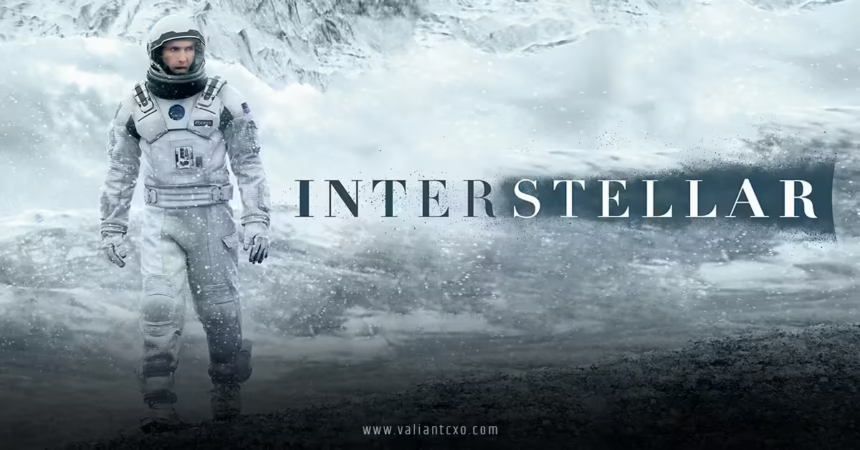
When you hear “interstellar,” chances are you think of Christopher Nolan’s 2014 masterpiece, Interstellar. This film brought the concept to life with stunning visuals and a heart-wrenching story of human survival. It explored real scientific ideas—like black holes, time dilation, and wormholes—while weaving a deeply human tale of love and sacrifice. The movie’s depiction of interstellar travel, guided by physicist Kip Thorne, made complex science accessible and thrilling. If you haven’t seen it, what are you waiting for? It’s a cosmic journey that’ll leave you questioning reality itself.
Books and Stories That Sparked Interstellar Dreams
Beyond the screen, interstellar themes dominate science fiction literature. Classics like Arthur C. Clarke’s 2001: A Space Odyssey and Carl Sagan’s Contact delve into humanity’s quest to explore interstellar space and connect with alien civilizations. These stories ask big questions: Are we alone? What does it mean to cross the interstellar void? They’re not just tales—they’re invitations to ponder our place in the universe.
The Human Side of Interstellar Ambition
Why are we so obsessed with interstellar exploration? It’s more than just curiosity—it’s about survival, legacy, and the human spirit. Our planet won’t last forever, whether due to natural disasters, resource depletion, or cosmic events like supernovae. Interstellar travel represents a chance to ensure humanity’s survival by colonizing other star systems. It’s like planting seeds in new gardens, knowing the old one might one day wither.
Interstellar: Exploring the Cosmic Wonders:But it’s not just about survival—it’s about meaning. Reaching interstellar space would be humanity’s ultimate achievement, a testament to our ingenuity and courage. Imagine the first humans stepping onto a planet orbiting another star. What would they feel? Awe? Fear? Pride? The interstellar dream pushes us to be better, to innovate, and to unite as a species.
Ethical Questions of Interstellar Exploration
Interstellar travel isn’t just a technical challenge—it’s a moral one. If we find habitable planets, who gets to go? How do we avoid repeating the mistakes of Earth’s colonial past? And if we encounter alien life, how do we ensure we’re not the cosmic equivalent of bad neighbors? These questions make interstellar exploration as much a philosophical journey as a physical one.
The Future of Interstellar Exploration
Interstellar: Exploring the Cosmic Wonders:So, where do we go from here? The road to interstellar travel is long, but the first steps are already being taken. Space agencies like NASA and private companies like SpaceX are pushing the boundaries of what’s possible. Missions like the James Webb Space Telescope are giving us unprecedented views of distant stars and galaxies, helping us understand the interstellar landscape.
In the coming decades, we might see robotic probes venturing into interstellar space, paving the way for human missions. And who knows? Maybe our great-grandchildren will live in a world where interstellar travel is as routine as international flights are today. The thought is thrilling, isn’t it?
How You Can Get Involved
You don’t need to be a rocket scientist to contribute to the interstellar dream. Follow space news, support scientific research, or even study fields like astrophysics or engineering. Websites like NASA’s official site offer a wealth of information on current space missions. Organizations like The Planetary Society advocate for space exploration and welcome public involvement. And for cutting-edge ideas, check out Breakthrough Initiatives, which is pushing the boundaries of interstellar exploration.
Conclusion
Interstellar: Exploring the Cosmic Wonders:Interstellar exploration is more than a scientific pursuit—it’s a testament to human curiosity, resilience, and imagination. From the sparse interstellar medium to the dream of visiting distant stars, the concept of interstellar captivates us because it represents the unknown, the possible, and the profound. Whether through groundbreaking technologies, inspiring stories, or ethical debates, interstellar exploration challenges us to look beyond our world and reach for the stars. So, let’s keep dreaming, keep exploring, and maybe one day, we’ll call the interstellar void home. What’s stopping us? Only time, and we’ve got plenty of that to make the impossible possible.
FAQs
1. What is the interstellar medium, and why is it important?
The interstellar medium is the sparse mix of gas, dust, and cosmic rays between stars. It’s crucial because it’s the raw material for new stars and planets, and it impacts interstellar travel by posing challenges like radiation.
2. Is interstellar travel possible with current technology?
Not yet. Current spacecraft are too slow and lack the energy for interstellar distances. However, projects like Breakthrough Starshot are exploring ways to send probes to nearby stars using advanced propulsion.
3. How did the movie Interstellar get its science right?
Interstellar worked with physicist Kip Thorne to ensure accuracy in depicting concepts like black holes and time dilation. While some elements were speculative, the film grounded its story in real physics.
4. What are the biggest challenges to interstellar exploration?
The main hurdles are vast distances, energy requirements, and cosmic hazards like radiation and dust. Developing faster propulsion and robust shielding is key to making interstellar travel feasible.
5. How can I stay updated on interstellar research?
Follow trusted sources like NASA, The Planetary Society, or Breakthrough Initiatives. These organizations share the latest on space exploration, including interstellar missions.
Click Here:valiantcxo.com