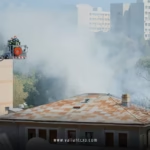
Air quality can feel like one of those “background” issues that only gets attention when something goes wrong. But if smoke, smog, or construction dust hits your area, your team will feel it immediately—and they’ll turn to you for answers. Having a clear, simple air quality policy is how you avoid scrambling in the moment and show your people that you’ve already thought about their health and safety.
We’re going to be taking a look at a straightforward Air Quality Policy Checklist that you can adapt for your own business, and how you can link it to broader issues like wildfire smoke health effects air pollution 2026. If you would like to find out more, feel free to read on.
Pic – CC0 License
Why every business needs an air quality policy
Most businesses already have fire drills and basic safety rules. Air quality should sit in the same category. Bad air can lead to headaches, fatigue, coughing, and reduced focus. Over time, it can trigger more serious problems for people with heart or lung conditions.
If your team works indoors in offices, retail spaces, warehouses, or hospitality, they still need guidance when the air gets worse outside. If they work outdoors—in construction, delivery, transport, or events—the impact is even stronger. By putting a simple policy in place, you reduce confusion, protect productivity, and show that you take health seriously.
Having this policy also makes it easier to respond to events connected to wildfire smoke health effects air pollution 2026, urban pollution spikes, and seasonal haze in places like Singapore or Dubai.
1. Define who owns air quality decisions
The first item on your Air Quality Policy Checklist is ownership. Someone has to be clearly responsible for watching conditions and making decisions.
Make sure your policy answers these questions:
- Who monitors daily air quality (a safety officer, HR, operations)?
- Who decides when to change working arrangements?
- Who communicates updates to staff and managers?
- Who can stop work if air quality becomes unsafe?
When ownership is clear, your team knows who to turn to and you avoid “too many cooks” making conflicting calls.
2. Set simple air quality thresholds
Next, your policy needs clear triggers. That means deciding what happens at different air quality levels. Use simple language and tie your rules to trusted local or national sources.
You might:
- Use the Air Quality Index (AQI) or equivalent local scale.
- Define “normal,” “moderate,” and “poor” air ranges.
- Link each range to a specific action (for example, limit outdoor work when AQI reaches a certain level).
For reference, the U.S. Environmental Protection Agency’s AirNow site explains AQI levels in everyday terms. In the UK, Public Health England and local authorities provide guidance. In Australia, state environment departments offer air quality ratings. Singapore and Dubai have their own reporting systems and advice.
The goal is not to build a complex system. It’s to give your managers simple rules they can follow without needing a science degree.
3. Include indoor air standards
Your Air Quality Policy Checklist should also cover indoor spaces. Smoke and pollution can enter through doors, windows, and leaky buildings, especially during events tied to wildfire smoke health effects air pollution 2026.
Key indoor points to include:
- How often HVAC filters are checked and replaced.
- What type of filters your system uses (and whether upgrades are needed).
- When windows and external doors should stay closed.
- Where portable air cleaners (HEPA units) should be used.
- How often indoor air comfort and complaints are reviewed.
By stating these rules in the policy, you make them routine, not an emergency reaction.

4. Protect outdoor and high-exposure workers
If your business involves drivers, construction teams, field sales, security staff, delivery workers, or event crews, they face higher exposure. Your checklist should give them extra protection.
Consider:
- When outdoor work should be reduced or paused.
- Providing masks that are suitable for smoke or pollution (if recommended by local health guidance).
- Allowing more frequent breaks indoors.
- Offering alternative duties on high pollution days.
- Clear instructions on what to do if someone feels unwell while outside.
You don’t need to promise perfection. You just need to show that you’ve thought through realistic steps.
5. Add a simple communication plan
A good policy is useless if no one hears about it. Your Air Quality Policy Checklist should spell out how you communicate before, during, and after an air quality event.
Include:
- How new staff are introduced to the policy (onboarding, handbook, intranet).
- Which channels you’ll use during an event (email, messaging apps, internal portal).
- How managers share updates with frontline staff.
- How you’ll talk to customers if services change or delays occur.
Your tone matters here. Clear, calm messages help people stay focused and feel supported, even when the air outside looks and smells terrible.
6. Connect to wider health topics
Air quality rarely exists in isolation. It connects directly to broader health and safety concerns. This is where linking your air quality policy to topics like wildfire smoke health effects air pollution 2026 makes sense.
You can:
- Include a short section on health risks of poor air, with links to reputable sources such as the World Health Organization’s air pollution overview.
- Encourage staff with existing conditions (asthma, heart disease, pregnancy) to discuss personal needs confidentially.
- Align your policy with any existing occupational health or wellness programmes.
You’re not trying to play doctor; you’re showing that your business is paying attention to issues that have real impact on people’s lives.
7. Review and test your policy regularly
Finally, your checklist should make sure the policy doesn’t gather dust on a shelf. Set a review schedule and a simple testing routine.
You might:
- Review the policy once a year or after any major smoke or pollution event.
- Run a short “tabletop” exercise with your managers to walk through a sample scenario.
- Ask staff for feedback after an event so you can improve the next response.
- Update references to local advice, especially as guidance can change over time.
The CDC’s guidance on wildfires and indoor air is updated as new information comes in, and your policy should be flexible enough to adjust alongside evolving best practice.
We hope that you have found this article enlightening in some way and that this Air Quality Policy Checklist feels like something you can actually use, not just file away. If you link these simple steps to your planning around wildfire smoke health effects air pollution 2026, you’ll be in a much stronger position when the next haze or smoke event hits. Your team will know what to expect, your managers will know what to do, and your business will stay more resilient in the face of something you can’t fully control: the air outside your door.