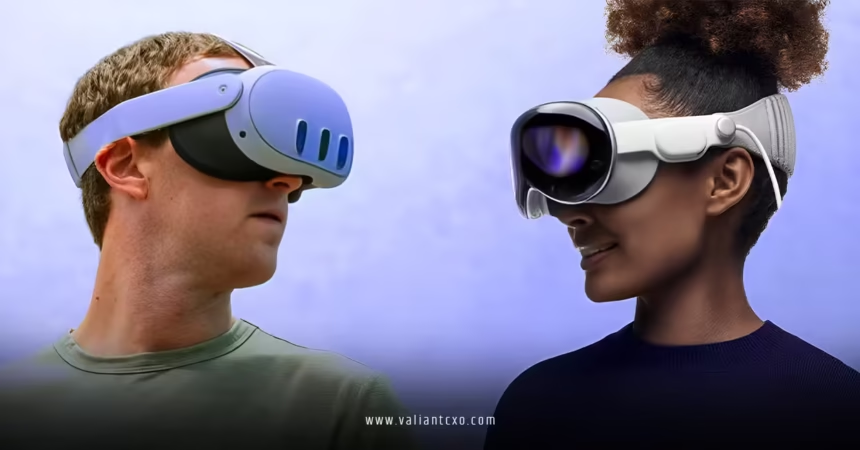
Apple Vision Pro vs Meta Quest 3 is the matchup everyone in mixed reality keeps circling back to. Not because they’re similar, but because they sit on opposite ends of the spectrum: one is a luxury spatial computer, the other is the everyday workhorse of consumer VR.
Here’s the thing: they’re both “great” in their own lanes. Your job is to figure out which lane you’re actually driving in.
Quick verdict: Apple Vision Pro vs Meta Quest 3 at a glance
If you want the TL;DR before diving deeper:
- Meta Quest 3 is the best choice for most people who want affordable VR gaming, casual mixed reality, and standalone fun.
- Apple Vision Pro is for people who want premium spatial computing, productivity, and tight Apple ecosystem integration and are willing to pay a luxury price.
- The price difference isn’t a gap. It’s a canyon.
- Use Quest 3 for games and experimentation.
Use Vision Pro if you’re intentionally building a spatial-first workflow or content experience. - If you’re deciding based on long-term Apple value, you’ll want to also read up on Apple Vision Pro M5 worth buying 2026 as the ecosystem matures and hardware iterates.
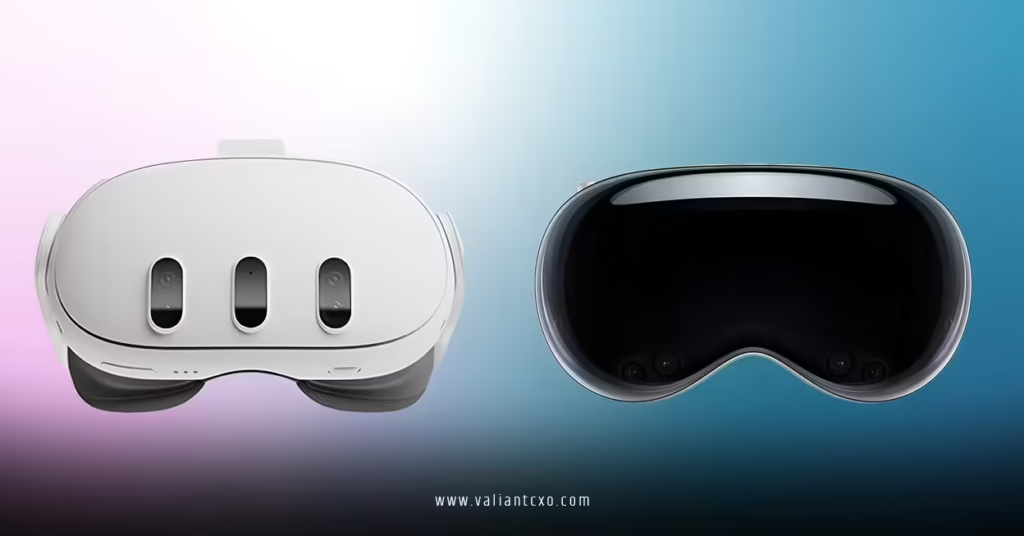
Comparison snapshot: Apple Vision Pro vs Meta Quest 3
Here’s a fast, scannable breakdown to anchor your decision.
| Feature | Apple Vision Pro | Meta Quest 3 |
|---|---|---|
| Positioning | Premium “spatial computer” focused on productivity, media, and Apple ecosystem | Mass-market VR/mixed reality headset focused on gaming and casual experiences |
| Price Tier | High-end, luxury device | Mid-range consumer-friendly device |
| Best For | Apple power users, creators, professionals | Gamers, families, hobbyists, VR newcomers |
| Core Strength | Display quality, interface polish, seamless Apple integration | Game library, standalone use, value for money |
| Use Without PC | Yes, as a spatial computer | Yes, fully standalone |
| Ecosystem Lock-in | Tightly Apple-centric | Meta ecosystem + PC/Cloud gaming paths |
| Ideal Buyer | Someone who wants a high-end mixed reality work/media machine | Someone who wants fun, accessible VR without overspending |
Who should buy Meta Quest 3?
Let’s start with the headset that makes sense for most people.
If you’re asking “What’s the best all-rounder VR headset right now without wrecking my budget?”, Meta Quest 3 is the default answer. It’s the reliable hatchback of the VR world: practical, accessible, and way more fun than the price suggests.
Quest 3 is ideal if you:
- Want VR gaming out of the box, no extra hardware required.
- Care more about library and fun than luxury display quality.
- Need something family-friendly for shared play, fitness apps, and casual experiences.
- Like the option to connect to a PC (wired or wireless) for higher-end gaming when you want to.
Quest 3 shines because it’s simple to explain: put it on, pick a game, have fun. No heavy ecosystem thinking required.
Where Quest 3 falls short
- Not in the same league as Vision Pro for premium spatial productivity or visual polish.
- Mixed reality is more “cool feature” than “serious daily work tool.”
- If you’re deep in Apple’s world and want everything to feel unified, Quest will always feel a bit separate from your main devices.
In other words, Quest 3 is the right move if you want maximum entertainment and experimentation per dollar.
Who should consider Apple Vision Pro?
Now to the other side of the ring.
Apple Vision Pro is not a casual headset. It’s more like a personal, portable cinema and multi-screen workstation glued to your face. Overkill for many. Incredible for the right person.
Vision Pro makes sense if you:
- Already own an iPhone, Mac, and other Apple gear, and you want deeper integration.
- Care a lot about display quality, hand/eye tracking, and interface smoothness.
- See spatial computing as a serious work or creative platform, not just a toy.
- Value immersive media consumption (movies, TV, spatial video) at a premium level.
You’re not buying Vision Pro instead of a Quest 3. You’re buying it instead of another monitor setup, a dedicated media room upgrade, or as a new kind of computing environment.
Where Apple Vision Pro struggles for average users
- The cost means it has to justify itself as more than a novelty.
- Content and app ecosystems are growing, but not aimed at mass gaming-first audiences.
- Comfort, long sessions, and battery expectations are all things you must think about before you purchase.
If you’re planning ahead, comparing Vision Pro today to Apple Vision Pro M5 worth buying 2026 is a smart way to think generationally: this first wave sets the tone, but later iterations typically smooth out rough edges, expand app support, and refine hardware based on real-world feedback.
Apple Vision Pro vs Meta Quest 3: use-case breakdown
Instead of obsessing over specs, let’s translate the choice into real-life scenarios. That’s what actually matters.
For gaming
- Winner: Meta Quest 3
If gaming is your main priority, Meta’s platform is the more natural fit. You get:
- A huge library of games and fitness apps.
- Lower risk if you’re not sure how much you’ll use it.
- Easy sharing with friends and family.
Vision Pro can do some gaming, but that’s not its main job right now. You’re paying for capabilities you won’t fully use if you just want beats, swords, and casual VR fun.
For productivity and work
- Leaning winner: Apple Vision Pro (if you’re Apple-centric)
If you’re thinking:
- “I want multiple floating screens.”
- “I want to work on a plane, hotel, or couch with a full workstation feel.”
- “I want a more immersive way to manage apps and content.”
Then Vision Pro is the better fit, especially if your workflow is already built around macOS, iOS, and iCloud.
Quest 3 can do some productivity via hacks, streaming, or third-party tools, but it never feels like it was born for that job.
For media and movies
- Leaning winner: Apple Vision Pro
Both headsets can handle media. But Vision Pro is designed to be a premium viewing device:
- Virtual environments
- Spatial audio integration
- Deep tie-ins with Apple’s own content and services
Quest 3 is still good for this, especially for the price, but if cinema-style immersion is your priority, Vision Pro plays in a different league.
For experimentation and learning
- Winner: Meta Quest 3
If you’re:
- Just curious about VR
- Trying mixed reality for the first time
- Not sure you’ll stick with it long-term
Quest 3 gives you a lower-risk way to explore. You can learn what you genuinely like about spatial experiences without committing to luxury-level hardware.
Step-by-step decision guide: which headset fits you?
Use this simple decision flow to get off the fence.
- What’s your #1 priority?
- Gaming, fitness, and fun → lean Quest 3.
- Work, productivity, and media with Apple devices → lean Vision Pro.
- How price-sensitive are you?
- If you’re trying to stay budget-conscious → Quest 3 is the obvious pick.
- If you’re okay with a “serious investment” for a specialized device → Vision Pro becomes realistic.
- What ecosystem are you in?
- Heavily Apple-based: iPhone, Mac, Apple TV, iCloud → Vision Pro grows more compelling.
- Mixed platforms, PC gaming, or just casual tech use → Quest 3 is easier to fit in.
- How sure are you you’ll use it weekly?
- Not sure, just curious → start with Quest 3.
- Very clear use cases (remote work, content review, spatial workflows) → Vision Pro starts to pay off.
- Are you thinking multi-year or “try it now”?
- “Try it now, see if VR sticks” → Quest 3.
- “I want to build a long-term spatial computing habit and will upgrade over time” → Vision Pro + awareness of futures like Apple Vision Pro M5 worth buying 2026 is the strategic path.
Common mistakes when choosing between Apple Vision Pro and Meta Quest 3
Mistake 1: Treating them as similar products
They’re not. One is a spatial computer, the other is a consumer VR console. Comparing them directly only by specs misses the point.
Fix: Decide your primary job first (gaming vs. work/media) and pick based on that.
Mistake 2: Underestimating ecosystem lock-in
If you’re deep into Apple, buying a device that doesn’t plug into your world as cleanly can feel off over time. If you’re not in Apple’s universe, Vision Pro loses a big chunk of its advantage.
Fix: Map how the headset will talk to your phone, computer, and apps before you buy.
Mistake 3: Buying Vision Pro purely for hype
Vision Pro is impressive. But that doesn’t mean it’s the right move for someone who wants primarily games and “wow” demos.
Fix: Only pick Vision Pro when you can articulate at least two practical use cases, not just “it looks futuristic.”
Mistake 4: Assuming Quest 3 is “cheap, so it must be weak”
Quest 3 is affordable, but that doesn’t mean it’s flimsy. For most people, it’s actually the best value headset out there.
Fix: Judge it on what it does for you—game library, standalone use, casual MR—not on how expensive it looks on a spec sheet.
Mistake 5: Not thinking ahead a generation
If you’re considering Vision Pro, you’re also implicitly betting on where Apple is going in a few years. Waiting for a later iteration, such as the maturity layer discussed when people evaluate Apple Vision Pro M5 worth buying 2026, may give you more polish and potentially better value.
Fix: If you’re on the fence and don’t have a burning use case today, let a generation or two pass and reassess.
Which headset ages better?
No one has a crystal ball, but patterns do exist.
- Meta Quest 3 is likely to remain the baseline recommendation for people wanting accessible VR without drama.
- Apple Vision Pro is more about planting a flag in the future of spatial computing. As the ecosystem grows and hardware iterates, the real question shifts from today’s version to questions like Apple Vision Pro M5 worth buying 2026—how good the platform becomes once it’s had a few generations to mature.
If you like stable, predictable value now? Go Quest.
If you like being early in a platform that’s evolving? Vision Pro is your playground.
Final thoughts: pick based on the job, not the logo
Here’s the cleanest way to slice it:
- Choose Meta Quest 3 if you want:
- Affordable VR and MR
- Great games and fitness apps
- Low commitment and high fun
- Choose Apple Vision Pro if you want:
- A premium spatial experience for work and media
- Deep Apple ecosystem integration
- To lean into spatial computing as a serious part of your digital life
The brand doesn’t answer the question for you. Your daily habits do.
If you eventually start exploring higher-end Apple spatial hardware, that’s when it makes sense to zoom out and ask the bigger value question framed as Apple Vision Pro M5 worth buying 2026—because the real power of Apple’s approach shows up over generations, not just in a single launch.
Whichever way you go, buy for how you live, not for how a promo video looks.
FAQ :
FAQ 1: Is Apple Vision Pro better than Meta Quest 3 for beginners?
Not usually. For beginners, Meta Quest 3 is the more practical choice because it’s far cheaper, easier to justify, and focused on gaming and casual mixed reality. Apple Vision Pro is better suited to Apple power users who want a premium work and media device, not someone just testing the VR waters.
FAQ 2: Which is better for gaming, Apple Vision Pro or Meta Quest 3?
Meta Quest 3 wins for gaming. It has a larger game library, strong support for fitness and social experiences, and works great as a standalone headset. Vision Pro can handle some games, but that’s not its core purpose or strongest use case.
FAQ 3: How do I decide between Apple Vision Pro and Meta Quest 3?
Start with your main goal. If you want affordable VR for games, fitness, and experimentation, go with Meta Quest 3. If you’re deep in the Apple ecosystem and want a premium spatial computer for productivity and media, then Apple Vision Pro makes more sense—especially if you’re also thinking long-term about how models like Apple Vision Pro M5 worth buying 2026 might fit into your upgrade path.