

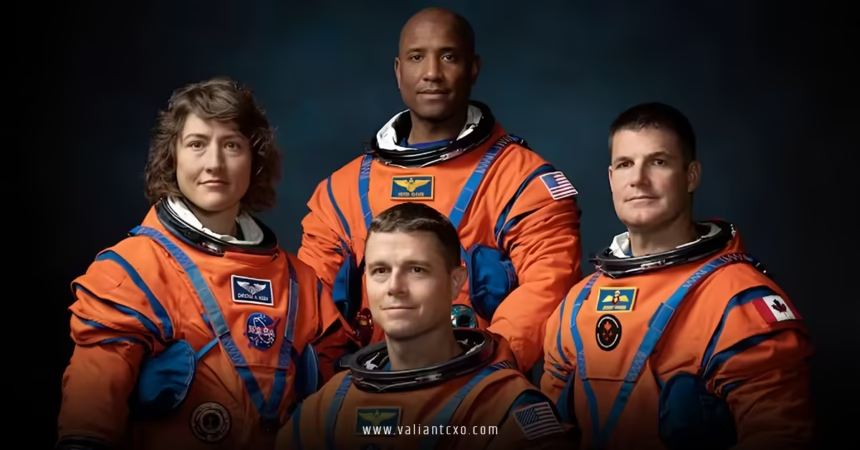
Artemis II crew details reveal an extraordinary team of four astronauts poised to make history as the first humans to venture beyond low-Earth orbit in over half a century. This mission marks NASA’s bold step forward in the Artemis program, sending Commander Reid Wiseman, Pilot Victor Glover, Mission Specialist Christina Koch from NASA, and Mission Specialist Jeremy Hansen from the Canadian Space Agency on a daring 10-day journey around the Moon. As excitement builds with the rocket now at the launch pad in January 2026, let’s dive into who these trailblazers are, what they’ve accomplished, and why their roles matter so much.
If you’ve been following space exploration, you know this isn’t just another flight—it’s humanity’s return ticket to deep space. Curious about how these individuals were chosen and what they’ll face? Stick around as we unpack the Artemis II crew details and connect it all to the broader picture.
Why the Artemis II Crew Details Matter in Today’s Space Race
Picture this: four people strapped into the Orion spacecraft, hurtling past the Moon at speeds over 24,000 miles per hour. No landing—just a breathtaking flyby that tests every system for future lunar landings. The Artemis II crew details highlight diversity, experience, and international collaboration. NASA didn’t pick these astronauts randomly; each brings unique skills honed through years of training, previous missions, and sheer grit.
This mission isn’t solo—it’s a partnership. Jeremy Hansen’s inclusion underscores Canada’s vital role in Artemis through contributions like the Canadarm3 robotic arm for the Lunar Gateway. Together, this crew embodies the spirit of global teamwork in pushing boundaries. And with the latest NASA Artemis launch schedule update showing the SLS rocket rolled out to Pad 39B on January 17, 2026, and a wet dress rehearsal targeted no later than February 2, the timeline feels very real.
Commander Reid Wiseman: The Steady Hand at the Helm
Leading the charge is Reid Wiseman, a U.S. Navy veteran turned astronaut whose calm demeanor hides a passion for exploration that started near an Air National Guard base in his Maryland hometown. Selected by NASA in 2009, Wiseman already logged 165 days in space during Expedition 41 aboard the International Space Station back in 2014. He flew as a flight engineer, conducting science experiments and spacewalks.
What stands out in the Artemis II crew details is Wiseman’s leadership experience—he even served as chief of NASA’s Astronaut Office from 2020 to 2022, overseeing the entire corps during critical Artemis planning. As commander, he’ll orchestrate the mission, make real-time decisions, and keep the team focused. Imagine being the voice everyone trusts when Earth is a tiny blue dot in the window. That’s Reid Wiseman.
For the latest on mission prep tied to this crew, check the ongoing NASA Artemis launch schedule update for rollout milestones and countdown details.
Pilot Victor Glover: Breaking Barriers with Precision
Victor Glover steps into the pilot seat, becoming the first Black astronaut to fly beyond low-Earth orbit. A former Navy test pilot and legislative fellow, Glover was selected in NASA’s 2013 class. His first spaceflight came on Crew-1 in 2020, where he spent six months on the ISS as pilot of the Crew Dragon Resilience—conducting hundreds of experiments and two spacewalks.
In the Artemis II crew details, Glover’s role involves handling Orion’s navigation, propulsion, and docking maneuvers (though no docking occurs on this test flight). His precision under pressure is legendary; think of him as the driver navigating cosmic highways at unimaginable speeds. Glover often speaks about representation, inspiring kids who see themselves in him. “This mission shows what’s possible when we invest in people,” he’s said in interviews. His presence elevates the entire crew dynamic.
Mission Specialist Christina Koch: The Record-Breaking Explorer
Few astronauts have stories as compelling as Christina Koch. An electrical engineer by training, she joined NASA in 2013 and quickly became a legend. During her 328-day stay on the ISS (2019–2020), she set the record for the longest single spaceflight by a woman and participated in the first all-female spacewalk with Jessica Meir.
Koch’s expertise shines in the Artemis II crew details—she’ll manage scientific observations, test Orion’s life-support systems, and handle emergency procedures. Her deep-space experience (she’s already flown farther than most living astronauts during that long ISS stint) makes her invaluable for understanding radiation effects and long-duration isolation. Koch’s calm, methodical approach turns potential chaos into controlled progress. She’s not just flying to the Moon; she’s proving sustained human exploration is within reach.
Mission Specialist Jeremy Hansen: Canada’s First Moon Voyager
Rounding out the quartet is Jeremy Hansen, the Canadian Space Agency’s contribution and the first Canadian ever assigned to a lunar mission. A former fighter pilot with the Royal Canadian Air Force, Hansen was selected as an astronaut in 2009. Though this is his first spaceflight, his training includes extensive robotics expertise and leadership in CSA’s space medicine programs.
In the Artemis II crew details, Hansen represents international partnership—he’ll conduct observations of the lunar surface, assist with spacecraft operations, and symbolize Canada’s commitment to Artemis. At over 6 feet tall, he’s joked about fitting into Orion’s compact cabin, but his calm humor and technical prowess make him a perfect fit. Becoming the first non-American on a crew headed to the Moon? That’s historic.

Training and Preparation: How the Artemis II Crew Details Came Together
These four didn’t just show up—they’ve been training intensely since their announcement in April 2023. From simulator runs at NASA‘s Johnson Space Center to suited tests inside the actual Orion capsule, every scenario gets rehearsed. Recent activities include working with flight controllers on abort options and emergency procedures as the rocket sits ready at the pad.
The crew even named their Orion spacecraft “Integrity,” reflecting their values of trust and reliability. With the SLS stack now at Launch Complex 39B and propellant loading tests imminent, they’re in the final stretch. The Artemis II crew details emphasize safety: every member cross-trains so anyone can step in if needed.
What the Mission Means for the Future
This flyby isn’t the end—it’s the bridge. Data from Artemis II will refine systems for Artemis III’s landing (now eyed for mid-2027). The crew’s experiences with radiation, communication delays, and deep-space navigation will shape Mars plans. It’s thrilling to think their work today enables tomorrow’s footprints on the Moon.
Conclusion: Inspiration from the Artemis II Crew Details
The Artemis II crew details paint a picture of diverse, highly skilled individuals united by courage and curiosity. Reid Wiseman’s leadership, Victor Glover’s precision, Christina Koch’s endurance, and Jeremy Hansen’s fresh perspective create a powerhouse team ready for the unknown. As NASA pushes toward that potential February 6, 2026, launch window (per the latest NASA Artemis launch schedule update), this crew reminds us why space exploration captivates us—it’s about human potential reaching for the stars.
Whether you’re dreaming of space or just love a good adventure story, these astronauts are living proof that bold goals are achievable. Keep watching the skies; history is about to unfold.
FAQs
Who makes up the Artemis II crew details?
The Artemis II crew details include Commander Reid Wiseman, Pilot Victor Glover, Mission Specialist Christina Koch (all NASA), and Mission Specialist Jeremy Hansen (Canadian Space Agency).
What is Reid Wiseman’s role in the Artemis II crew details?
As commander, Reid Wiseman oversees the entire mission, ensures crew safety, and leads decision-making during the lunar flyby.
How does Victor Glover stand out in the Artemis II crew details?
Victor Glover is the pilot and the first Black astronaut to travel beyond low-Earth orbit, bringing test-pilot expertise and ISS experience to navigation tasks.
Why is Christina Koch significant in the Artemis II crew details?
Christina Koch holds the record for the longest single spaceflight by a woman and contributes engineering skills plus deep-space endurance to the mission.
What makes Jeremy Hansen unique in the Artemis II crew details?
Jeremy Hansen becomes the first Canadian to venture to the Moon, representing international collaboration and adding robotics and aviation expertise.

