
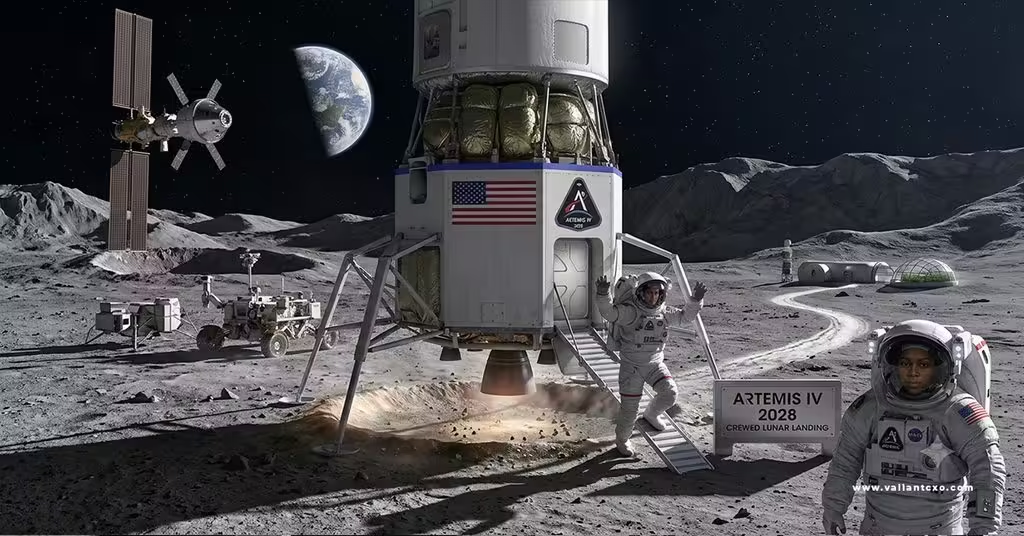
Artemis IV moon landing 2028 is the mission the whole program has been building toward: the first time humans set foot on the Moon since Apollo 17 in 1972. Here’s the fast version.
- What it is: NASA’s first crewed lunar landing of the Artemis era, aimed at the Moon’s south pole.
- When: NASA says 2028. Some reporting points to early 2028, but that’s a target, not a launch date.
- How: Orion and four astronauts launch on SLS. Two of them descend in a commercial lander, either SpaceX’s Starship or Blue Origin’s Blue Moon Mark 2.
- Why it moved: Artemis III is now an Earth-orbit docking rehearsal, so the landing slid to Artemis IV.
- Why it matters: It’s the first step toward a lasting presence on the Moon and a stepping stone to Mars.
If you want the lead-up, start with our breakdown of the Artemis II splashdown and NASA’s next steps for Artemis III timeline. It explains how we got here.
Why Artemis IV Became the Landing Mission
The original plan had Artemis III touching down on the Moon. That changed in February 2026, when NASA converted Artemis III into a low Earth orbit test. Orion will dock with test versions of both commercial landers, and the actual landing moved one mission down the line.
The reasoning is simple. Docking two spacecraft for the first time near the Moon is a bad idea. Doing it a few hundred miles above Earth, where a crew can come home in hours if something breaks, is a much better one.
It’s the driving-school parking lot before the highway on-ramp.
Artemis III is planned as a 14-day Earth-orbit flight to reduce risk ahead of the Artemis IV moon landing mission. Whatever shakes out of that flight feeds directly into Artemis IV. If you want the full state of play, NASA laid it out in its Artemis acceleration update.
How the Artemis IV Moon Landing 2028 Mission Works
NASA hasn’t locked in a single lander. It’s running two paths in parallel and will pick based on readiness.
Astronauts launch aboard Orion on the SLS rocket from Kennedy Space Center in Florida. After that, the two plans diverge.
The SpaceX Starship path
Starship refuels in Earth orbit, rendezvous with Orion, then carries the spacecraft toward the Moon. That’s a change from the original design, which had Orion meeting the lander in lunar orbit. Once at the Moon, two astronauts descend in Starship, do several moonwalks, then blast off to rejoin Orion for the trip home.
The Blue Origin path
Blue Origin took a different route. It would launch three transfer stages on New Glenn, followed by the Blue Moon Mark 2 lander, and those stages boost the lander into lunar orbit. Orion then meets the lander in a closer lunar orbit before two crew members descend to the surface. This design defers the tricky in-space propellant transfer that Starship relies on.
Which one flies first?
NASA says lander readiness decides it. A second crewed landing opportunity follows, which means whichever lander doesn’t go first likely gets a turn on Artemis V. For more on the strategy, CBS News covered how NASA is hedging its bets.
Artemis IV Moon Landing 2028: Lander Comparison
Here is your code converted into a properly formatted table:
| Factor | SpaceX Starship | Blue Origin Blue Moon Mk 2 |
|---|---|---|
| How it gets to the Moon | Refuels in Earth orbit, then pushes Orion toward the Moon | Three transfer stages push the lander to lunar orbit |
| Where it meets Orion | Earth orbit | Lunar orbit |
| Key technical hurdle | In-orbit propellant transfer | Chaining multiple transfer stages and the lander |
| Surface crew | Two astronauts | Two astronauts |
| 2028 landing target | Yes | Yes |
| Selection | NASA will choose based on lander readiness | NASA will choose based on lander readiness |
The Hardware Beyond the Landers
The landers get the headlines, but other pieces matter just as much.
The rocket. For Artemis IV, NASA is pursuing two upper-stage options for SLS: the current interim cryogenic propulsion stage and a stretched version of ULA’s Centaur V that can carry more propellant. Keeping two options avoids betting everything on one supplier.
The suits. NASA and Axiom Space are developing a lighter “Sortie suit” for the first moonwalks. It weighs roughly half as much as Axiom’s primary suit, which is saved for longer missions later.
The crew. NASA named the Artemis III crew in June. In what I found, Artemis IV’s crew hasn’t been announced as of early November 2026. Expect that news once Artemis III is closer.
Why the South Pole?
The south pole has water ice, and ice means water, oxygen and fuel for future bases. That’s the pitch. The risk side is just as real: rough terrain, long shadows and brutal lighting. SpacePolicyOnline reported that some critics question choosing the pole over a smoother site nearer the equator, and a NASA official acknowledged there are many unknowns. You can read that discussion in SpacePolicyOnline’s Artemis III, IV and V report.
Is it the right call? In my view it’s a defensible bet, but it raises the difficulty. Not wrong, just harder.
Step-by-Step: How to Track the Artemis IV Moon Landing 2028 Schedule
If you’re new to this, here’s the routine I’d use.
- Watch Artemis III first. Nothing about Artemis IV firms up until the orbit test flies.
- Follow the lander pathfinders. Blue Moon and Starship test articles have to launch and perform.
- Check NASA’s hardware updates. Stacking, rollouts and engine tests tell you more than date announcements.
- Track the upper-stage decision. Which SLS stage flies for Artemis IV is a schedule signal.
- Note the language. “Targeting 2028” is a goal. A firm launch date only shows up months out.
- Cross-check against older coverage. A lot of 2024 and 2025 articles are stale.
Common Mistakes & How to Fix Them
Mistake: Thinking Artemis III lands on the Moon.
Fix: It doesn’t anymore. It’s an Earth-orbit test.
Mistake: Assuming one lander is already chosen.
Fix: NASA is keeping both on the table and will decide based on readiness.
Mistake: Reading 2028 as a promise.
Fix: The date has already shifted once. Plan for the possibility of another slip.
Mistake: Treating this as an SLS-only story.
Fix: The landing depends on commercial landers, suits and an upper stage all being ready together.
Mistake: Ignoring the competition angle.
Fix: NASA leadership has cited strategic competitors in justifying urgency. That pressure shapes schedule choices, though it doesn’t guarantee they’ll pay off.
Key Takeaways
- Artemis IV is NASA’s first planned crewed landing of the Artemis era, targeted for 2028.
- Four astronauts launch on Orion; two descend to the lunar south pole.
- SpaceX’s Starship and Blue Origin’s Blue Moon Mark 2 are both in the running.
- Artemis III’s Earth-orbit docking test comes first and de-risks the landing.
- NASA will pick the lander for Artemis IV based on readiness, with a second landing to follow.
- Hardware choices, like the SLS upper stage and a lighter spacesuit, are being hedged.
- The south pole is high reward and high difficulty.
- 2028 is a target. Watch milestones, not headlines.
The Bottom Line
Artemis IV is the payoff for everything that came before it: the SLS, Orion, the landers and years of testing. The plan is more flexible than the old one, and the extra rehearsal flight makes it safer. Whether it all lands in 2028 depends on hardware, not hope.
Your next step: bookmark NASA’s Artemis page and check it after each Artemis III milestone. Those updates will tell you whether 2028 is holding.
FAQs
Who will land on the Moon during Artemis IV?
Four astronauts fly aboard Orion, and two of them descend to the surface. The crew hasn’t been announced in the sources I found as of November 2026.
Will the Artemis IV moon landing 2028 use SpaceX or Blue Origin?
Both companies are targeting 2028, and NASA will select whichever lander is ready first. Artemis III’s Earth-orbit test will help inform that choice.
Why isn’t Artemis III landing on the Moon?
NASA wanted to rehearse docking and lander operations in Earth orbit first, similar to Apollo 9. That shifted the first landing to Artemis IV, which keeps the 2028 goal alive.