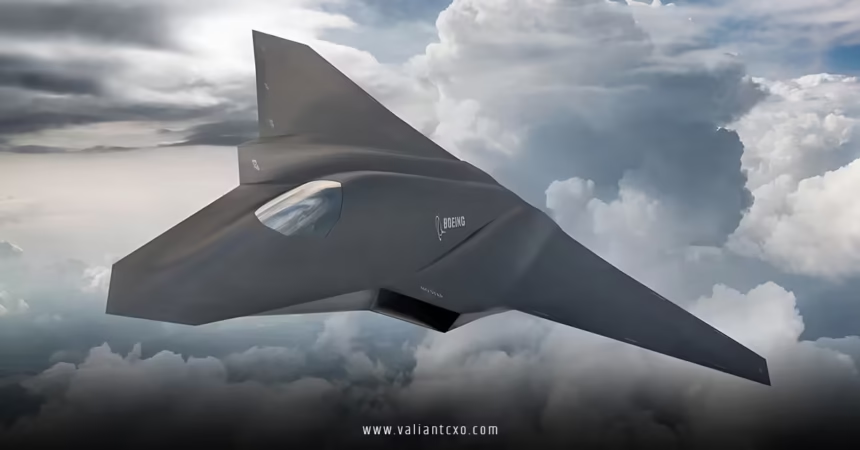
Boeing F-47 NGAD fighter jet represents a groundbreaking shift in aerial warfare. Imagine a sleek, shadowy predator slicing through the skies, outthinking and outmaneuvering any opponent before they even know you’re there. That’s the promise of this cutting-edge machine, the centerpiece of the U.S. Air Force’s Next Generation Air Dominance program. Have you ever wondered what comes after the F-22 Raptor, the king of fifth-generation stealth fighters? Well, the Boeing F-47 NGAD fighter jet is here to claim that throne, blending mind-blowing technology with raw power to keep American skies secure for decades.
What Is the Boeing F-47 NGAD Fighter Jet?
At its core, the Boeing F-47 NGAD fighter jet is the U.S. Air Force’s ambitious push into sixth-generation aviation. Announced in a high-profile reveal in March 2025, this aircraft isn’t just another upgrade—it’s a complete reimagining of air superiority. Designed to replace the legendary F-22, the Boeing F-47 NGAD fighter jet serves as the manned hub in a “family of systems” that includes drone wingmen, advanced sensors, and networked battle management tools.
Think of it like a quarterback calling plays in a football game: the pilot in the Boeing F-47 NGAD fighter jet directs a team of unmanned Collaborative Combat Aircraft (CCAs), extending reach and firepower without risking more lives. This isn’t science fiction; years of secret testing have already proven the concepts viable.
The History and Development of the Boeing F-47 NGAD Fighter Jet
The journey to the Boeing F-47 NGAD-fighter-jet didn’t happen overnight. It traces back to studies in the 2010s, when the Air Force realized fifth-generation fighters like the F-22 and F-35 might not cut it against evolving threats from peers like China. The program kicked off seriously around 2014, evolving from DARPA’s air dominance initiatives.
Fast-forward to 2025: after a brief pause due to cost concerns, President Donald Trump announced Boeing as the winner of the over $20 billion Engineering and Manufacturing Development contract. Why Boeing? Their proposal beat out Lockheed Martin, thanks to innovative risk-reduction through X-plane demonstrators flown secretly since the late 2010s. These test beds logged hundreds of hours, ironing out kinks in stealth, propulsion, and more.
The name “F-47” pays homage to the WWII P-47 Thunderbolt, the Air Force’s 1947 founding, and supportive leadership. Production is already underway in St. Louis, with first flight targeted for 2028—blazing fast by defense standards.
Key Milestones in Boeing F-47 NGAD Fighter Jet Development
- 2010s Origins: Early concepts and DARPA collaborations lay groundwork.
- 2020-2024: Secret X-planes fly, de-risking technologies for the Boeing F-47 NGAD-fighter-jet.
- 2024 Pause: Brief reevaluation for affordability.
- March 2025: Boeing wins contract; Boeing F-47 NGAD-fighter-jet officially named.
- 2026 Status: Production ramps up, with billions allocated in budgets.
Design Features of the Boeing F-47 NGAD Fighter Jet
Details remain classified—naturally, for something this game-changing—but what’s public paints an exciting picture. The Boeing F-47 NGAD-fighter-jet boasts a tailless, blended wing-body design, echoing stealth bombers for ultra-low radar signatures. No vertical tails mean bomber-like invisibility, yet it retains fighter agility.
Expect significantly longer range than the F-22, advanced all-aspect stealth, and adaptive engines that switch modes for efficiency or thrust. It’s built for sustainability too—higher availability, easier maintenance. Picture a ghost in the sky: enemies won’t see it coming, but it’ll spot them from afar with next-level sensors and AI-driven decision-making.
Why Tailless Design Matters for the Boeing F-47 NGAD Fighter Jet
Going tailless isn’t just stylish; it’s strategic. Traditional tails create radar reflections. By ditching them, the Boeing F-47 NGAD-fighter-jet achieves “stealth supremacy,” penetrating deep into contested airspace while controlling drone swarms. It’s like hiding in plain sight, but in the vast blue yonder.
Technologies Powering the Boeing F-47 NGAD Fighter Jet
What makes the Boeing F-47 NGAD-fighter-jet truly sixth-gen? It’s the tech stack. Advanced propulsion from programs like NGAP promises supercruise without afterburners, saving fuel for those Pacific-spanning missions. AI integrates everything, helping pilots process data faster than ever—getting inside the enemy’s OODA loop (observe, orient, decide, act).
Manned-unmanned teaming is huge: the Boeing F-47 NGAD-fighter-jet acts as a “loyal wingman” commander, directing CCAs for scouting, jamming, or striking. Add cutting-edge electronic warfare, hypersonic-capable weapons, and networked connectivity, and you’ve got a force multiplier.
Collaborative Combat Aircraft and the Boeing F-47 NGAD Fighter Jet
CCAs are the unsung heroes here. Affordable drones fly alongside the Boeing F-47 NGAD-fighter-jet, carrying extra munitions or acting as decoys. Plans call for 1,000+ CCAs supporting around 200 manned jets, creating overwhelming numbers without breaking the bank.
The Boeing F-47 NGAD Fighter Jet vs. Competitors
How does the Boeing F-47 NGAD-fighter-jet stack up globally? China’s J-20 and emerging sixth-gen prototypes are formidable, but the F-47 aims to leap ahead with superior range, stealth, and systems integration. Russia’s efforts lag, while allies like the UK/Japan/Italy’s GCAP program share some traits but lack the U.S.’s scale.
Domestically, beating Lockheed Martin was a upset—Boeing hadn’t won a clean-sheet fighter in decades. This win revitalizes their defense arm, ensuring competition keeps innovation sharp.
Challenges Facing the Boeing F-47 NGAD Fighter Jet Program
No program this ambitious is smooth sailing. Costs are eye-watering—once estimated at three times an F-35 per unit—but redesigns and mature tech from X-planes help. Budget pressures in 2024 caused a pause, but momentum returned strong. Delays in production facilities or supply chains could push timelines, yet Boeing’s massive investments signal commitment.
Geopolitically, accelerating threats demand speed. Can the Boeing F-47 NGAD-fighter-jet deliver on time? Early signs say yes, with production already humming.
Future Outlook for the Boeing F-47 NGAD Fighter Jet
Looking ahead, the Boeing F-47 NGAD fighter jet could enter service in the early 2030s, forming the backbone of U.S. air power. Paired with CCAs, it’ll dominate contested environments, from the Indo-Pacific to Europe. Exports? Unlikely soon, given sensitivity, but tech trickle-down could boost allies.
As threats evolve—think AI swarms or hypersonics—the Boeing F-47 NGAD-fighter-jet’s adaptability shines. It’s not just a plane; it’s a system evolving with the battlefield.
In conclusion, the Boeing F-47 NGAD-fighter-jet marks a pivotal moment in aviation history. From its secretive X-plane roots to production today, it embodies American ingenuity pushing boundaries. This isn’t merely about replacing the F-22; it’s about securing skies against tomorrow’s challenges. With superior stealth, range, and smart integration, the Boeing F-47 NGAD fighter jet ensures air superiority endures. Exciting times ahead—stay tuned as this beast takes flight.
FAQs About the Boeing F-47 NGAD Fighter Jet
1. What makes the Boeing F-47 NGAD fighter jet a sixth-generation aircraft?
The Boeing F-47 NGAD fighter jet qualifies as sixth-gen through advanced stealth, AI integration, manned-unmanned teaming, and adaptive propulsion—leaps beyond fifth-gen like the F-22.
2. When will the Boeing F-47 NGAD fighter jet first fly?
Current plans target a first flight for the Boeing F-47 NGAD fighter jet around 2028, with initial operational capability in the 2030s.
3. How many Boeing F-47 NGAD fighter jets does the Air Force plan to buy?
The U.S. Air Force aims for around 200 Boeing F-47 NGAD fighter jets, supported by over 1,000 Collaborative Combat Aircraft drones.
4. Why did Boeing win the contract for the Boeing F-47 NGAD fighter jet?
Boeing’s mature design from years of X-plane testing, innovative approach, and competitive pricing edged out rivals for the Boeing F-47 NGAD fighter jet contract.
5. How does the Boeing F-47 NGAD fighter jet differ from the F-22 Raptor?
The Boeing F-47 NGAD fighter jet offers longer range, superior stealth, drone command capabilities, and better sustainment compared to the F-22.