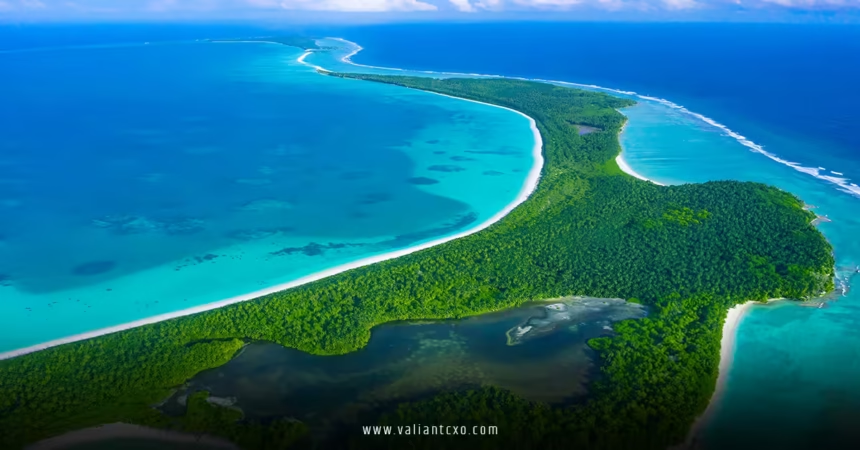
The Chagos Islands decolonization history is one of the most poignant and controversial chapters in modern colonial legacy stories. Picture a remote string of coral atolls in the middle of the Indian Ocean—peaceful, isolated, home to coconut plantations and a small community for generations. Then imagine that community uprooted, families scattered, and the islands turned into a geopolitical chess piece. That’s the core of the Chagos Islands decolonization history: a tale of forced detachment, human displacement, international court battles, and finally, a hard-won shift toward sovereignty restoration.
This history isn’t just about dusty archives; it echoes broader questions of justice, self-determination, and lingering imperial power. And it ties directly into recent events—like the Trump criticism UK Chagos Islands handover Mauritius 2026, where former US President Trump blasted the UK’s decision to transfer control as a sign of “weakness.” But to understand why that criticism hit so hard, we need to go back to the beginning.
Early Days: From Uninhabited Atolls to Colonial Dependency
The Chagos Archipelago—over 60 islands, with Diego Garcia as the largest—was largely uninhabited until the late 18th century. French settlers arrived around 1793, establishing copra (dried coconut) plantations using enslaved labor from Africa and later indentured workers from India. These people became the Chagossians (also called Ilois), developing a distinct Creole culture tied to fishing, farming, and island life.
By 1814, Britain seized Mauritius (including Chagos) from France under the Treaty of Paris. The islands remained a quiet dependency of Mauritius for over a century—administratively linked, geographically distant (about 1,300 miles away), but part of the same colonial unit. No one questioned this setup until the winds of decolonization blew stronger after World War II.
The Critical Turning Point: 1965 Detachment from Mauritius
As Mauritius edged toward independence, Britain made a fateful move. In 1965—three years before Mauritius became free—the UK detached the Chagos Archipelago via an Order in Council, creating the British Indian Ocean Territory (BIOT). This wasn’t a random carve-up. It was strategic.
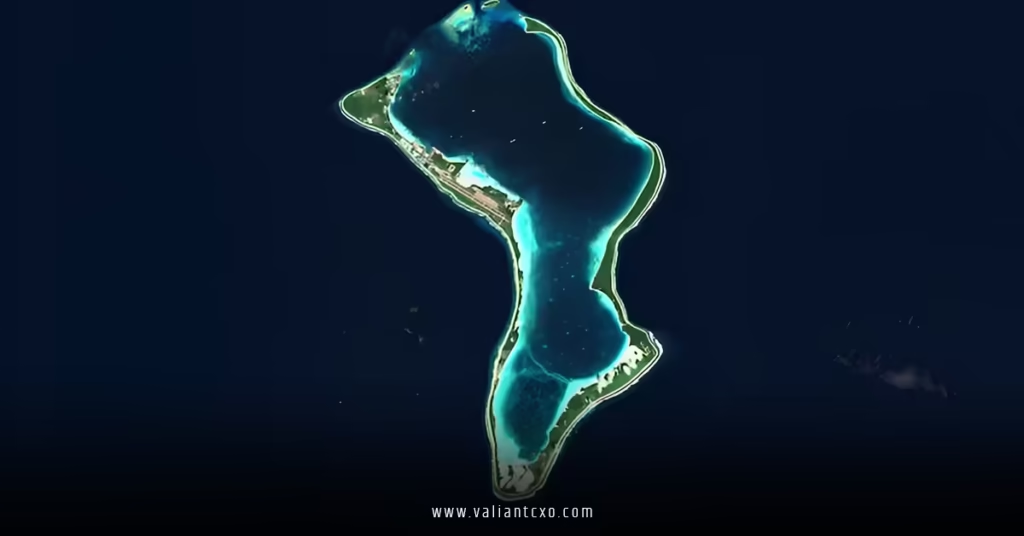
The United States wanted a secure military base in the Indian Ocean to counter Soviet influence during the Cold War. Diego Garcia’s location was perfect: remote, flat for runways, and far from prying eyes. US officials insisted on “exclusive control without local inhabitants.” Britain agreed, paying Mauritius a £3 million grant (a pittance) and promising to return the islands “when no longer required for defense purposes.”
Was this detachment legal? Mauritius’ leaders, still under British influence, reportedly consented—but under duress. The International Court of Justice (ICJ) later called it unlawful, arguing it violated the right to self-determination. The process ripped apart Mauritius’ territorial integrity right before independence in 1968.
The Dark Chapter: Forced Displacement of the Chagossians (1967–1973)
Here’s where the story turns heartbreaking. Between 1967 and 1973, the UK (with US backing) forcibly removed around 2,000 Chagossians from their homes. People were tricked onto boats, told it was temporary, then barred from returning. Homes were burned, pets killed to speed departures—survivors describe it as a nightmare.
Families ended up in Mauritius or the Seychelles, often in poverty, facing discrimination. The goal? Make Diego Garcia “uninhabited” for the base. A joint UK-US facility was built in the 1970s, becoming a key hub for surveillance, refueling, and operations (think Gulf Wars, Afghanistan). But at what human cost? Courts later labeled it “shameful,” and human rights groups called it a crime against humanity.
For decades, Chagossians fought back through lawsuits, winning partial victories—like a 2000 UK court ruling allowing return (quickly overturned in 2004 via Orders in Council). The struggle highlighted how colonial powers prioritized military needs over people.
International Pressure Builds: UN Resolutions and the 2019 ICJ Advisory Opinion
The Chagos Islands decolonization history gained global traction in the 1980s–2010s. African nations, the UN Special Committee on Decolonization, and resolutions repeatedly urged Britain to return the islands. Key moments:
- UN General Assembly resolutions (e.g., 1514 on decolonization) condemned detachment as violating territorial integrity.
- In 2017, Mauritius pushed the UN to seek an ICJ advisory opinion.
The 2019 ICJ ruling was landmark. By a near-unanimous vote, the court declared:
- Decolonization of Mauritius wasn’t lawfully completed in 1968 due to the unlawful separation.
- Britain must end administration “as rapidly as possible.”
- The UK bears international responsibility; states must cooperate to finish decolonization.
The UN General Assembly endorsed this in Resolution 73/295 (116-6 vote), demanding withdrawal within six months. Britain resisted, calling the opinion non-binding and citing defense needs.
The Path to Resolution: The 2025 UK-Mauritius Agreement
Pressure mounted. In October 2024, the UK announced it would cede sovereignty to Mauritius. The deal—finalized in May 2025—includes:
- Sovereignty transfer to Mauritius.
- 99-year lease for Diego Garcia (renewable), securing the base.
- Right of return for Chagossians (except Diego Garcia initially).
- Funds for resettlement and addressing historical wrongs.
This marked a major step in completing Mauritius’ decolonization. Yet challenges remain: Chagossian groups debate if it goes far enough, and geopolitical tensions linger.
Why This History Matters Today—and the Link to Trump Criticism
The Chagos Islands decolonization history isn’t ancient; it’s ongoing. It exposes how Cold War priorities trumped human rights, how international law evolves slowly against power, and how decolonization remains unfinished for many.
Recent developments—like the Trump criticism UK Chagos Islands handover Mauritius 2026—show the issue’s volatility. In early 2026, Trump called the handover “great stupidity” and “total weakness,” warning of Chinese/Russian influence despite earlier US support. His comments amplified UK opposition voices, framing it as surrender. Yet the deal persists, balancing security with justice.
In a world questioning colonial legacies, the Chagos story urges reflection: When does strategy justify displacement? How do we right historical wrongs without new risks? The islands may be tiny, but their history speaks volumes about power, people, and progress.
The Chagos Islands decolonization history reminds us that empires fade slowly—but justice, when pursued relentlessly, can reshape maps and mend broken lives. What’s your take on where this saga heads next?
FAQs
What is the core of Chagos Islands decolonization history?
Chagos Islands decolonization history centers on Britain’s 1965 detachment of the archipelago from Mauritius, forced removal of Chagossians, and ongoing sovereignty dispute resolved via the 2025 handover agreement.
How did the 1965 detachment impact Mauritius’ independence?
Britain separated Chagos to create BIOT for a US-UK base, arguably under duress, meaning Mauritius’ 1968 independence didn’t fully restore territorial integrity—deemed unlawful by the 2019 ICJ.
What role did the ICJ play in Chagos Islands decolonization history?
In 2019, the ICJ ruled Britain’s administration unlawful and ordered an end “as rapidly as possible,” boosting global calls for return and influencing the eventual 2025 agreement.
Why were Chagossians displaced in Chagos Islands decolonization history?
To make Diego Garcia uninhabited for a military base amid Cold War needs, leading to their forced exile between 1967–1973—a move later criticized as a human rights violation.
How does Chagos Islands decolonization history connect to Trump criticism UK Chagos Islands handover Mauritius 2026?
The 2025 handover fulfilled decolonization goals, but Trump’s 2026 attacks labeled it weak, highlighting tensions between historical justice and modern strategic concerns.