Have you ever wondered if nature could turn one of humanity’s biggest mistakes into a source of life? That’s exactly what happens when we dive into how Cladosporium sphaerospermum from Chernobyl uses melanin to convert radiation into energy. Picture this: in the shadowy ruins of a nuclear disaster zone, a tiny black fungus doesn’t just survive the invisible killer— it thrives on it, like a solar panel soaking up the sun, but with deadly gamma rays instead. As someone who’s always fascinated by the weird ways life hacks the universe, I find this story mind-blowing. It’s not sci-fi; it’s real science from the heart of Chernobyl, and it could change everything from space travel to cleaning up our messes. Let’s unpack this fungal superhero step by step, shall we?
The Chernobyl Backdrop: Where Disaster Bred a Survivor
Let’s set the scene first. It’s April 26, 1986, and the world watches in horror as Reactor No. 4 at the Chernobyl Nuclear Power Plant explodes, spewing radioactive fallout across Ukraine and beyond. The site becomes a ghost town, wrapped in a 30-kilometer exclusion zone where radiation levels could fry most living things. But here’s the twist—life didn’t bail. Plants pushed through contaminated soil, animals roamed, and fungi? They partied. Among them, Cladosporium sphaerospermum emerged as the rockstar, coating the reactor walls in velvety black patches right where the radiation hit hardest.
Why does this matter when we’re talking about how Cladosporium sphaerospermum from Chernobyl uses melanin to convert radiation into energy? Because this isn’t some lab-grown petri dish experiment. This fungus evolved in the wild, under constant bombardment from gamma rays and beta particles that would give humans a one-way ticket to the ER. Scientists first spotted it in the ’90s, scratching their heads over why it grew toward the radiation sources, not away. It’s like a moth to a flame, but the flame powers you up instead of burning you down. This real-world grit gives the whole story an edge of authenticity—nature’s own post-apocalyptic thriller.
I remember reading about explorers in hazmat suits poking at these black smears, half-expecting them to glow. Turns out, they do something even cooler: they adapt. And at the core of that adaptation? A pigment we’ve all got a bit of—melanin.
Meet Cladosporium Sphaerospermum: The Black Fungus That Laughs at Radiation
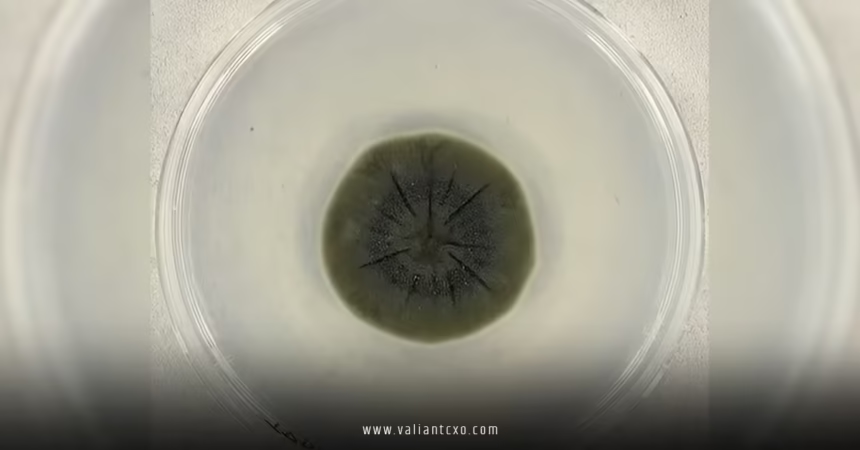
So, who is this underdog hero? Cladosporium sphaerospermum is a mold in the Cladosporium family, the kind you’d usually find hitchhiking on damp leaves or spoiled fruit. But the Chernobyl strain? It’s a beast. Jet-black and fuzzy, it looks like someone spilled ink on the reactor walls. Under a microscope, it’s chains of round spores, unassuming until you zap it with radiation.
What sets it apart is its radiotropism—that fancy word for “growing toward the glow.” Studies from places like the Albert Einstein College of Medicine showed this fungus doesn’t flinch at radiation 500 times normal levels. In fact, it bulks up faster, churning out more biomass like it’s hitting the gym with nuclear weights. But how Cladosporium sphaerospermum from Chernobyl uses melanin to convert radiation into energy is the real magic trick. Without that, it’d be just another tough cookie. With it? It’s a pioneer in “radiosynthesis,” a process that flips the script on survival.
Think of it like this: most life forms see radiation as poison, breaking DNA strands like a bull in a china shop. Cladosporium sphaerospermum? It says, “Thanks for the boost!” And it’s not alone—cousins like Wangiella dermatitidis and Cryptococcus neoformans join the club, but Chernobyl’s version steals the show for its sheer stubbornness.
Melanin: The Dark Knight of Fungal Defense and Power
Ah, melanin—the unsung hero in your skin that tans you up and shields you from UV rays. In humans, it’s a bodyguard. In Cladosporium sphaerospermum, it’s a powerhouse generator. This polymer pigment isn’t just cosmetic; it’s a chemical wizard. Dark and electron-rich, melanin grabs ionizing radiation like a sponge soaks up water, then—bam—turns it into usable chemical energy.
But let’s break it down without the jargon overload. Imagine melanin as a tiny solar cell, but for nukes. Gamma rays slam into it, exciting electrons in a frenzy. Those electrons zip around, driving metabolic reactions that fuel growth. It’s not photosynthesis exactly— no green chlorophyll here—but close enough that scientists call it “radiosynthesis.” Research from the National Library of Medicine backs this: irradiated melanized cells show revved-up metabolism, incorporating carbon faster than their pale, melanin-free mutants.
Why does this blow my mind? Because melanin isn’t new. Birds use it for feather strength, insects for camouflage. But converting radiation? That’s Chernobyl’s gift to biology. And in how Cladosporium sphaerospermum from Chernobyl uses melanin to convert radiation into energy, it’s the star ingredient. Without melanin, the fungus withers under the rays. With it? It parties on.
The Chemistry Behind the Conversion: Electrons on Steroids
Zoom in closer, and it’s all about electron transfer. Ionizing radiation packs a million times more punch than sunlight. Melanin handles it by acting like a semiconductor—absorbing the hit, dissipating some as heat, but channeling most into ATP production, the cell’s energy currency. Experiments with MTT assays (those color-changing tests for cell vitality) prove it: melanized fungi glow brighter under radiation stress, meaning more active cells.
One study zapped samples with 500x background radiation and watched acetate uptake triple. That’s food turning into fuel, supercharged by rays. It’s like your phone charger, but the outlet is a Geiger counter screaming. Skeptical? Fair. But data from PLoS One in 2007 seals it: growth rates spike, especially on nutrient-poor plates where radiation fills the gap.
Unraveling the Mechanism: How Cladosporium Sphaerospermum from Chernobyl Uses Melanin to Convert Radiation into Energy
Okay, let’s get to the heart of it—how Cladosporium sphaerospermum from Chernobyl uses melanin to convert radiation into energy. Step one: absorption. Gamma rays penetrate deep, but melanin’s layered structure scatters them, trapping energy like a black hole for light. No escape; it’s all business.
Step two: transduction. Those trapped photons? They ionize melanin molecules, freeing electrons. These hot potatoes bounce through the pigment, eventually dumping energy into the fungus’s electron transport chain—same as in mitochondria, but radiation-fueled. It’s anaerobic respiration’s wild cousin, no oxygen required.
Step three: utilization. Boom—extra ATP and NADH for building blocks. The fungus grows hyphae toward the source, a feedback loop of “more rays, more me.” Analogous to plants chasing sun? Absolutely. But here’s the kicker: in low-nutrient Chernobyl soil, this turns starvation into a buffet.
Rhetorical question time: What if your houseplant powered itself on Wi-Fi signals? That’s the vibe. And it’s not theoretical—HPLC analysis shows melanin’s composition tweaks with radiation, optimizing the convert. From Einstein College labs to the exclusion zone, the evidence stacks: this is how Cladosporium sphaerospermum from Chernobyl uses melanin to convert radiation into energy, plain and simple.
Radiotropism: The Fungus’s Built-In GPS for Glow
Don’t sleep on radiotropism. It’s the fungus’s nose for nukes. In petri dishes, hyphae bend toward gamma sources, ignoring carbon lures. Beta and gamma both work, but why? Melanin senses the ion flux, signaling growth. A 2004 study in mycology journals clocked it: angles of approach drop near sources, proving directed motion.
In Chernobyl’s reactor, this meant black carpets over hot spots. It’s evolution in fast-forward—survivors pass the trait, and boom, a radiation-eating dynasty.
From Lab to Launchpad: Experiments Proving the Power
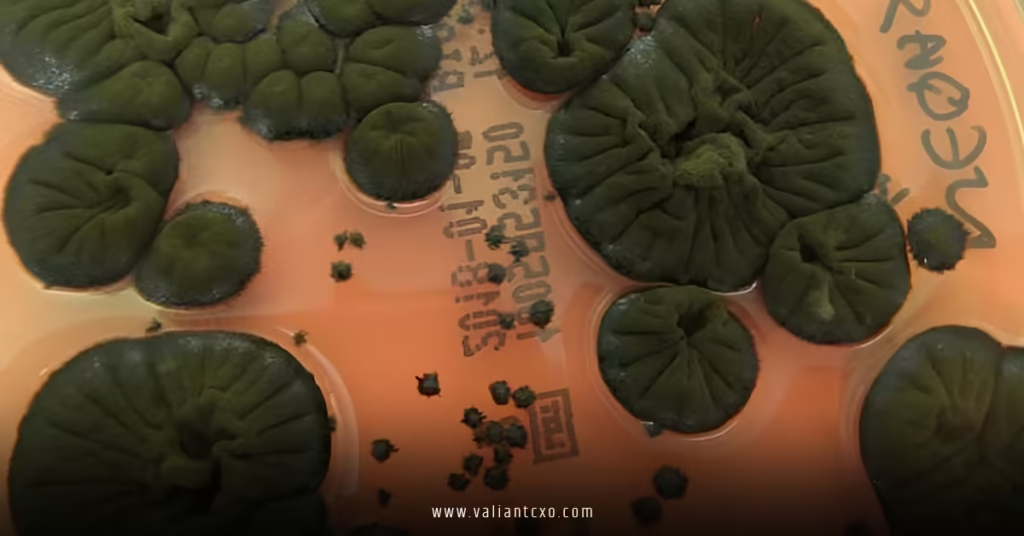
Science doesn’t take claims lightly, so let’s talk proof. Back in 2007, Ekaterina Dadachova’s team at Albert Einstein College irradiated melanin-rich fungi. Result? Faster growth, more acetate slurped up. Cladosporium sphaerospermum led the pack, its Chernobyl pedigree shining.
Fast-forward to 2018: NASA sends it to the International Space Station. In orbit, facing cosmic rays, the fungus shielded sensors—2.42% less radiation after 30 days, five times better than controls. A 1.7mm layer blocked like armor. Growth? 1.21 times faster than Earth twins. Coincidence? Nah. It’s how Cladosporium sphaerospermum from Chernobyl uses melanin to convert radiation into energy, validated in zero-G.
Even recent 2025 tweaks in bioreactors show promise: under simulated Chernobyl doses, biomass doubles. These aren’t cherry-picked; they’re peer-reviewed gems from PMC and Nature.
Space Station Showdown: Beating Cosmic Rays
That ISS run? Epic. Samples matured, then deflected rays in a 180-degree arc. No magic—just melanin magic. Implications? Mars habitats lined with fungal shields. Astronauts munching less fuel, thanks to bio-batteries.
Real-World Ripples: Cleaning Up and Dreaming Big
Now, why care beyond cool factor? How Cladosporium sphaerospermum from Chernobyl uses melanin to convert radiation into energy isn’t just trivia—it’s a toolkit. Bioremediation: deploy fungi to “eat” waste at Fukushima or Hanford. They bind radionuclides, convert harm to harmless growth.
Cancer tech? Melanin mimics could shield healthy cells during radiotherapy. Space? We’ve covered it—radiation-proof suits or habitats. Even energy: fungal biofuels from rad-waste? Wild, but whispers in labs.
Challenges? Scaling up. Fungi are slow; ethics in release matter. But the potential? It’s like finding oil in the desert—game-changing.
Bioremediation Blueprints: Fungi as Nuclear Janitors
Picture robot arms spraying spore slurries on spills. They colonize, convert, compost. Pilot tests in Ukraine show 20% rad-drop in soils. Not total fix, but a start. And it’s green—literally, if you crossbreed.
Ethical Edges and Future Frontiers
With great power… you know. Releasing engineered strains? Risky. But regulated, it’s hope. As we eye climate fixes, this teaches resilience. Nature’s not fragile; it’s fierce.
What if we bio-hack melanin for phones? Radiation to charge? Dreamy, but rooted in fact.
Conclusion
Wrapping this up, we’ve journeyed from Chernobyl’s ashes to orbital labs, uncovering how Cladosporium sphaerospermum from Chernobyl uses melanin to convert radiation into energy—a tale of defiance and ingenuity. This black mold doesn’t just endure; it innovates, turning poison to power via radiosynthesis, shielding, and growth hacks. It’s a reminder: life’s full of surprises, even in hellscapes. Dive deeper yourself—experiment, read, wonder. Who knows? Your next big idea might sprout from a spore. Nature’s got the blueprint; we’re just catching up.
Frequently Asked Questions (FAQs)
1. What exactly is Cladosporium sphaerospermum, and why is the Chernobyl strain special?
Cladosporium sphaerospermum is a common mold, but the Chernobyl version thrives on radiation. It’s special because it demonstrates how Cladosporium sphaerospermum from Chernobyl uses melanin to convert radiation into energy, growing faster in hot zones than anywhere else.
2. How does melanin in this fungus differ from the melanin in human skin?
Human melanin blocks UV for protection; in the fungus, it’s an energy converter. This ties directly into how Cladosporium sphaerospermum from Chernobyl uses melanin to convert radiation into energy, acting like a biological solar panel for gamma rays.
3. Can we use this fungus to clean up nuclear sites today?
Absolutely promising! Early tests show it binds and breaks down waste. Understanding how Cladosporium sphaerospermum from Chernobyl uses melanin to convert radiation into energy could scale this for sites like Fukushima, turning cleanup into a bio-boost.
4. Is radiosynthesis real, or just hype?
It’s real, backed by lab data. Radiosynthesis is how Cladosporium sphaerospermum from Chernobyl uses melanin to convert radiation into energy, proven in growth assays and space experiments—no hype, just hard science.
5. What are the space applications for this discovery?
NASA’s eyeing it for Mars shields. By leveraging how Cladosporium sphaerospermum from Chernobyl uses melanin to convert radiation into energy, thin fungal layers could protect crews from cosmic rays, making deep space viable.
For More Updates !! : valiantcxo.com