
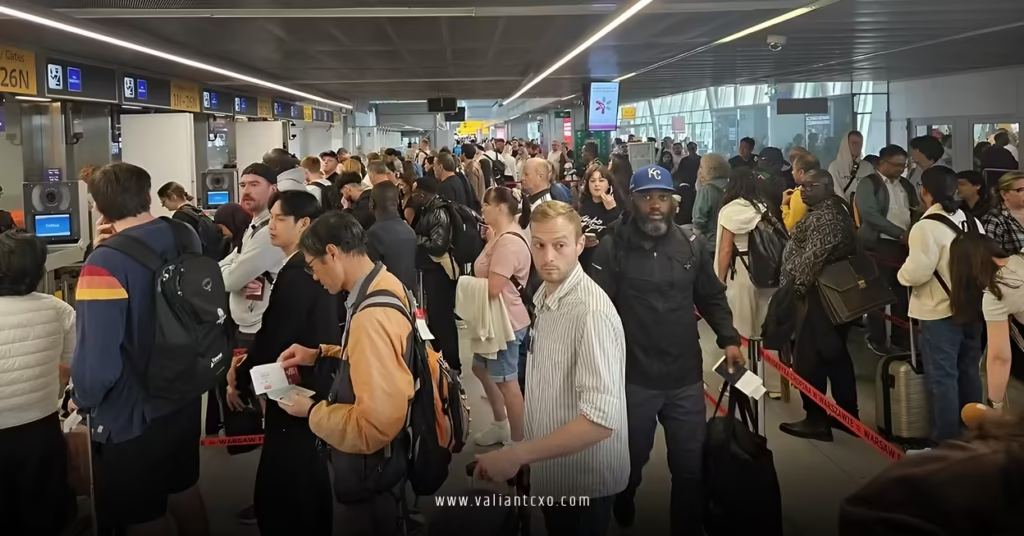
EU EES airport border delays summer 2026 are the real-world risk behind Europe’s new Entry/Exit System rollout: longer passport checks, slower queues at some airports, and more friction for non-EU travelers entering the Schengen area.
- EES is the EU’s automated system for recording short-stay entries and exits for many non-EU visitors.
- Summer 2026 is the danger zone because travel volumes spike while airports and border systems are still settling in.
- Delays will not hit every airport equally. Big hubs, tight connections, and peak weekend arrivals are the pressure points.
- U.S. travelers should expect a different border experience than in past years.
- The fix is simple: build buffer time, know your first-entry airport, and assume manual checks can still happen.
Here’s the thing: if you’re flying to Europe in summer 2026, the issue is not “Will EES exist?” It’s “How messy will the first few busy months feel at my airport?” That’s the question that matters.
EU EES airport border delays summer 2026: the short version
EES, or the Entry/Exit System, is the EU’s new border control platform for recording when eligible non-EU travelers enter and leave the Schengen area. For U.S. travelers, that means passport scans, biometric checks in many cases, and a more formalized entry process than the old stamp-and-go routine.
Why the delay concern? Because first-time enrollment can take longer, especially when airports are crowded, machines are new, and passengers are unfamiliar with the process. If you’re landing in Europe during peak summer traffic, that extra minute at the booth becomes everyone else’s delay too.
What EES actually changes at the airport
Think of EES like replacing a sticky note system with a digital ledger. Cleaner on paper. Slower at the counter at first.
Instead of a basic passport stamp, border officers or automated kiosks may need to:
- Scan your travel document
- Capture facial data and, in many cases, fingerprints
- Record your entry and exit electronically
- Check whether you are still within the permitted short-stay window
For official background on how the system works, the European Commission’s EES overview is the cleanest starting point.
Why summer 2026 is the pressure test
Summer is always rough at European airports. Add a new border-control system and you’ve got a classic bottleneck.
The biggest reasons for EU EES airport border delays summer 2026 are straightforward:
- Peak passenger volume: airports are already stretched in summer
- First-use friction: travelers and staff are still learning the flow
- Mixed processing lanes: some passengers will use kiosks, others won’t
- Manual fallback: if a kiosk fails or a traveler needs extra screening, the line slows
- Connection pressure: one delayed arrival can cascade into missed onward flights
Will every airport be a disaster? No. But the worst delays usually show up where volume is heavy and the rollout is uneven.
EU EES airport border delays summer 2026: which travelers feel it most
Not everyone will feel the pain equally.
EU EES airport border delays summer 2026 for U.S. travelers
If you’re a U.S. passport holder entering Schengen for a short stay, you’re exactly the kind of traveler likely to pass through EES checks. On your first entry after the system is active at that border point, the process can take longer than before because your biometric and document data may need to be captured.
EU EES airport border delays summer 2026 for families
Families tend to move slower at border control. More passports. More questions. More hands full with bags and kids. If one child needs assistance or a document issue pops up, the whole line backs up.
EU EES airport border delays summer 2026 for transit flyers
This is where people get caught. If you arrive on one flight and connect to another within Europe, a delay at first entry can eat into a tight connection fast. That’s especially risky at large hubs where passport control sits between you and the next gate.
What to expect at the booth or kiosk
Some travelers imagine EES as a fully automated, zero-human experience. Not quite.
In practice, you may encounter:
- A kiosk or automated gate
- A passport scan
- Facial capture
- Fingerprint collection
- A border officer review if something doesn’t match
The process can be quick when everything goes smoothly. It can also stall instantly if the passport chip is unreadable, the biometric capture fails, or the traveler is using a document type that needs manual review.
For travel-planning context, the U.S. State Department travel guidance for Europe is useful for general entry expectations and traveler preparedness.
Answer-ready table: what changes, what slows down, what to do
| Border Situation | What EES Changes | Delay Risk | What to Do |
|---|---|---|---|
| First arrival into Schengen | Biometric and passport data may be captured | Medium to high | Arrive early, don’t book a tight onward connection |
| Busy summer hub airport | More passengers funnel through the same checkpoints | High | Build extra transfer time and expect line variation |
| Returning visitor with prior EES record | Repeat processing may be faster | Low to medium | Still plan for queues; repeat does not mean instant |
| Family or group arrival | Each traveler may need individual processing | High | Keep documents ready for every person |
| Flight connection through Europe | Border control can interrupt connection timing | High | Choose longer layovers, especially at first-entry airports |
Step-by-step action plan for beginners
If this is your first Europe trip under EES, keep it simple.
Step 1: Identify your first Schengen airport
This matters more than most people realize. Your first airport of entry is where the border-control friction usually hits hardest. If that airport is a major hub in July or August, expect lines.
Step 2: Build a bigger connection window
Don’t play the “we can make it” game with a 45-minute Europe connection. That’s a gamble even without border delays. With EES in the mix, it’s a headache waiting to happen.
Step 3: Keep every travel document easy to reach
Passport. Return ticket if needed. Proof of accommodation if requested. Any visa or residence document if relevant. If you have to dig through three bags while a line forms behind you, you’re already behind.
Step 4: Expect first-time processing to take longer
If you’re entering after the system is active at that airport, assume the line moves slower than old-school stamp processing. That’s normal. Not ideal. But normal.
Step 5: Do not treat your arrival time as border-cleared time
Landing at 2:00 p.m. does not mean you’re in the arrivals hall at 2:10. In summer, that assumption gets people burned.
Step 6: Check airport-specific guidance before departure
Airport operations can differ a lot. Some airports will be smoother. Some will be clunky. A quick check before you leave can save you from a messy arrival.
Common mistakes and how to fix them
Assuming all European airports will work the same
Bad assumption. One airport may have decent flow and another may choke. The fix: check your exact arrival airport, not just the country.
Booking tight connections
This is the classic self-inflicted wound. The fix: give yourself breathing room, especially on first entry into Schengen.
Forgetting that families move slower
One person can zip through faster than five. The fix: travel with documents organized for every traveler, including kids.
Thinking EES means “no delay because it’s digital”
Digital does not equal instant. Systems still fail, queues still form, and humans still intervene. The fix: plan for the airport you actually get, not the idealized version.
Ignoring peak travel season
Summer is not the time to gamble on a marginal itinerary. The fix: choose flights with buffer, not bravado.
What airports and airlines are likely to do
Airports and airlines are not blind to this. They know passenger flow will be a pressure point. Expect more signage, more staff direction, and probably more reminders to arrive early.
Still, there’s a limit to how much process tuning can offset a surge of passengers plus a new border regime. If your plan depends on a perfectly smooth, fully matured rollout, you’re betting on the best-case version of summer 2026.
That’s not how airport operations usually work.
The practical travel mindset that wins
In my experience, the travelers who handle changes like EES best are the ones who stop assuming the system owes them speed. They plan for friction. They build slack into the itinerary. They treat the border like a checkpoint, not a formality.
That mindset saves money, stress, and missed connections.
If you’re wondering whether this is overcautious, ask yourself a blunt question: do you want to spend your first hour in Europe standing in a line you could have avoided by booking one smarter connection?
Key Takeaways
- EU EES airport border delays summer 2026 are most likely at busy first-entry airports.
- U.S. travelers entering Schengen may face longer checks during initial EES processing.
- Families and transit passengers are more exposed to delays than solo travelers.
- Tight connections are the biggest avoidable mistake.
- Digital border systems still create lines when volume spikes.
- First-time entry under EES can take longer than travelers expect.
- Buffer time matters more than optimism.
- Airport-specific planning beats generic “Europe travel” advice every time.
Final thoughts
EU EES airport border delays summer 2026 are not a reason to cancel a Europe trip. They are a reason to travel smarter. If you build in extra time, avoid tight connections, and know exactly where your first border checkpoint is, you cut most of the risk out of the equation.
The main win here is simple: less chaos, fewer missed flights, and a calmer start to your trip.
FAQs
How bad will EU EES airport border delays summer 2026 be for U.S. travelers?
They’ll vary by airport, but the biggest pain point is likely to be first-time entry processing during peak summer arrivals. Busy hubs and tight connection windows are where delays are most likely to show up.
Will EU EES airport border delays summer 2026 affect every flight into Europe?
No. Delays should be uneven. Some airports and time slots will run relatively smoothly, while others may slow down hard during peak periods.
What is the best way to avoid EU EES airport border delays summer 2026?
Book longer layovers, avoid rushed first-entry connections, and keep your passport and travel documents ready. If your itinerary depends on a 30- to 60-minute transfer, it is too tight.