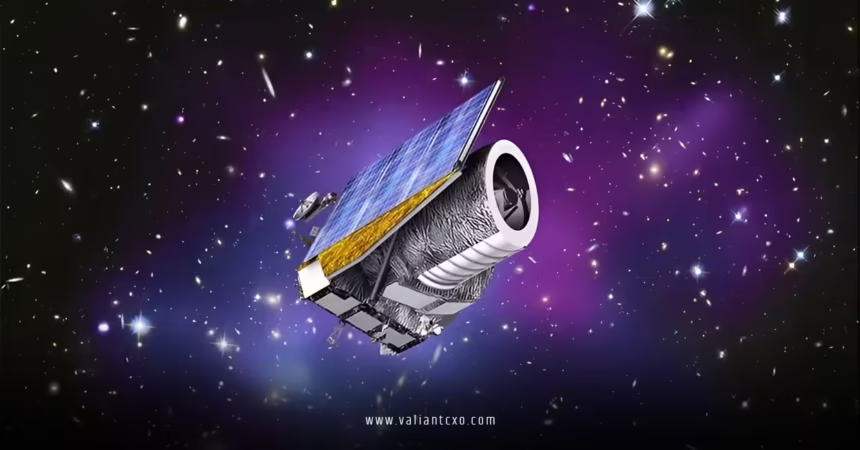
The Euclid Space Telescope Dark Energy Mission represents one of the most ambitious efforts in modern cosmology. Launched by the European Space Agency (ESA) in July 2023, Euclid is designed to map the large-scale structure of the universe with unprecedented precision, probing the enigmatic forces of dark energy and dark matter that dominate our cosmos.
By observing billions of galaxies across more than a third of the sky, this mission aims to create the most detailed 3D map of the universe ever made, revealing how dark energy drives the accelerated expansion of the cosmos.
What Is the Euclid Space Telescope Dark Energy Mission?
Named after the ancient Greek mathematician Euclid, the telescope operates from a halo orbit around the Sun-Earth Lagrange point L2, approximately 1.5 million kilometers from Earth. Equipped with a 600-megapixel visible-light camera and near-infrared spectrometer/photometer, Euclid measures galaxy shapes (weak gravitational lensing) and redshifts to reconstruct cosmic history over the past 10 billion years.
Key objectives of the Euclid Dark Energy Mission include:
- Measuring the accelerating expansion of the universe to percent-level accuracy.
- Constraining the nature of dark energy (often parameterized by the equation-of-state w).
- Mapping dark matter distribution through gravitational effects.
- Testing whether general relativity holds on cosmic scales or if modifications are needed.
Dark energy accounts for about 70% of the universe’s energy density, yet its fundamental nature remains unknown. Euclid’s data will help determine if it’s a cosmological constant or something more dynamic.
How Euclid Studies Dark Energy and Dark Matter
Euclid employs two primary techniques:
- Weak Gravitational Lensing: Tiny distortions in galaxy shapes caused by intervening dark matter reveal its distribution and evolution.
- Galaxy Clustering and Baryon Acoustic Oscillations: By mapping galaxy positions and redshifts, scientists trace the cosmic web and measure expansion history.
As of mid-2026, Euclid has surveyed thousands of square degrees and released early data showcasing millions of galaxies. The first major cosmology results are expected in late 2026.
Breakthrough: Euclid Telescope Largest High-Resolution Image Milky Way Galactic Bulge 60 Million Stars 2026
While primarily focused on the distant universe, Euclid demonstrated its extraordinary capabilities closer to home. In March 2025, the telescope captured the Euclid telescope largest high-resolution image Milky Way galactic bulge 60 million stars 2026 — the most detailed visible-light view ever taken of our galaxy’s crowded central region.
This massive mosaic, assembled from multiple pointings over about 26 hours, resolves over 60 million stars in the galactic bulge. It not only highlights Euclid’s wide-field precision but also opens new avenues for studying microlensing events to detect exoplanets and hidden stellar populations.
This stunning image underscores the telescope’s versatility: even when “turned around” from its deep-space survey, it delivers groundbreaking science that complements its core dark energy mission.
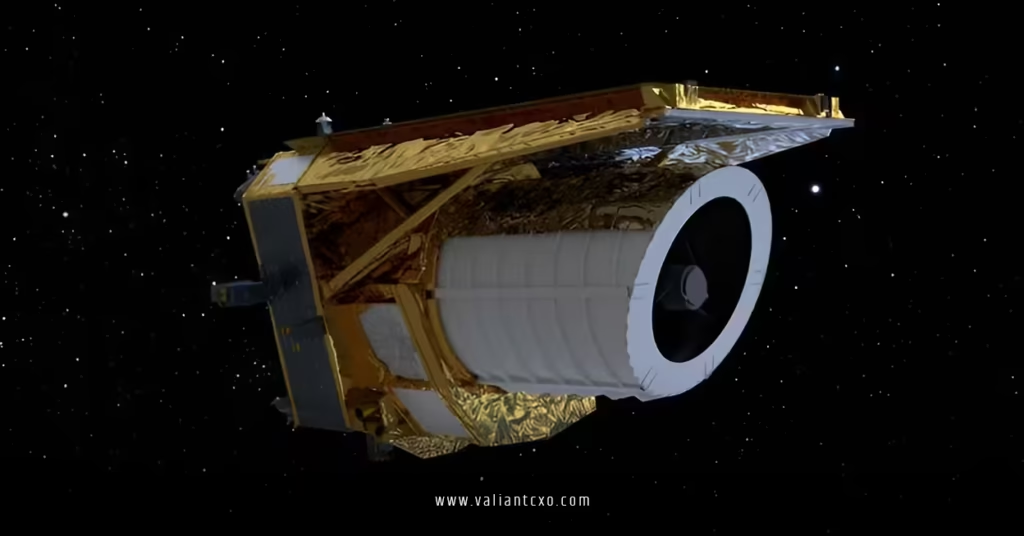
Mission Progress and Latest Updates (2026)
- Euclid has observed significant portions of its planned ~15,000 square degree survey area.
- Quick Data Releases (Q1, Q2) have provided glimpses of deep fields with millions of galaxies.
- Upcoming full Data Release 1 (expected November 2026) will fuel major scientific papers.
The mission’s six-year nominal lifetime positions it to deliver transformative insights into why the universe is expanding faster over time.
Why the Euclid Dark Energy Mission Matters
Understanding dark energy is crucial for cosmology. It influences the ultimate fate of the universe — whether it expands forever, recollapses, or follows another path. Euclid’s data will refine models of cosmic evolution and potentially reveal new physics beyond the Standard Model.
Its observations also benefit broader astronomy, from star formation in our Milky Way to distant galaxy clusters.
Conclusion: The Future of Cosmic Exploration
The Euclid Space Telescope Dark Energy Mission stands at the forefront of efforts to decode 95% of the universe that remains “dark.” With its recent galactic achievements — including the record-breaking Milky Way bulge image — and upcoming cosmology results, Euclid continues to push the boundaries of what we know about our place in the cosmos.
Stay tuned for more revelations as data releases roll out through 2026 and beyond. For space enthusiasts and researchers alike, this mission offers a window into the fundamental forces shaping reality.
FAQs
Q1: What is the main goal of the Euclid Space Telescope Dark Energy Mission?
The Euclid Space Telescope Dark Energy Mission aims to map billions of galaxies to understand dark energy and dark matter, which make up ~95% of the universe. By measuring cosmic expansion and gravitational lensing, it will reveal why the universe is accelerating and test fundamental physics.
Q2: What is the Euclid telescope largest high-resolution image Milky Way galactic bulge 60 million stars 2026?
In March 2025 (released June 2026), Euclid captured the largest and most detailed visible-light image ever of the Milky Way’s galactic bulge, resolving over 60 million stars. This mosaic, taken in ~26 hours, demonstrates the telescope’s power and aids exoplanet searches via microlensing.
Q3: When will Euclid release its first major dark energy results?
The first major cosmology data release from the Euclid Dark Energy Mission is expected in October/November 2026. Early quick releases have already shared millions of galaxies, with the full Data Release 1 set to deliver transformative insights into dark energy