
Hey, have you ever wondered why those stunning underwater photos of colorful coral reefs seem rarer these days? It’s largely because of global coral bleaching events—massive, widespread die-offs triggered by overheated oceans. These aren’t random blips; they’re getting bigger, more frequent, and more devastating with each passing year. And right now, in early 2026, we’re still reeling from the fallout of the most intense one on record, which has many experts warning that coral reefs collapse 2026 could become a harsh reality for countless reefs worldwide if heat stress doesn’t ease soon.
Let’s break this down in a way that makes sense. Coral bleaching happens when corals get stressed—usually from prolonged high water temperatures—and expel the tiny algae (zooxanthellae) living in their tissues. Those algae provide food through photosynthesis and give corals their vibrant colors. Without them, corals turn ghostly white and start starving. If the heat lingers, death follows. When this hits reefs across multiple ocean basins simultaneously, we call it a global coral bleaching event.
These events have ramped up dramatically since the late 20th century, tied directly to human-driven climate change warming our oceans.
The History of Global Coral Bleaching Events: A Timeline of Escalation
The first global coral bleaching event hit in 1998, during a super-strong El Niño. It affected about 21% of the world’s reefs with bleaching-level heat stress. Reefs in places like the Indian Ocean and Caribbean suffered badly, with widespread mortality.
Then came 2010—the second event—with around 37% of reefs hit. It was serious, but still not the monster we see now.
The third global coral bleaching event (2014–2017) changed everything. It lasted years, hammered reefs during both El Niño and neutral conditions, and impacted roughly 68% of global reef areas. Australia’s Great Barrier Reef lost about a third of its corals in back-to-back years (2016–2017). Scientists called it unprecedented at the time.
Fast-forward to today: the fourth global coral bleaching event kicked off in early 2023 and has been raging ever since. NOAA and the International Coral Reef Initiative (ICRI) confirmed it in April 2024. By late 2025, bleaching-level heat stress had struck about 84% of the world’s coral reefs—far surpassing the previous record. Mass bleaching has been documented in at least 83 countries and territories, spanning the Atlantic, Pacific, and Indian Oceans.
This ongoing crisis has forced NOAA’s Coral Reef Watch to add new, extreme levels (3–5) to their Bleaching Alert Scale because heat stress is pushing risks of massive mortality higher than ever before.
Imagine your body running a fever that won’t break for months—that’s what corals are enduring on a planetary scale.
What Causes These Global Coral Bleaching Events?
The main driver? Rising ocean temperatures from greenhouse gas emissions. Oceans absorb over 90% of excess heat trapped by climate change, leading to more frequent and intense marine heatwaves.
El Niño events supercharge this by suppressing cooling upwelling and shifting warm water around. The 2023–2025 period saw record ocean heat, amplified by a strong El Niño in 2023–2024.
Local factors pile on: pollution, overfishing (removing algae-grazing fish), and coastal development weaken corals’ resilience, making them bleach faster and recover slower.
The result? Bleaching events now happen even outside classic El Niño years—like the 2022 Great Barrier Reef event during La Niña.
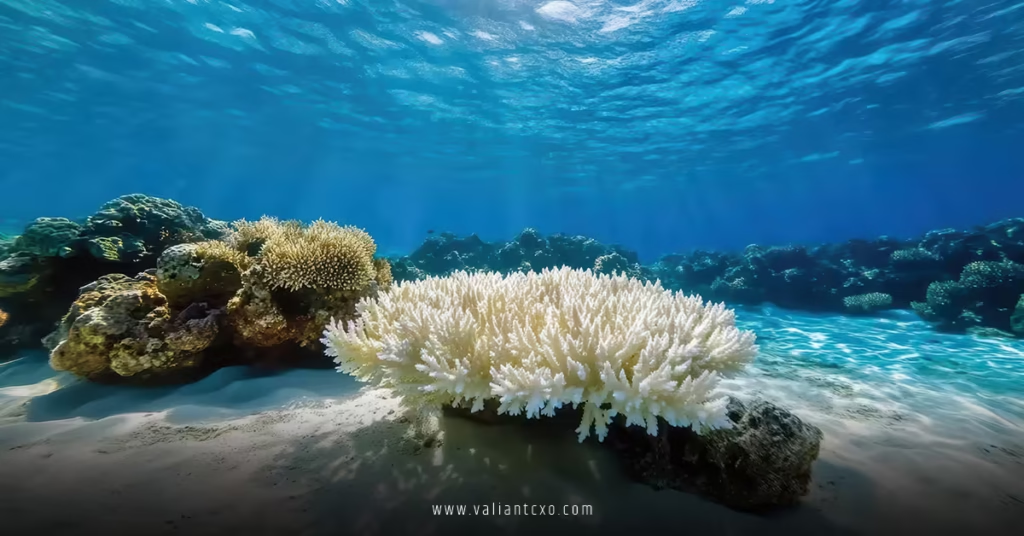
Major Impacts of Recent Global Coral Bleaching Events
The current fourth event has been brutal. From 2023 through 2025, heat stress covered record areas, with some reefs seeing over 80% mortality risk in prolonged alerts.
On the Great Barrier Reef—our planet’s largest reef system—2024 brought the fifth mass bleaching since 2016, with the largest spatial footprint ever recorded. Then 2025 delivered the sixth, marking consecutive years (2024–2025) of bleaching for only the second time. Coral cover plunged dramatically: northern regions dropped 25%, southern by 30%, with some reefs losing up to 70% of hard corals. Fast-growing Acropora species, key to recovery, got hammered hardest.
Elsewhere: Florida’s reefs faced unprecedented heat in 2023, Caribbean areas shifted toward algae dominance, Pacific islands like Fiji and French Polynesia saw widespread damage, and even resistant spots like parts of the Red Sea struggled.
These events crash biodiversity—25% of marine species depend on reefs. Fisheries suffer (billions rely on reef fish for food), tourism takes hits, and natural storm barriers erode, increasing coastal flooding risks.
Economically, reefs generate trillions in value annually through fishing, tourism, and protection. Losing them ripples through communities and global food security.
How Global Coral Bleaching Events Connect to Coral Reefs Collapse 2026
Here’s the scary link: repeated global coral bleaching events leave no recovery time. Corals need 10–15 years or more to regrow after major die-offs, but intervals are shrinking to 1–5 years.
The fourth event’s scale—84% affected, ongoing into 2026—has scientists worried about tipping points. If another strong heat spike hits in 2026 (possibly with El Niño patterns), many shallow tropical reefs could flip permanently to algae-covered rubble. That’s the coral reefs collapse 2026 scenario experts fear: not total global extinction, but irreversible loss of most warm-water reefs as we know them.
Some hope exists—deeper “mesophotic” reefs or resilient pockets (like parts of the Gulf of Aqaba) might serve as refuges. But without slashing emissions fast, the trajectory looks grim.
For real-time tracking, check out NOAA Coral Reef Watch—they provide satellite data on heat stress worldwide.
Also see the Great Barrier Reef Foundation for updates on Australia’s frontline, and the International Coral Reef Initiative (ICRI) for global coordination efforts.
What Can We Do About Global Coral Bleaching Events?
The big fix starts with climate action: cut emissions aggressively to limit warming. Every fraction of a degree counts—staying under 1.5°C could save more reefs.
Locally, protect reefs through marine reserves, reduce pollution, control invasive species like crown-of-thorns starfish, and support restoration. Scientists are growing heat-tolerant corals in nurseries, experimenting with shading or probiotics, and relocating resilient strains.
Individuals matter too—lower your carbon footprint, choose sustainable seafood, support reef-friendly policies, and spread awareness.
It’s not hopeless, but the window narrows with each global coral bleaching event.
Wrapping Up: The Urgent Reality of Global Coral Bleaching Events
We’ve walked through the timeline—from 1998’s first wake-up call to the current fourth global coral bleaching event battering 84% of reefs. We’ve seen causes rooted in climate change, devastating impacts on biodiversity and economies, and the direct tie to fears of coral reefs collapse 2026 if trends continue unchecked.
These aren’t distant problems—they affect food, jobs, coastlines, and the wonder of our oceans. But we still have tools: science-backed restoration, protected areas, and urgent emissions cuts. The reefs that survive could seed recovery—if we give them a fighting chance. Let’s act like the future of these underwater wonders depends on it—because it does.
FAQs About Global Coral Bleaching Events
What are the four global coral bleaching events so far?
The first was in 1998 (21% of reefs affected), the second in 2010 (37%), the third from 2014–2017 (68%), and the ongoing fourth starting in 2023, which has impacted ~84% of reefs as of late 2025.
How do global coral bleaching events lead to coral reefs collapse 2026?
Frequent, intense bleaching leaves no recovery time, pushing reefs toward permanent shifts to algae-dominated states. The current event’s scale, plus potential 2026 heat, could tip many reefs into irreversible collapse.
Which reefs have been hit hardest by recent global coral bleaching events?
The Great Barrier Reef suffered consecutive events in 2024–2025 with major coral losses. Florida, the Caribbean, Pacific islands, and parts of the Indian Ocean also faced severe bleaching and mortality.
Can reefs recover from global coral bleaching events?
Yes, if heat stress ends quickly and stressors like pollution are low. Some corals regain algae and recover, but repeated events reduce resilience, making full recovery harder.
What role does climate change play in global coral bleaching events?
It’s the primary driver—warmer oceans trigger heat stress. Events now occur more often, even without strong El Niño, due to accumulated ocean heat from greenhouse gases.