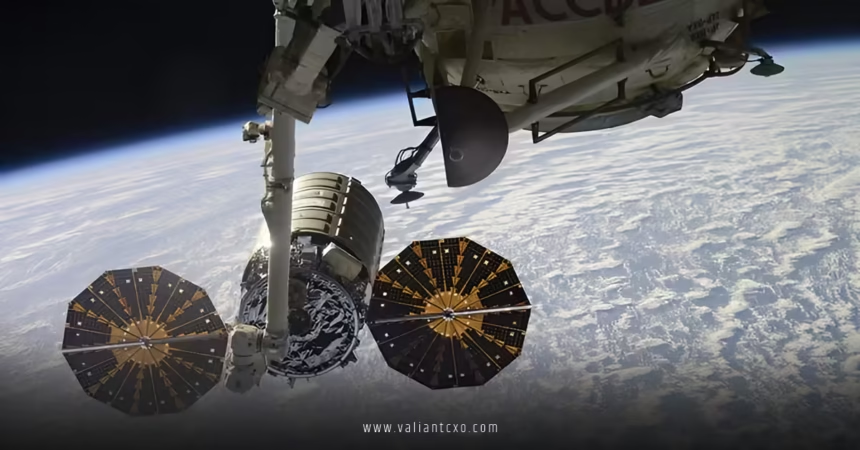
Imagine a 57-foot robotic arm floating in the vacuum of space, reaching out to snag a massive cargo ship hurtling toward the International Space Station at thousands of miles per hour. Sounds like sci-fi? It’s routine engineering now.
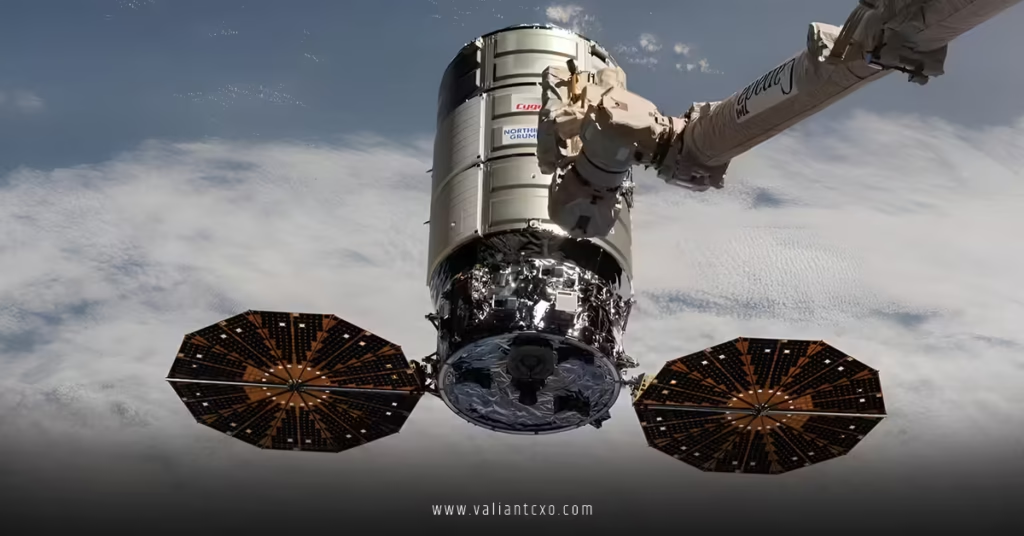
How Canadarm2 captures cargo spacecraft is one of the most precise ballet moves in orbital logistics. Astronauts use this Canadian-built robotic arm to grapple uncrewed visitors like Northrop Grumman’s Cygnus or older Japanese HTVs, then carefully berth them to a docking port. In the recent Northrop Grumman CRS-24 Cygnus cargo arrival at ISS April 2026, NASA astronauts Chris Williams and Jack Hathaway executed a flawless capture of the Cygnus XL at 1:20 p.m. EDT on April 13, just two days after its Falcon 9 launch.
This process keeps the ISS stocked with food, experiments, and spare parts without relying solely on automated docking. Here’s everything you need to know—broken down simply for beginners and intermediate space fans.
What Is Canadarm2?
Canadarm2 is the big sibling of the original Shuttle Canadarm. Launched in 2001 aboard STS-100, it’s a 17-meter (57-foot) robotic manipulator system with seven joints for incredible flexibility. It can move payloads, support spacewalks, and yes—catch incoming cargo ships.
The arm mounts on the Mobile Base System, letting it “walk” across the station by grappling powered fixtures. At its tip sits the Latching End Effector (LEE)—basically a smart robotic hand.
Think of it as a giant, zero-gravity crane with surgical precision. One wrong twitch and you risk damaging a multi-ton spacecraft or the station itself. That’s why the process demands tight coordination between crew, ground teams, and onboard sensors.
Why Capture Instead of Docking?
Not every cargo vehicle docks autonomously. SpaceX Dragon (newer versions) often docks directly, but vehicles like Cygnus and the old HTV use a “berthing” approach. The spacecraft flies to a hold point nearby. Then Canadarm2 reaches out, grabs it, and gently installs it onto a port.
This method gives humans full control during the final, most delicate phase. It also allows the arm to handle heavier or bulkier loads that might challenge pure automation.
In practice, it’s proven rock-solid. Canadarm2 has performed dozens of these “cosmic catches” since its first with Japan’s HTV-1 in 2009.
Step-by-Step: How Canadarm2 Captures Cargo Spacecraft
Here’s the real sequence. Short, tense, and choreographed to the millimeter.
- Approach Phase
The cargo ship (like Cygnus XL) uses GPS, star trackers, and laser systems to close in. It stops at a safe distance—often about 1 km below or behind the station. Crew monitors everything from the Cupola, the station’s panoramic window. - Alignment and Rendezvous
The visiting vehicle fires thrusters in small bursts to match the station’s orbit and orientation. Guidance systems sync their movements. Relative speed drops to near zero. - Hold at Capture Point
The spacecraft parks roughly 10–12 meters away. For the Northrop Grumman CRS-24 Cygnus cargo arrival at ISS April 2026, it stabilized at this distance before the arm moved in. - Grapple with the Latching End Effector
Astronauts in the Cupola take manual control using two hand controllers:
- Translational Hand Controller (left hand) — moves the arm up/down, left/right, in/out.
- Rotational Hand Controller (right hand) — handles roll, pitch, yaw. Cameras and sensors help line up the LEE with the spacecraft’s grapple fixture—a sturdy pin with a base plate on the cargo vehicle.
- The Snare and Latch
Once aligned, the astronaut triggers the LEE. Internal snares close around the grapple pin like a lasso. Then motors pull the fixture inward, creating a rigid, secure connection. No banging—just smooth mechanical mating. - Berthing
Ground controllers or crew use Canadarm2 to maneuver the captured spacecraft to the target port (often Unity module’s Earth-facing port). Bolts secure it. Hatches open later for unloading.
The whole capture can happen in minutes once the arm starts moving. But the prep takes hours of monitoring.
Quick Comparison: Capture vs. Automated Docking
| Aspect | Canadarm2 Capture (Cygnus/HTV) | Automated Docking (Dragon) |
|---|---|---|
| Final Control | Astronaut + ground team | Onboard systems |
| Distance at Hold | ~10-12 meters | Direct approach to port |
| Risk Mitigation | Human override at every step | Redundant sensors and abort modes |
| Typical Use | Bulk cargo, heavier loads | Crewed-capable or return cargo |
| Speed of Final Step | Precise, slower for safety | Faster but highly automated |
This table shows why both methods coexist—they complement each other perfectly.
The Tech Inside the “Hand”
The Latching End Effector is genius. It features:
- Three snare wires that tighten around the grapple pin.
- A carriage that retracts to pull everything tight.
- Sensors and cameras for alignment.
- Redundant motors and latches for fail-safes.
Astronauts train extensively in simulators on the ground and even practice dry runs on station before real arrivals. One session involves flying the arm to imaginary grapple points while handling lag and microgravity quirks.
Real-World Example: Northrop Grumman CRS-24 Cygnus Capture
During the April 2026 mission, Cygnus XL launched April 11 carrying over 11,000 pounds of supplies and science gear, including quantum research hardware and stem cell production tools. Two days later, it arrived at the capture point.
NASA astronaut Chris Williams, with Jack Hathaway assisting, operated Canadarm2 from the Cupola. At 1:20 p.m. EDT, the arm reached out, grappled the spacecraft cleanly, and later berthed it to Unity’s Earth-facing port.
No drama. Just textbook execution that kept the station’s science running without missing a beat. You can relive similar moments on NASA live streams—they’re oddly hypnotic.
Common Mistakes Beginners Make (and How to Avoid Them)
- Thinking it’s fully autonomous — Nope. Humans stay in the loop for capture. Fix: Remember, the arm needs skilled operators watching every joint.
- Underestimating relative motion — Even at “zero” speed, orbital dynamics are tricky. Fix: Teams use multiple hold points and laser ranging for precision.
- Ignoring training — Capturing isn’t joystick gaming. Fix: Astronauts log hours in simulators replicating the exact Cupola view and hand controllers.
- Forgetting berthing follows capture — Grabbing is only step one. Fix: Ground teams handle the install while crew focuses on systems checks.
Rule of thumb from watching these ops: Patience beats speed. A safe capture today prevents headaches tomorrow.
Why This Matters for the ISS Program
Canadarm2 turned the station into a true logistics hub. It handles cargo that would otherwise need riskier methods. It also frees crew time for science instead of constant manual docking.
As commercial resupply matures, this robotic catch remains a reliable backup and primary method for certain vehicles. Future stations or lunar gateways may borrow the same tech.
Learn the official details straight from the source: Canadarm2 cosmic catches at the Canadian Space Agency.
Read NASA’s account of recent operations: NASA Space Station Blog on Canadarm2 captures.
Explore the full Mobile Servicing System: NASA Mobile Servicing System overview.
Key Takeaways
- How Canadarm2 captures cargo spacecraft relies on precise astronaut control of the Latching End Effector to snare a grapple fixture.
- The process includes approach, alignment, grapple, and berthing—taking precision over brute force.
- In the Northrop Grumman CRS-24 Cygnus cargo arrival at ISS April 2026, it delivered a flawless cosmic catch in under 50 hours from launch.
- Training, sensors, and redundant systems keep risks low.
- Capture enables safe handling of vehicles that don’t dock autonomously.
- Canadarm2 has performed dozens of these maneuvers successfully since 2009.
- The Cupola offers astronauts an incredible front-row seat to the action.
Conclusion
How Canadarm2 captures cargo spacecraft showcases human ingenuity meeting extreme engineering. It’s not flashy rockets—it’s steady hands guiding a giant arm through the silent void to keep the ISS alive and productive.
Next time you watch a live stream of a Cygnus or similar arrival, pay attention to that moment the arm reaches out. That quiet click of the snare? It’s the sound of orbital supply chains working flawlessly.
Want to go deeper? Check the next cargo mission schedule and try spotting the station overhead. The view from Earth never gets old.
External Links
- Canadian Space Agency – Canadarm2’s cosmic catches
Anchor text suggestion: how Canadarm2 performs cosmic catches
(Excellent step-by-step from the agency that built the arm.) - NASA Space Station Blog – Canadarm2 Captures Cygnus XL
Anchor text suggestion: NASA’s official account of the CRS-24 capture
(Direct mission coverage from April 2026.) - NASA Mobile Servicing System overview
Anchor text suggestion: full details on Canadarm2 and the Mobile Servicing System
(Authoritative technical background.)
Frequently Asked Questions
1. How long does it take for Canadarm2 to capture a cargo spacecraft like Cygnus?
The actual grapple with Canadarm2 usually takes just a few minutes once the spacecraft reaches the capture point about 10–12 meters away. However, the full process—from the cargo ship’s final approach to secure berthing—spans several hours of careful monitoring. In the Northrop Grumman CRS-24 Cygnus cargo arrival at ISS April 2026, astronauts completed the capture at 1:20 p.m. EDT on April 13, roughly 48 hours after the April 11 launch.
2. Who operates Canadarm2 during a cargo capture?
NASA astronauts inside the station’s Cupola module control Canadarm2 using two hand controllers. For the Northrop Grumman CRS-24 Cygnus cargo arrival at ISS April 2026, NASA astronaut Chris Williams served as the prime operator with Jack Hathaway assisting. Ground teams at NASA’s Johnson Space Center provide real-time support and later handle the berthing to the Unity module.
3. What is the difference between Canadarm2 capture and automated docking?
Capture involves astronauts using the robotic arm to physically grab and berth the spacecraft, giving human oversight during the final close approach. Automated docking lets the vehicle (like newer Dragon spacecraft) connect directly using onboard sensors. Cygnus relies on the Canadarm2 method because it allows safe handling of its larger XL variant with over 11,000 pounds of cargo.
4. Has Canadarm2 ever failed to capture a cargo spacecraft?
Canadarm2 has an excellent track record with dozens of successful “cosmic catches” since 2009. Missions include multiple Cygnus and HTV vehicles. The system includes redundant snares, sensors, and abort options. No major failures have occurred during capture operations, thanks to extensive astronaut training and layered safety checks.
5. Can I watch Canadarm2 capture a cargo spacecraft live?
Yes—NASA streams most rendezvous and capture events live on NASA+, YouTube, and their website. The Northrop Grumman CRS-24 Cygnus cargo arrival at ISS April 2026 was broadcast in full, showing the tense moments as the arm reached out to grapple the spacecraft. Search for upcoming missions on NASA’s live schedule to catch the next one.