How to implement zero-knowledge proofs for privacy in enterprise blockchain 2026 is no longer a futuristic dream—it’s a practical necessity for businesses handling sensitive data on distributed ledgers. Imagine you’re running a supply chain network where competitors share tracking info but can’t peek at each other’s pricing strategies, or a financial consortium verifying creditworthiness without exposing full customer histories. That’s the magic of zero-knowledge proofs (ZKPs): proving something is true without spilling the beans. In 2026, with stricter regulations like GDPR updates and rising cyber threats, enterprises are turning to ZKPs to balance transparency with confidentiality on blockchain platforms.
Why does this matter now? Public blockchains expose everything by design, which clashes with enterprise needs for privacy. But ZKPs flip the script, letting you verify transactions or computations while keeping details hidden. Think of it like showing your ID age proof at a bar without handing over your full birth certificate. As blockchain adoption surges in sectors like finance, healthcare, and logistics, mastering how to implement zero-knowledge proofs for privacy in enterprise blockchain 2026 gives your organization a real edge.
Understanding Zero-Knowledge Proofs: The Basics You Need in 2026
Let’s break it down simply. A zero-knowledge proof lets one party (the prover) convince another (the verifier) that a statement is true without revealing any extra information. The three core properties? Completeness (honest provers succeed), soundness (cheaters can’t fool verifiers), and zero-knowledge (verifiers learn nothing beyond the statement’s truth).
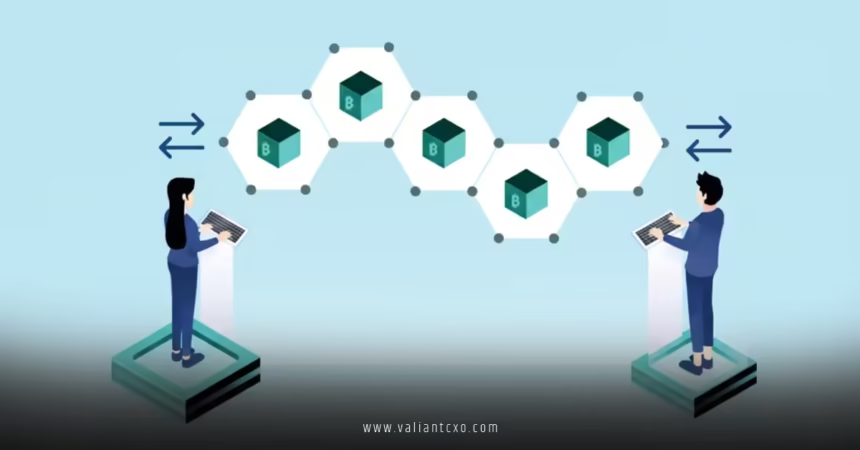
In blockchain, this shines for privacy. Traditional ledgers are like glass houses—everyone sees everything. ZKPs add curtains: the network confirms validity, but sensitive data stays private.
The main types you’ll encounter in 2026:
- zk-SNARKs (Zero-Knowledge Succinct Non-Interactive Arguments of Knowledge): Super compact proofs, fast verification. Great for enterprise where on-chain costs matter. Downside? Often need a trusted setup.
- zk-STARKs (Zero-Knowledge Scalable Transparent Arguments of Knowledge): No trusted setup, quantum-resistant, scalable for big computations. Proofs are larger, but perfect for high-volume enterprise apps.
Hybrid approaches are gaining traction too, blending the best of both for enterprise reliability.
Why Enterprises Need Zero-Knowledge Proofs for Privacy in 2026
Enterprises aren’t playing around with crypto hobbies—they need compliance, data protection, and scalability. Regulations demand privacy (think HIPAA for health data or financial secrecy laws), but blockchains demand auditability.
ZKPs solve this paradox. They enable:
- Private transactions on public or permissioned chains.
- Verifiable computations without exposing IP.
- Compliance proofs (e.g., “this meets KYC rules”) without revealing user data.
In 2026, trends show enterprises piloting ZK for supply chain confidentiality, confidential DeFi for institutions, and secure identity verification. Tools like zk-rollups boost scalability while preserving privacy, making enterprise blockchain viable at scale.
Hesitant? Consider the risks of not adopting: data breaches from over-transparent ledgers or regulatory fines from non-compliance. How to implement zero-knowledge proofs for privacy in enterprise blockchain 2026 isn’t optional—it’s strategic.
Key Use Cases: How Zero-Knowledge Proofs Transform Enterprise Blockchain
Picture these real-world scenarios:
- Financial Services: Banks verify solvency or transaction validity without exposing client details. Projects like those from Deutsche Bank explore ZK for private on-chain finance.
- Supply Chain Management: Partners prove product authenticity or ethical sourcing without revealing suppliers’ identities or costs.
- Healthcare: Share patient data proofs (e.g., vaccination status) without breaching privacy.
- Identity Management: Zero-knowledge credentials let users prove attributes (age, citizenship) selectively.
- Regulatory Compliance: Prove adherence to rules like anti-money laundering without full disclosure.
These aren’t hypotheticals—2026 sees live deployments in central bank pilots and enterprise consortia.
Step-by-Step Guide: How to Implement Zero-Knowledge Proofs for Privacy in Enterprise Blockchain 2026
Ready to roll up your sleeves? Here’s a practical roadmap.
Step 1: Assess Your Needs and Choose the Right ZKP Type
Start with your use case. Need fast, cheap verification? Go zk-SNARKs. Prioritize transparency and future-proofing? zk-STARKs win. For enterprise, hybrid or zk-rollup solutions often fit best.
Evaluate platforms: zkSync, Starknet, Polygon zkEVM for Ethereum compatibility; Hyperledger Besu or Corda with ZK extensions for permissioned setups.
Step 2: Select Tools and Frameworks
In 2026, developer-friendly libraries lower the barrier:
- Circom: Popular DSL for zk-SNARK circuits. Easy for custom privacy logic.
- Halo2: Flexible, from Zcash, great for custom proofs without trusted setups.
- Noir or gnark: Higher-level abstractions for complex enterprise logic.
For integration, zkSync or Starknet provide ready ecosystems.
Step 3: Design Your Circuit
Write the logic proving your statement. For privacy in transactions:
- Define public inputs (e.g., transaction hash).
- Private inputs (e.g., amounts, sender details).
- Constraints ensure validity without leaks.
Use analogies: Your circuit is a locked box. Inputs go in, proof comes out saying “it’s correct” without opening the box.
Test rigorously—under-constrained circuits lead to exploits.
Step 4: Generate and Verify Proofs
- Prover generates proof off-chain (computationally heavy).
- Verifier checks on-chain (fast, cheap).
Integrate with smart contracts: Deploy verifier contracts on your blockchain.
For enterprise, use zk-rollups to batch proofs, slashing costs.
Step 5: Integrate into Your Blockchain Architecture
- Permissioned chains: Add ZK modules to Hyperledger Fabric or Quorum.
- Hybrid: Use zk-rollups on Ethereum for public verifiability with private execution.
- Test on devnets, audit circuits (critical for security).
Monitor performance: Proof generation times have dropped dramatically by 2026.
Step 6: Deploy, Monitor, and Optimize
Launch pilots, gather feedback. Scale with hardware acceleration (GPUs for proving). Stay updated—2026 brings zkVMs for easier Rust-based proofs.
Common pitfalls? Overlooking trusted setups or ignoring quantum threats. Mitigate with zk-STARKs where possible.

Challenges and Best Practices When Implementing ZKP in Enterprise Settings
It’s not all smooth. Proof generation can be resource-intensive, though 2026 optimizations help. Integration requires crypto expertise—partner with specialists.
Best practices:
- Start small: Pilot one use case.
- Audit everything: Circuits especially.
- Ensure compliance: ZKPs aid GDPR by minimizing data exposure.
- Train teams: Build internal know-how.
The Future Outlook for Zero-Knowledge Proofs in Enterprise Blockchain
By late 2026 and beyond, expect zkVMs making ZK as easy as writing regular code. Quantum resistance becomes standard, and ZKPs embed in core protocols.
Enterprises ignoring this risk falling behind. Those mastering it? They’ll lead in trustless, private collaboration.
In wrapping up, how to implement zero-knowledge proofs for privacy in enterprise blockchain 2026 boils down to understanding the tech, choosing fitting tools, and methodically integrating it. You’ve got the privacy without losing verifiability—game-changing for business. Don’t wait; start experimenting today. Your competitors might already be proving things without revealing a thing.
For more on blockchain privacy tech, check these high-authority resources:
- Ethereum Foundation on Zero-Knowledge
- Zcash Official Documentation
- Chainlink Education Hub on ZK Projects
FAQs
What are the main benefits of learning how to implement zero-knowledge proofs for privacy in enterprise blockchain 2026?
The key perks include enhanced data protection, regulatory compliance, reduced breach risks, and scalable private transactions—all while maintaining blockchain’s trust features.
Which ZKP type is best for beginners starting how to implement zero-knowledge proofs for privacy in enterprise blockchain 2026?
zk-SNARKs via Circom offer a gentle entry due to succinct proofs and strong community support, though zk-STARKs shine for long-term security.
How long does it typically take to prototype how to implement zero-knowledge proofs for privacy in enterprise blockchain 2026?
A basic proof-of-concept can take 4-12 weeks with experienced devs, depending on complexity and chosen framework.
Do I need advanced math skills for how to implement zero-knowledge proofs for privacy in enterprise blockchain 2026?
Not necessarily—high-level libraries abstract much of the crypto. Understanding basics helps, but tools like Noir make it accessible.
What common mistakes should I avoid when figuring out how to implement zero-knowledge proofs for privacy in enterprise blockchain 2026?
Skipping audits, using outdated setups, ignoring performance costs, and under-constraining circuits top the list—always prioritize security reviews.