Interstellar objects like Oumuamua and Borisov have captured our imagination in ways few celestial discoveries can. Picture this: chunks of rock or ice, ejected from far-off planetary systems, wandering the vast emptiness between stars for millions—or even billions—of years, only to stumble into our solar neighborhood. These aren’t your garden-variety asteroids or comets bound to our Sun; they’re true outsiders, hyperbolic travelers on one-way tickets through the galaxy. Since 2017, we’ve confirmed just a handful, starting with the enigmatic 1I/’Oumuamua, followed by the more comet-like 2I/Borisov, and most recently 3I/ATLAS in 2025. What makes interstellar objects like Oumuamua and Borisov so fascinating? They offer a rare peek into alien worlds without leaving home.
Think of them as interstellar postcards—remnants from other star systems that tell stories of planet formation elsewhere. Ever wondered if exoplanets build their worlds differently? These visitors might hold the clues. Let’s explore their discoveries, quirks, and why they’re rewriting astronomy textbooks.
The Discovery of Interstellar Objects Like Oumuamua and Borisov
The history of spotting interstellar objects like Oumuamua and Borisov feels like a cosmic thriller unfolding in real time. For decades, astronomers theorized these rogue bodies existed, flung out by gravitational slingshots from young star systems. But proof? That eluded us until modern surveys sharpened their gaze.
It all kicked off in October 2017 when the Pan-STARRS1 telescope in Hawaii caught something odd: a fast-moving point of light zipping past on a wildly open orbit. Calculations screamed “interstellar!” Dubbed 1I/’Oumuamua (Hawaiian for “scout from afar”), it was our first confirmed visitor. No coma, no tail—just a tumbling, elongated rock defying expectations.
Fast-forward to August 2019: Amateur astronomer Gennady Borisov, peering through his backyard telescope in Crimea, spotted another hyperbolic intruder. This one behaved like a classic comet, sprouting a fuzzy coma and tail. Named 2I/Borisov, it solidified that interstellar objects come in varieties.
By 2025, the ATLAS survey in Chile nabbed the third: 3I/ATLAS (also C/2025 N1), an active comet with water vapor outgassing. Today, on this very date—December 19, 2025—3I/ATLAS is making its closest Earth approach. Curious about catching a glimpse? Check our detailed guide on how to view interstellar comet 3I/ATLAS closest approach to Earth December 2025.
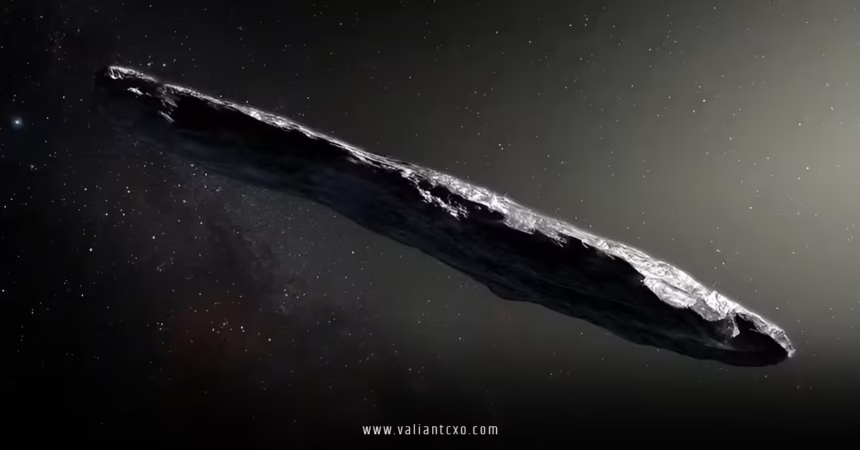
These artist’s impressions capture the cigar-shaped mystery of ‘Oumuamua, highlighting its unusual form compared to anything in our solar system.
What Makes Interstellar Objects Like Oumuamua and Borisov Unique?
Interstellar objects like Oumuamua and Borisov aren’t just rare; they’re weird in ways that challenge what we know about solar system leftovers. All share hyperbolic orbits—eccentricity greater than 1—meaning they’re not bound to our Sun. They’re speeding through at 20-60 km/s extra velocity, courtesy of galactic wanderings.
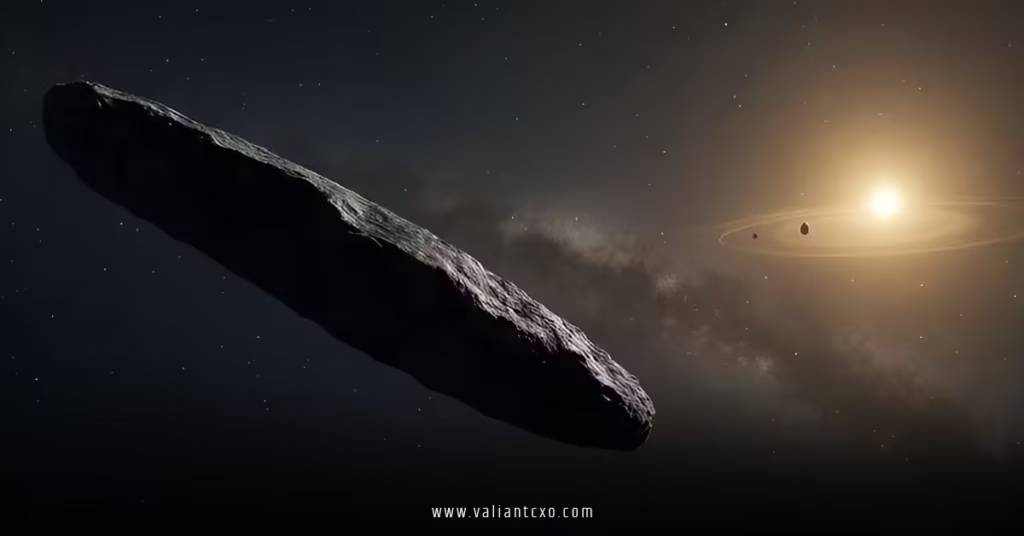
But similarities end there. ‘Oumuamua was asteroid-like: no detectable outgassing, yet it accelerated non-gravitationally (perhaps hidden hydrogen ice?). Elongated like a pancake or cigar (up to 10:1 ratio), reddish hue—nothing like our Kuiper Belt rocks.
Borisov? Total opposite. A proper comet with cyanide gas, dust tail, and coma, mirroring long-period comets here but enriched in carbon monoxide, hinting at formation in a colder outer disk.
3I/ATLAS blends traits: cometary activity (water vapor, reddish dust), massive nucleus (up to 20 km?), and extreme speed. Ages vary too—’Oumuamua young (~1 billion years), Borisov middle-aged, ATLAS ancient (~10 billion).
Rhetorical question: Why such diversity? It screams planetary systems vary wildly across the galaxy.
Hubble’s sharp views of Borisov reveal its classic cometary glow, a stark contrast to ‘Oumuamua’s bare-rock vibe.
Key Differences Between Oumuamua and Borisov
Diving deeper into interstellar objects like Oumuamua and Borisov reveals striking contrasts:
- Shape and Activity: ‘Oumuamua—tumbling, elongated, inactive. Borisov—spherical nucleus, active with tail.
- Composition: ‘Oumuamua possibly nitrogen ice (exo-Pluto fragment?). Borisov rich in CO, typical yet alien.
- Origin Clues: Trajectories trace back to different galactic regions; ‘Oumuamua from young thin disk, Borisov older.
These differences highlight how interstellar objects like Oumuamua and Borisov sample diverse exoplanetary environments.
This comparison animation shows the paths of interstellar objects like Oumuamua and Borisov through our system—note the varying trajectories.
Why Interstellar Objects Like Oumuamua and Borisov Matter to Science
Interstellar objects like Oumuamua and Borisov aren’t mere curiosities; they’re scientific goldmines. They deliver pristine material from other stars—untouched by our Sun’s influence—revealing exoplanet formation chemistry.
‘Oumuamua sparked debates on natural vs. artificial origins (lightsail theories, anyone?). Borisov confirmed comets elsewhere resemble ours, yet with twists like high CO suggesting colder births.
Future detections? Vera C. Rubin Observatory could spot dozens yearly. Missions like ESA’s Comet Interceptor await flyby chances.
Analogy: Like finding bottles washed ashore from distant oceans, each tells a unique tale of faraway shores.
For real-time excitement, don’t miss today’s Earth flyby of 3I/ATLAS—learn how to view interstellar comet 3I/ATLAS closest approach to Earth December 2025 with telescopes or apps.
The Future of Studying Interstellar Objects Like Oumuamua and Borisov
With better tech, interstellar objects like Oumuamua and Borisov won’t stay rare. LSST surveys promise floods of discoveries, enabling statistics on sizes, compositions, and origins.
Probes? Concepts for interceptors could rendezvous, sampling directly. Imagine sniffing alien ice!
These visitors remind us: The galaxy teems with ejected worlds. We’re just starting to listen.
Conclusion
Interstellar objects like Oumuamua and Borisov have transformed astronomy from speculation to reality, proving our solar system gets regular cosmic drop-ins from afar. From ‘Oumuamua’s puzzling silence to Borisov’s familiar fizz and ATLAS’s timely arrival today, they’ve shown diversity in extrasolar building blocks. As we spot more, expect revelations about planet formation galaxy-wide. Keep looking up—the next messenger could rewrite everything we think we know. And right now, on December 19, 2025, seize the moment: Grab that telescope and hunt for 3I/ATLAS. Guides like how to view interstellar comet 3I/ATLAS closest approach to Earth December 2025 make it accessible. Clear skies!
FAQs
1. What are the main differences between interstellar objects like Oumuamua and Borisov?
‘Oumuamua was inactive and elongated, like a rock, while Borisov was a classic active comet with a tail and coma.
2. How many confirmed interstellar objects like Oumuamua and Borisov are there as of December 2025?
Three: 1I/’Oumuamua (2017), 2I/Borisov (2019), and 3I/ATLAS (2025), with the latter closest to Earth today.
3. Can I see interstellar objects like Oumuamua and Borisov with a backyard telescope?
‘Oumuamua and Borisov required professional scopes, but current ones like 3I/ATLAS might be visible—see tips on [how to view interstellar comet 3I/ATLAS closest approach to Earth December 2025].
4. Why do interstellar objects like Oumuamua and Borisov have hyperbolic orbits?
They’re unbound to our Sun, entering and exiting on open paths after eons in interstellar space.
5. Will we discover more interstellar objects like Oumuamua and Borisov soon?
Yes! New observatories could find dozens annually, building on these pioneers.