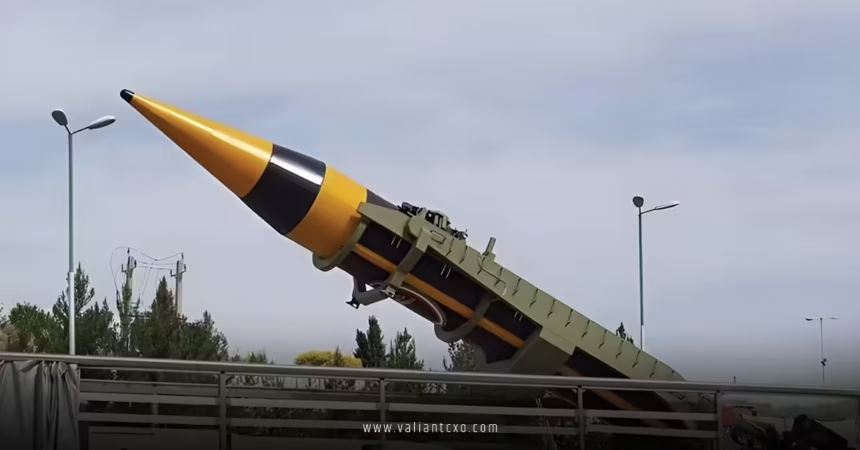
Iran ballistic missile capabilities and how they’ve become such a hot topic in global security chats? In early 2026, with tensions boiling over in the Middle East, Iran’s missile program is making headlines again—think massive barrages aimed at Israel and US bases. But let’s cut through the noise: Iran’s got the biggest ballistic missile stockpile in the region, packed with tech that’s evolved from short-range rockets to hypersonic beasts. Stick with me as we unpack this, from the nuts and bolts to why it matters right now.
The Evolution of Iran Ballistic Missile Capabilities: From Humble Beginnings to Regional Dominance
Imagine starting with basic artillery rockets and turning them into a force that can strike thousands of kilometers away—that’s the story of Iran ballistic missile capabilities. Back in the 1980s, during the Iran-Iraq War, Tehran got its hands on Soviet Scud missiles and reverse-engineered them. Fast forward to today, and Iran’s Islamic Revolutionary Guard Corps (IRGC) oversees a program that’s all about self-reliance. They’ve dodged sanctions by building everything in-house, from solid-fuel engines to guidance systems.
What makes this arsenal tick? It’s diverse, for one. Short-range stuff like the Shahab-1 hits up to 300 km—perfect for nearby threats. Then you’ve got medium-range monsters like the Shahab-3, stretching 800-1,300 km. But the real game-changers are the longer ones: Sejil zips along at over 17,000 km/h with a 2,500 km range, while the Emad and Ghadr both push 2,000 km. Don’t forget the Kheibar and Haj Qasem, adding precision to the mix. Analysts from think tanks like the Arms Control Association peg Iran’s total at around 2,500 missiles in 2026, down from pre-2025 levels due to Israeli strikes but rebounding fast.
Why the focus on ballistics? Unlike a fancy air force, missiles are cheap, mobile, and hard to spot. Iran hides them in underground bunkers, popping them out for surprise launches. It’s like a game of whack-a-mole for anyone trying to take them down.
Key Missiles in Iran’s Arsenal: Breaking Down the Tech Behind Iran Ballistic Missile Capabilities
Let’s get specific—because Iran ballistic missile capabilities aren’t just about numbers; it’s the tech that packs the punch. Take the Sejil: solid-fuel powered, it launches quick without the hassle of liquid propellants. That means less warning time for defenses. Ranges? Up to 2,500 km, enough to hit Israel or US bases in the Gulf from deep inside Iran.
Then there’s the Emad, an upgraded Shahab-3 with better accuracy—think hitting within 500 meters of a target. The Ghadr series adds maneuverability, dodging interceptors mid-flight. Newer entries like the Khorramshahr (2,000 km) and Hoveyzeh (1,350 km) incorporate hypersonic elements, flying at Mach 5+ speeds. Hypersonic? That’s like a bullet train in the sky, changing direction to evade radar.
Iran’s also dabbling in cruise missiles like the Hoveyzeh, which hug the terrain to stay under the radar. And don’t overlook their anti-ship variants—remember the claims around the [USS Abraham Lincoln struck by ballistic missiles]? Iran boasted of using advanced ballistics there, though US officials called it a miss. That incident underscores how Iran ballistic missile capabilities aim to challenge naval giants.
Production-wise, Iran’s churning out dozens monthly, per Israeli intel. They’ve rebuilt after 2025’s “12-Day War,” where Israel wiped out 40% of their stock. Underground factories and foreign smuggling networks keep the flow going, despite US sanctions.
Recent Developments: How 2026 Escalations Highlight Iran Ballistic Missile Capabilities
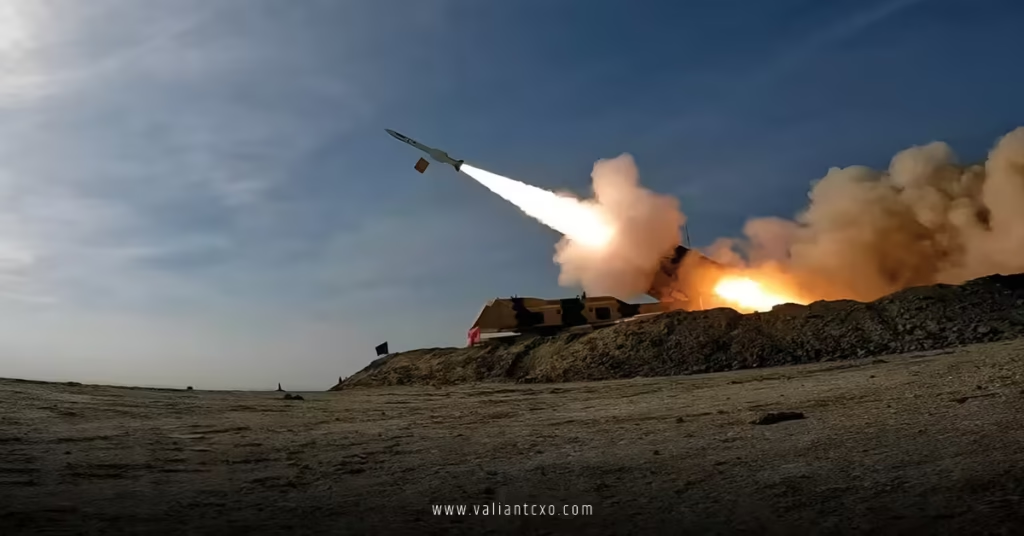
Fasten your seatbelts—2026 has been wild for Iran ballistic missile capabilities. In February, amid US-Israeli strikes on Iranian sites, Tehran unleashed barrages: over 170 missiles at Israel in one go, per reports from Critical Threats. Many got intercepted by systems like Iron Dome, but some hit, causing damage and casualties.
Why now? Retaliation. After US bombs hit missile launchers and bases, Iran fired back at US facilities in Qatar, UAE, and beyond. Sources like Al Jazeera note Iran’s longest missiles reach 2,500 km—covering Europe edges but not the US homeland yet. President Trump warned they could “soon” hit America, but experts from the Defense Intelligence Agency say that’s years off, maybe 2035 with space tech help.
Iran’s strategy? Overwhelm defenses with sheer volume. In the 12-Day War, they launched 500+ missiles; now, rebuilt stockpiles let them sustain fire. They’ve targeted civilian spots too, shaking Gulf stability, as TIME reported. It’s not just power—it’s messaging: “Don’t mess with us.”
Challenges and Defenses: Can Anyone Counter Iran Ballistic Missile Capabilities?
Here’s a rhetorical question: If Iran ballistic missile capabilities are so advanced, why don’t they always hit? Defenses play a huge role. Israel’s Iron Dome, US Patriot systems, and Aegis on ships swat many down. In recent clashes, only a fraction impacted, per Axios and Fox News.
But Iran’s evolving: Hypersonics like the Fattah glide at speeds that outpace interceptors. Analogies help—think of it as a fastball versus a curveball; the latter’s harder to catch. Mobility adds stealth—truck-mounted launchers move fast, hidden in mountains.
Sanctions bite too. Treasury’s targeting shadow fleets and procurement networks, as in February 2026 actions against IRGC suppliers in Turkey and UAE. Yet, Iran persists, possibly with North Korean or Russian tech swaps.
For the US and allies, it’s about layered defense: satellites spot launches, fighters scramble, and ground systems engage. But saturation attacks—hundreds at once—could overwhelm, as seen in simulations.
Global Implications: Why Iran Ballistic Missile Capabilities Matter Beyond the Middle East
Zoom out: Iran ballistic missile capabilities aren’t just regional—they’re global chess pieces. With ranges hitting Europe, they deter NATO moves. Proliferation worries too—Iran shares tech with Houthis, Hezbollah, even Venezuela rumors.
Economically? Oil routes in the Strait of Hormuz are vulnerable; a missile strike could spike prices worldwide. Politically, it fuels arms races—Saudi Arabia, UAE ramp up their own programs.
And nukes? US intel sees missiles as potential nuke carriers, though Iran denies weapons intent. If paired, it’s game-changing. But for now, conventional warheads dominate, packing explosives or clusters.
In 2026’s chaos, these capabilities force diplomacy rethink. Talks? Tough with ongoing strikes. Deterrence? US shows force, but Iran’s resilience shines.
Future Trajectory: Where Are Iran Ballistic Missile Capabilities Headed?
Peering ahead, Iran ballistic missile capabilities show no slowdown. They’re eyeing longer ranges via space launches—Zuljanah rocket tests hint at ICBM foundations. By 2035, per DIA, they might reach the US, but hurdles like re-entry tech loom.
Investments in precision, hypersonics, and swarms suggest a focus on quality over quantity. Underground “missile cities” enhance survivability. Alliances with Russia (space help) and China (components) accelerate this.
But risks abound: Escalations could draw in superpowers. If strikes degrade production again, Iran might pivot to asymmetric tactics like drones.
Conclusion
Wrapping up, Iran ballistic missile capabilities stand as a testament to Tehran’s ingenuity amid isolation—boasting thousands of missiles with ranges up to 2,500 km, hypersonic speeds, and rapid production. From recent barrages in 2026 to rebuilds post-2025 war, they’ve proven resilient, challenging US and Israeli dominance while signaling strength. Yet, defenses and sanctions curb their edge. As tensions simmer, understanding this arsenal isn’t just academic—it’s key to navigating a volatile world. What do you think: diplomacy or deterrence? Dive deeper, stay informed, and let’s hope cooler heads prevail.
FAQs
What are the main types of missiles in Iran ballistic missile capabilities?
Iran’s arsenal includes short-range like Shahab-1 (300 km), medium-range Shahab-3 (1,300 km), and longer ones like Sejil (2,500 km) and Emad (2,000 km), focusing on mobility and precision.
How have recent events affected Iran ballistic missile capabilities?
In 2026, US-Israeli strikes destroyed launchers, but Iran rebuilt, launching over 170 missiles at Israel in retaliation, showcasing their ongoing production of dozens monthly.
Can Iran ballistic missile capabilities reach the United States?
Not yet—current max is 2,500 km. Experts predict ICBM potential by 2035 using space tech, but it’s years away despite claims.
Why are hypersonics important in Iran ballistic missile capabilities?
Hypersonics like Fattah travel at Mach 5+, evading defenses with speed and maneuvers, making them harder to intercept than traditional ballistics.
How do sanctions impact Iran ballistic missile capabilities?
US Treasury targets procurement networks, disrupting supplies, but Iran uses domestic production and allies to sustain growth.