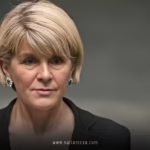
Julie Bishop ANU resignation May 2026 sent shockwaves through Australian higher education circles this week. The former foreign minister stepped down as chancellor of the Australian National University effective immediately, citing untenable interference from the university regulator.
- What happened: Bishop tendered her resignation on May 7-8, 2026, seven months ahead of her December term end.
- Why it matters: ANU has faced months of turmoil—bullying claims, staff cuts, leadership exits, and governance questions. Her exit marks a turning point for one of Australia’s top universities.
- Immediate fallout: Pro-chancellor Dr. Larry Marshall steps in temporarily while the next chancellor gets picked with heavy regulator oversight.
- Broader impact: Raises fresh questions about university autonomy, political appointments in academia, and fixing toxic cultures fast.
- For US readers: Think of it as a high-profile board chair walking away from an Ivy League equivalent amid Senate scrutiny and public backlash.
This isn’t just another resignation. It’s the climax of a very public leadership meltdown at a flagship research institution.
Background: How Julie Bishop Landed at ANU
Julie Bishop, a seasoned Liberal politician and former Deputy Leader, took the chancellor role in 2020. Her initial three-year term got extended to run until December 2026. Chancellors at ANU serve as ceremonial and strategic figureheads, chairing the university council and representing the institution publicly.
She brought star power—international diplomacy experience, networks, and a reputation for toughness. Early on, it looked like a smart hire for an institution navigating post-pandemic challenges and funding pressures.
Here’s the thing: Political heavyweights often land these gigs. They open doors. But when internal storms hit, that outsider status can become a lightning rod.
What Triggered the Julie Bishop ANU Resignation May 2026
Pressure had built for months. Key flashpoints included:
- Abrupt departure of Vice-Chancellor Genevieve Bell in 2025 amid restructuring, job losses, and course cut proposals.
- Allegations of bullying and a toxic workplace that reached Senate inquiries.
- Staff and student calls for accountability.
- Concerns over Freedom of Information compliance and council decision-making.
The Tertiary Education Quality and Standards Agency (TEQSA) stepped in unusually hard, stripping the council of its usual role in picking the next chancellor. Bishop called the regulatory moves “unprecedented and coordinated interference.” She decided she couldn’t keep steering the ship effectively.
The kicker is this didn’t come out of nowhere. Bishop had dug in earlier, denying allegations and vowing to see things through. Something shifted in early May 2026 that made continuation impossible.
Timeline of the ANU Leadership Crisis
| Date/Period | Event | Impact |
|---|---|---|
| 2020 | Bishop appointed Chancellor | Fresh leadership signal |
| 2023 | Term extended to Dec 2026 | Stability assumed |
| Sep 2025 | VC Genevieve Bell resigns | Major leadership vacuum |
| Late 2025–Early 2026 | Bullying claims, Senate scrutiny, staff unrest | Public trust erodes |
| Early 2026 | TEQSA intervenes on appointments | Governance overhaul |
| May 8, 2026 | Julie Bishop ANU resignation | Immediate change at top |
This table cuts through the noise. Crises like this rarely explode overnight—they simmer until one more event tips the scale.

Why the Resignation Matters for Universities Worldwide
Leadership transitions at places like ANU ripple far beyond Canberra. For American readers watching Australian higher ed (or dealing with similar issues at home), this case highlights risks when political figures enter academic governance. It also spotlights regulator power versus institutional independence.
In my experience covering these shifts, what usually happens is a short-term hit to reputation followed by a scramble for “cultural reset” messaging. Donors watch closely. Top talent gets nervous. Prospective students Google the drama.
Rhetorical question: If a chancellor with Bishop’s profile couldn’t navigate the politics, what does that say about the underlying problems?
Lessons for Beginners: Understanding University Governance
New to how universities actually run? Here’s a quick primer on what this saga reveals.
Chancellors aren’t day-to-day CEOs (that’s the vice-chancellor). They chair the governing body, handle big-picture strategy, and lend gravitas. But when scandals erupt, they become the face of accountability.
Step-by-Step Action Plan for Beginners Watching This Story:
- Read primary sources — Check official ANU statements and TEQSA updates rather than hot takes.
- Follow the money and power — Track funding pressures, government oversight, and council composition.
- Look for patterns — Job cuts + bullying claims + leadership exits often signal deeper cultural rot.
- Assess responses — Does the institution own issues or deflect? Bishop’s camp pointed to external interference; critics pointed inward.
- Think long-term — What changes actually stick after the headlines fade? I’d watch the next appointment process closely.
If I were advising a young academic or student navigating similar environments, I’d say document everything, build alliances outside your silo, and never assume titles protect you.
Common Mistakes & How to Fix Them
Universities in crisis often repeat the same errors. Here’s the playbook—and the fixes.
- Mistake 1: Treating symptoms (one resignation) instead of root causes (culture, processes).
Fix: Independent reviews with real teeth, not internal whitewashes. - Mistake 2: Appointing big-name outsiders without cultural fit.
Fix: Prioritize governance experience alongside profile. Balance is everything. - Mistake 3: Poor communication during turmoil.
Fix: Transparent, timely updates. Silence breeds rumors. - Mistake 4: Ignoring staff morale until it boils over.
Fix: Regular pulse checks and genuine listening mechanisms. Not just surveys.
Bishop’s tenure showed how quickly things can spiral when these get ignored. The regulator’s heavy hand suggests the council lost trust on appointments.
What Happens Next at ANU
Dr. Larry Marshall acts as pro-chancellor for now. The next permanent appointment will involve more external oversight—an unusual move that underscores the depth of governance concerns. Expect a focus on restoring stability, repairing staff relations, and rebuilding public confidence.
For those in higher ed leadership (or aspiring to it), watch how ANU handles the search. It could set precedents for other institutions facing similar pressures.
Read more about ANU’s official response on their site for the latest straight from the source. For governance context, the Tertiary Education Quality and Standards Agency explains their role in quality assurance. Background on Bishop’s career appears in depth at Australian Parliament House records.
Key Takeaways
- Julie Bishop ANU resignation May 2026 caps a turbulent period marked by leadership exits and public scrutiny.
- Governance independence took a hit with regulator intervention—future appointments will look different.
- Toxic culture claims and restructuring fallout proved hard to contain.
- Quick action now could turn this into a reset opportunity for ANU.
- Political appointees bring strengths and vulnerabilities in academia.
- Transparency and accountability matter more than star power during crises.
- US observers: Similar dynamics play out on American campuses—watch the parallels.
- Real change requires fixing systems, not just swapping faces.
The dust hasn’t settled yet. But one thing’s clear: ignoring staff and governance warnings carries a steep price.
Next step: If you’re following higher ed leadership stories, bookmark ANU updates for the next few months. The appointment of the new chancellor will reveal whether this resignation becomes a genuine turning point or just another chapter.
FAQs
What exactly caused Julie Bishop ANU resignation May 2026?
Bishop cited regulatory overreach making it impossible for the council to function properly. This came after prolonged turmoil involving bullying allegations, staff departures, and intervention by TEQSA.
Will the Julie Bishop ANU resignation May 2026 lead to major changes?
It opens the door. With external oversight on the next appointment and calls for healing from unions and others, ANU has a chance to address underlying issues—if leadership follows through.
How does this compare to other university leadership crises?
It mirrors cases where high-profile chancellors or presidents face pressure over culture and finances. The regulator’s direct role makes this one stand out.