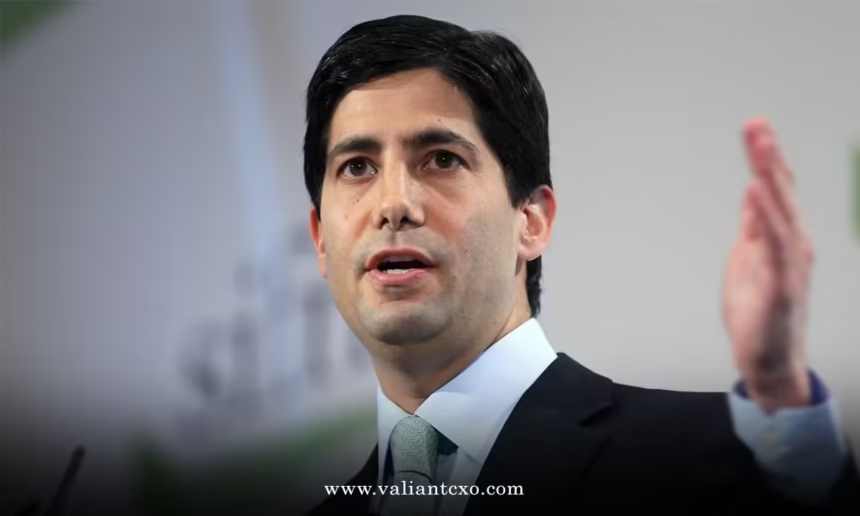
If you’re wondering about Kevin Warsh Federal Reserve background, you’re tapping into one of the most intriguing resumes in modern economic policy. Warsh isn’t just another name in finance—he’s a former Federal Reserve Governor who navigated one of the darkest periods in U.S. economic history, and he’s once again in the spotlight as a top candidate to lead the central bank. With Trump nominates Kevin Warsh Fed chair making headlines, understanding his deep-rooted experience at the Fed is key to grasping why he’s generating so much buzz.
Let’s dive in. Who is this guy, really? And what did he actually do during his time at the world’s most powerful central bank?
Early Life and Education: Building the Foundation
Kevin Maxwell Warsh was born on April 13, 1970, in Albany, New York, growing up in the nearby suburb of Loudonville. Raised in a Jewish family as the youngest of three kids, he credits his upstate New York roots with grounding him in the “real economy”—the kind you feel in everyday communities, not just on trading floors.
Warsh headed west for college, earning his Bachelor of Arts from Stanford University in 1992. He majored in public policy, with a strong focus on economics, statistics, and political science—perfect prep for someone destined to shape monetary policy. Not stopping there, he crossed the country to Harvard Law School, graduating cum laude with a J.D. in 1995. Along the way, he squeezed in coursework at MIT Sloan School of Management and Harvard Business School on market economics and debt capital markets. Talk about a well-rounded toolkit: law, economics, and business savvy all in one.
This blend of legal precision and economic insight would serve him well in the high-stakes world of finance and policy.
Pre-Fed Career: Wall Street to White House
Before stepping into the marble halls of the Federal Reserve, Warsh cut his teeth on Wall Street. From 1995 to 2002, he worked at Morgan Stanley in New York City, climbing to executive director in the Mergers & Acquisitions department. Picture him structuring massive deals, advising on corporate strategy, and getting a front-row seat to how capital markets really work. That insider knowledge of Wall Street proved invaluable later.
In 2002, he jumped to public service, joining the George W. Bush administration as Special Assistant to the President for Economic Policy and Executive Secretary of the White House National Economic Council. Here, he advised on everything from fund flows in capital markets to broader U.S. economic strategy. It was a crash course in how policy gets made at the highest levels—exactly the kind of experience that caught the eye when a Fed spot opened up.
Appointment to the Federal Reserve: Making History at Age 35
In January 2006, President George W. Bush nominated Warsh to the Board of Governors of the Federal Reserve System. He was sworn in on February 24, 2006, becoming the youngest person ever appointed to that role at just 35. Some critics questioned his youth and limited direct monetary policy experience, but then-Fed Chair Ben Bernanke saw something different: sharp political instincts, deep Wall Street connections, and the ability to bridge divides.
Warsh served until March 31, 2011—a tenure that overlapped with one of the most turbulent times in Fed history.
Key Roles and Responsibilities During His Fed Tenure (2006-2011)
As a Governor, Warsh wore multiple hats. He became the Fed’s primary liaison to Wall Street during the 2008 financial crisis, acting as the central bank’s bridge to panicked bankers and executives. Imagine the phone calls: markets freezing, institutions on the brink—Warsh was the guy explaining realities to both sides.
He represented the Fed on the Group of Twenty (G-20), engaging with global leaders on international finance. As the Board’s emissary to emerging and advanced economies in Asia, he built crucial relationships abroad. Internally, he served as Administrative Governor, overseeing operations, personnel, and the Board’s financial performance—like running a massive organization while the world economy teetered.
His crisis-era role put him in Bernanke’s inner circle alongside figures like Timothy Geithner (then New York Fed President). Warsh helped negotiate lifelines, including for his old firm Morgan Stanley, and warned early about undercapitalized banks and the doomed investment bank model.
Contributions During the 2008 Financial Crisis
The 2008 meltdown defined Warsh’s Fed legacy. He was part of the team that rolled out emergency liquidity programs, slashed rates, and stabilized markets. Bernanke later praised him for protecting the Fed in Republican circles and connecting with Wall Street CEOs.
Warsh pushed for transparency in some areas but remained cautious on certain policies. He voiced early concerns about inflation risks (even as deflation loomed for others) and questioned expansive balance sheet moves. Some saw him as hawkish—prioritizing credibility over aggressive easing. Yet he played a key part in the aggressive response that prevented a deeper depression.
Think of it like this: the Fed was firefighting a raging blaze. Warsh wasn’t just handing out hoses; he was scouting escape routes, talking to the neighbors (markets), and making sure the house (economy) didn’t burn down completely.
Post-Fed Career: Thought Leadership and Influence
After resigning early in 2011 (his term ran to 2018), Warsh didn’t fade away. He became the Shepard Family Distinguished Visiting Fellow in Economics at Stanford’s Hoover Institution, where he researches monetary policy, central banking, and finance. He’s also a lecturer at Stanford Graduate School of Business.
Today, he’s a partner at Duquesne Family Office (Stanley Druckenmiller’s firm), sits on UPS and Coupang boards, and belongs to the Group of Thirty and the Congressional Budget Office’s Panel of Economic Advisers.
Warsh stays vocal on policy. He authored a 2014 report for the Bank of England on monetary policy transparency—recommendations Parliament adopted. In recent years, he’s critiqued Fed overreach, called inflation “a choice,” and pushed for reforms to restore focus and credibility. His April 2025 speech “Central Banking at a Crossroads” slammed deviations from core mandates.
Why Kevin Warsh Federal Reserve Background Matters Today
With Trump nominates Kevin Warsh Fed chair dominating discussions as Jerome Powell’s term ends in May 2026, Warsh’s history gives him unique credibility. He knows the institution inside out—from crisis management to global diplomacy. Markets see him as experienced yet reform-minded, potentially open to lower rates while guarding against inflation.
His blend of private-sector grit, White House savvy, and Fed tenure makes him stand out. Whether advocating restrained balance sheets or productivity-boosting policies, Warsh brings perspective few others match.
Conclusion: A Proven Track Record Poised for Bigger Things
Kevin Warsh’s Federal Reserve background isn’t just a line on a resume—it’s a story of rising fast, facing historic challenges head-on, and emerging as a thoughtful voice in economics. From youngest Governor to crisis navigator to influential thinker at Hoover, he’s built expertise that resonates now more than ever. As debates swirl around the next Fed chair, Warsh’s experience offers stability, insight, and a clear-eyed view of what central banking should—and shouldn’t—be.
If you’re tracking monetary policy or markets, keep an eye on him. His past at the Fed could very well shape its future. Curious about how his views might play out? Dive deeper into the ongoing nomination talks—it’s a fascinating chapter unfolding right now.
Here are three external links to high-authority sources for more on Kevin Warsh’s background:
- Wikipedia: Kevin Warsh
- Federal Reserve History: Kevin M. Warsh
- Hoover Institution: Kevin Warsh Profile
FAQ :
1. What is Kevin Warsh’s most notable achievement during his Federal Reserve background?
Serving as a key liaison to Wall Street during the 2008 financial crisis, helping stabilize markets and earning praise from Chair Ben Bernanke for his market savvy and crisis leadership.
2. How old was Kevin Warsh when he joined the Federal Reserve Board?
He was 35, making him the youngest Governor in Federal Reserve history when appointed in 2006.
3. What roles did Kevin Warsh hold at the Fed besides being a Governor?
He served as Administrative Governor (overseeing operations and personnel), the Fed’s G-20 representative, and emissary to Asian economies.
4. Why is Kevin Warsh’s Federal Reserve background relevant to Trump nominates Kevin Warsh Fed chair discussions?
His insider experience, crisis handling, and recent critiques of Fed policy position him as a knowledgeable, reform-oriented candidate to replace Jerome Powell in 2026.
5. Where is Kevin Warsh currently based in his post-Fed career?
He’s the Shepard Family Distinguished Visiting Fellow in Economics at Stanford’s Hoover Institution, a lecturer at Stanford GSB, and a partner at Duquesne Family Office.