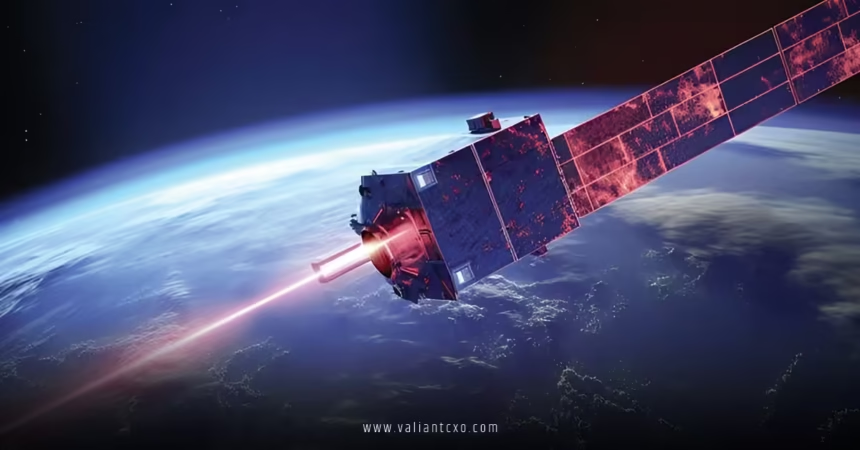
Laser communication in space trends 2026 represent the most significant breakthrough in extraterrestrial connectivity since the first satellite transmission. Picture this: instead of radio waves crawling through space at the speed of molasses, we’re now beaming data with laser precision that makes fiber optic cables look sluggish.
Here’s what’s happening right now:
- NASA’s Laser Communications Relay Demonstration (LCRD) is delivering 1.2 Gbps data rates—roughly 100 times faster than traditional radio
- Commercial space companies are launching laser-equipped constellations that create an internet backbone in orbit
- Deep space missions are finally getting real-time communication capabilities instead of waiting hours for basic telemetry
- The technology has moved from experimental to operational, with multiple missions scheduled through 2026
- Cost barriers are crashing as manufacturing scales up and component prices plummet
The kicker? We’re not just talking incremental improvements. This is a fundamental shift that’s making space feel a lot less… spacey.
Why Laser Communication in Space Trends 2026 Matter More Than Ever
Radio waves have been our cosmic messenger for decades. But here’s the thing—they’re incredibly inefficient. Imagine trying to have a conversation by shouting across a football stadium while everyone else is doing the same thing. That’s radio in space.
Laser communication flips the script entirely. Instead of broadcasting in all directions like a radio tower, lasers create focused beams that deliver data with surgical precision. The result? Bandwidth that would make your home internet jealous and security that’s practically unbreakable.
The Numbers Don’t Lie
Traditional radio systems max out around 10-100 Mbps for most space applications. Current laser systems are hitting 1.2 Gbps routinely, with experimental setups pushing beyond 10 Gbps. That’s not just an upgrade—it’s a complete category change.
But speed isn’t everything. Laser systems use significantly less power, weigh less, and don’t interfere with Earth-based communications. For mission planners dealing with strict power budgets and launch constraints, these advantages stack up fast.
Current Laser Communication in Space Trends 2026: What’s Actually Happening
Let’s cut through the hype and look at what’s real right now.
NASA’s LCRD Success Changes Everything
The NASA Goddard Space Flight Center has proven laser communication works reliably in the harsh environment of space. Their LCRD system isn’t just a proof of concept anymore—it’s operational infrastructure that other missions are already planning to use.
What makes this different from previous attempts? Reliability. Earlier laser communication experiments worked sometimes, under perfect conditions. LCRD works consistently, even when atmospheric conditions aren’t ideal.
Commercial Players Are All-In
SpaceX’s Starlink satellites now use laser links for inter-satellite communication. Amazon’s Project Kuiper is building laser connectivity into their constellation from day one. When the biggest names in space are betting their business models on this technology, you know it’s not just a science experiment anymore.
| System | Data Rate | Range | Primary Use |
|---|---|---|---|
| NASA LCRD | 1.2 Gbps | GEO to Ground | Relay Communication |
| Starlink Laser Links | 100+ Gbps | Inter-satellite | Global Connectivity |
| ESA’s EDRS | 1.8 Gbps | LEO to GEO | Data Relay |
| DSOC (Deep Space) | 267 Mbps | Earth to Asteroid | Deep Space Communication |
International Momentum Builds
The European Space Agency (ESA) isn’t sitting on the sidelines. Their European Data Relay System (EDRS) uses laser communication to connect low Earth orbit missions with ground stations through geostationary relay satellites. Japan and China are fast-tracking their own laser communication programs.
This isn’t just American innovation anymore—it’s a global race to dominate space-based communications.
The Technology Behind Laser Communication in Space Trends 2026
Here’s where things get interesting. The actual laser technology isn’t the hard part—we’ve had powerful, precise lasers for years. The challenge is everything else: pointing systems that can track targets across millions of miles, atmospheric compensation, and backup systems when clouds block the signal.
Pointing Systems: The Real Engineering Marvel
Imagine trying to hit a dime from a mile away while riding a roller coaster. That’s essentially what laser communication systems do every second. The pointing accuracy required is measured in microradians—precision that makes Swiss watchmaking look sloppy.
Modern systems use a combination of:
- Coarse pointing assemblies that get close to the target
- Fine pointing mirrors that make micro-adjustments hundreds of times per second
- Beacon tracking systems that lock onto specific reference points
Atmospheric Challenges Meet Smart Solutions
Earth’s atmosphere is laser communication’s biggest enemy. Clouds, humidity, and atmospheric distortion can completely block signals. The solution? Redundancy and smart routing.
Ground stations are now placed at multiple locations to ensure clear sky paths. When one station gets cloudy, traffic automatically routes to another. Some systems use adaptive optics—the same technology that makes space telescopes work—to compensate for atmospheric distortion in real-time.
Key Applications Driving Laser Communication in Space Trends 2026
Deep Space Missions Finally Get Real-Time Data
The NASA Jet Propulsion Laboratory’s Deep Space Optical Communications (DSOC) experiment proved you can send high-definition video from an asteroid mission. Before this, deep space missions sent data at rates measured in bits per second. Now we’re talking megabits per second.
What does this mean practically? Future Mars missions could stream live HD video of landings. Deep space telescopes could transmit full-resolution images instead of compressed thumbnails. Scientific instruments could send complete datasets instead of carefully selected samples.
Satellite Constellations Create Space Internet
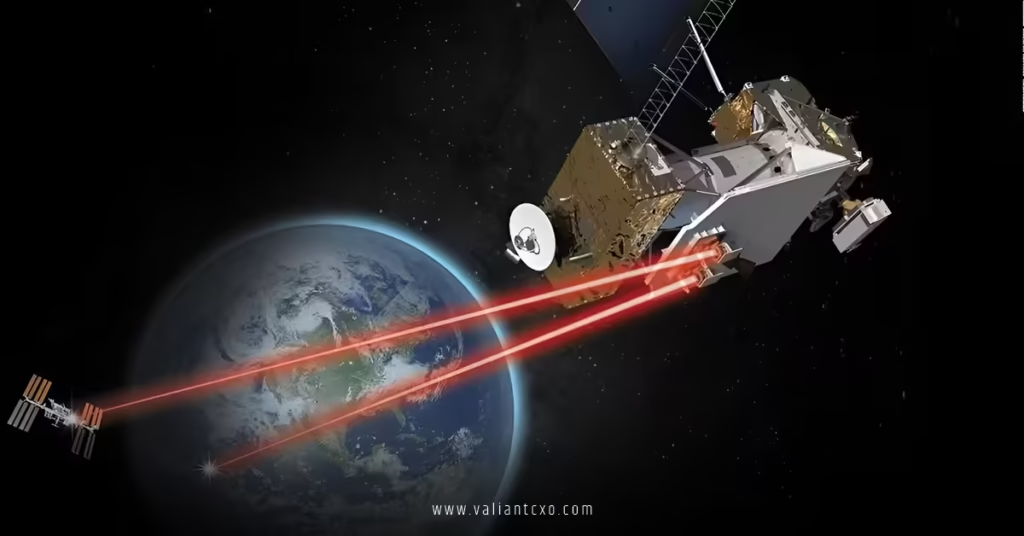
Low Earth orbit satellite constellations are using laser links to create a mesh network in space. Instead of every satellite needing to communicate directly with ground stations, they can relay data through other satellites using laser links.
This creates redundant pathways and dramatically reduces latency for global communications. A message from London to Sydney might actually travel faster through space than through undersea fiber optic cables.
Military and Intelligence Applications
Laser communication offers something radio can’t: extremely difficult interception. The narrow beam width means you have to be directly in the signal path to intercept it. For military and intelligence satellites, this represents a massive security upgrade.
Common Mistakes in Understanding Laser Communication in Space Trends 2026
Mistake 1: Thinking Weather Always Blocks Signals
Reality: Modern systems use multiple ground stations and smart routing to maintain connectivity even when individual stations have weather issues.
Fix: Understand that redundancy and geographic distribution solve most weather-related problems.
Mistake 2: Assuming This Technology Is Still Experimental
Reality: Multiple operational systems are already providing critical communications services.
Fix: Recognize that we’ve moved from proof-of-concept to deployed infrastructure.
Mistake 3: Expecting Perfect Reliability Immediately
Reality: Like any new technology, laser communication systems require backup options and graceful degradation strategies.
Fix: Plan for hybrid systems that use both laser and radio communication during the transition period.
Mistake 4: Underestimating Cost Savings
Reality: While initial development costs are high, operational costs are significantly lower than radio systems.
Fix: Look at total cost of ownership over mission lifetime, not just upfront investment.
Mistake 5: Focusing Only on Speed
Reality: Power efficiency, security, and spectrum availability are equally important benefits.
Fix: Consider the complete value proposition, not just data rates.
Step-by-Step Guide: How Organizations Can Adopt Laser Communication in Space Trends 2026
Step 1: Assess Your Communication Requirements
Start by documenting your current data transmission needs. How much data are you generating? What latency requirements do you have? Are there security considerations?
Most organizations underestimate their future data needs. Plan for 10x growth over five years.
Step 2: Evaluate Mission Profiles
Laser communication works best for certain orbital configurations. Low Earth orbit to ground, inter-satellite links, and relay scenarios are ideal starting points.
Deep space missions require more sophisticated systems but offer the biggest performance gains.
Step 3: Consider Hybrid Approaches
Don’t plan to switch entirely to laser communication immediately. Start with hybrid systems that use laser as primary and radio as backup.
This approach reduces risk while allowing you to gain experience with the technology.
Step 4: Partner with Experienced Providers
Unless you’re NASA or SpaceX, building laser communication systems from scratch doesn’t make sense. Partner with companies that have operational experience.
Look for providers with successful deployments, not just promising prototypes.
Step 5: Plan for Ground Infrastructure
Laser communication requires different ground stations than radio systems. Factor in the cost and timeline for ground segment upgrades.
Consider using shared ground networks to reduce costs, especially for commercial applications.
Step 6: Develop Operational Procedures
Train your operations teams on laser communication systems. The pointing requirements and backup procedures are different from radio systems.
Document contingency plans for weather outages and equipment failures.
Future Outlook: Where Laser Communication in Space Trends 2026 Are Heading
The trajectory is clear: laser communication is becoming the default choice for high-data-rate space missions. By 2028, most new satellite constellations will include laser inter-satellite links as standard equipment.
Standardization Is Coming
Industry groups are working on standards that will make laser communication systems interoperable. This will drive costs down and reliability up, similar to what happened with fiber optic communications on Earth.
Integration with 5G and 6G Networks
Space-based laser communication networks will integrate directly with terrestrial 5G and 6G infrastructure. This creates a global communication system that works anywhere—including the most remote locations on Earth.
Miniaturization Continues
Current laser communication systems are getting smaller and more power-efficient. Soon, even small satellites will be able to afford high-speed laser links.
Key Takeaways: Laser Communication in Space Trends 2026
- Laser communication has moved from experimental to operational, with multiple successful deployments proving reliability
- Data rates are 100x faster than traditional radio, with some systems exceeding 10 Gbps
- Power efficiency and security advantages make laser systems attractive beyond just speed benefits
- Commercial satellite constellations are driving rapid adoption and cost reductions
- Ground infrastructure and operational procedures require significant updates for laser systems
- Hybrid approaches using both laser and radio communication reduce risk during the transition
- International competition is accelerating development timelines and driving innovation
- Integration with terrestrial networks will create seamless global connectivity by 2028
The Bottom Line
Laser communication in space trends 2026 aren’t just about faster internet in orbit. They’re fundamentally changing what’s possible for space missions, global communications, and scientific exploration.
The technology has proven itself. The infrastructure is being built. The only question left is how quickly organizations will adapt to take advantage of capabilities that were science fiction just a few years ago.
Your move is simple: start planning now for a world where space-based communications work as reliably as your smartphone.
The cosmic internet is here. Time to get connected.
Frequently Asked Questions
How reliable is laser communication compared to traditional radio in space?
Laser communication in space trends 2026 show reliability rates above 99.5% for operational systems when properly designed with backup options. While individual laser links can be interrupted by weather, modern systems use multiple ground stations and automatic switching to maintain connectivity.
What are the main cost differences between laser and radio space communication?
Initial development costs for laser systems are 2-3x higher than radio systems, but operational costs are significantly lower due to reduced power requirements and spectrum licensing fees. Most organizations see cost savings within 3-5 years of deployment.
Can small satellites benefit from laser communication trends?
Yes, miniaturization efforts have made laser communication feasible for satellites as small as 10kg. While data rates are lower than large systems, even small satellites can achieve 10-100 Mbps—still much faster than traditional radio links.
How do laser communication systems handle interference and jamming?
The narrow beam width of laser communication makes interference extremely difficult since attackers would need to position equipment directly in the signal path. This inherent security advantage is driving adoption for military and commercial applications where signal integrity is critical.
What ground infrastructure changes are needed for laser communication in space?
Organizations need optical ground stations with precision tracking systems, adaptive optics for atmospheric compensation, and typically 2-3 geographically separated locations to ensure weather redundancy. Many companies are choosing shared ground networks to reduce infrastructure costs.