LUX-ZEPLIN (LZ) experiment possible first dark matter WIMP signal just landed on desks across physics departments, and the room got quiet. One lone nuclear recoil at 248 keV. Background models can’t swallow it cleanly. Significance sits at 2.6σ global. Not a discovery. Not even “evidence” by the usual particle-physics bar. Still the cleanest single event LZ has ever seen in a region where ordinary particles rarely show up.
Quick orientation for anyone who just walked in:
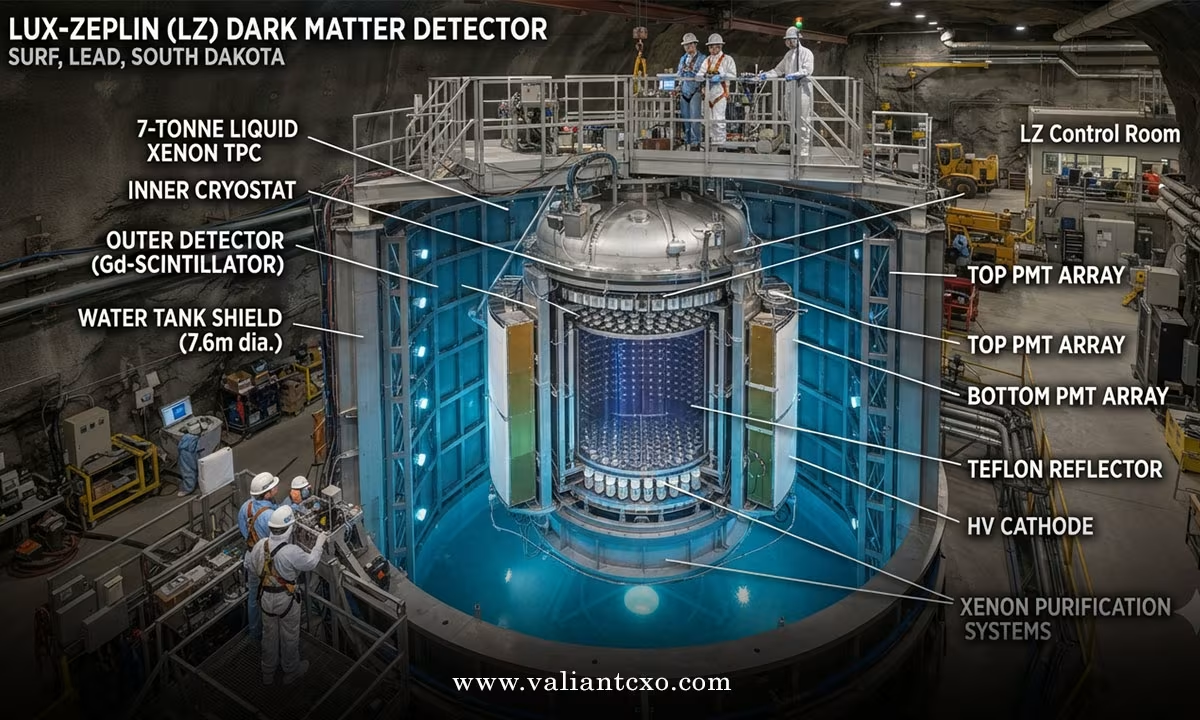
- LZ is a 10-tonne liquid-xenon time-projection chamber buried nearly a mile under the Black Hills at the Sanford Underground Research Facility in South Dakota.
- The collaboration examined 220 live days (2.84 tonne-years) collected March 2023–April 2024, this time with an extended energy window up to ~270 keV.
- One event survived every cut and salt-unblinding procedure. Expected background in that pocket is tiny.
- If the particle is a WIMP, its mass is probably ≥200 GeV/c² and the interaction is not the simplest spin-independent elastic scatter.
- More data is already in the can; the experiment keeps running toward its 1,000-day goal.
That single flash is why the community is paying attention right now.
How the detector actually works
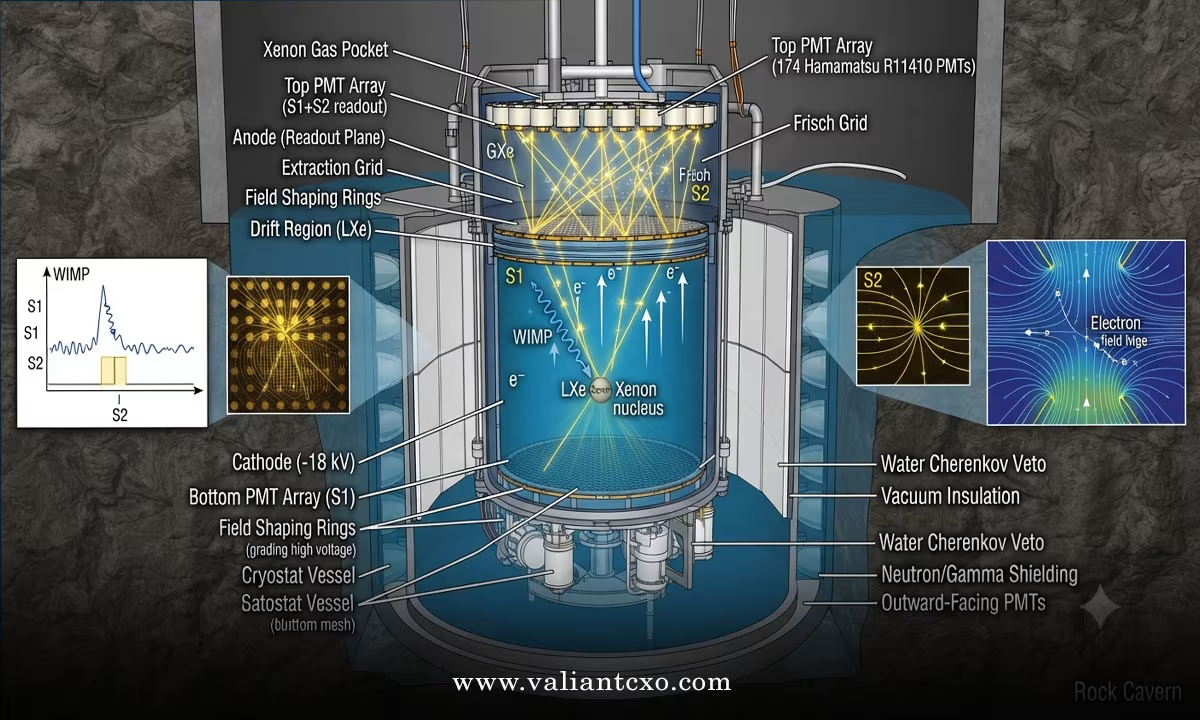
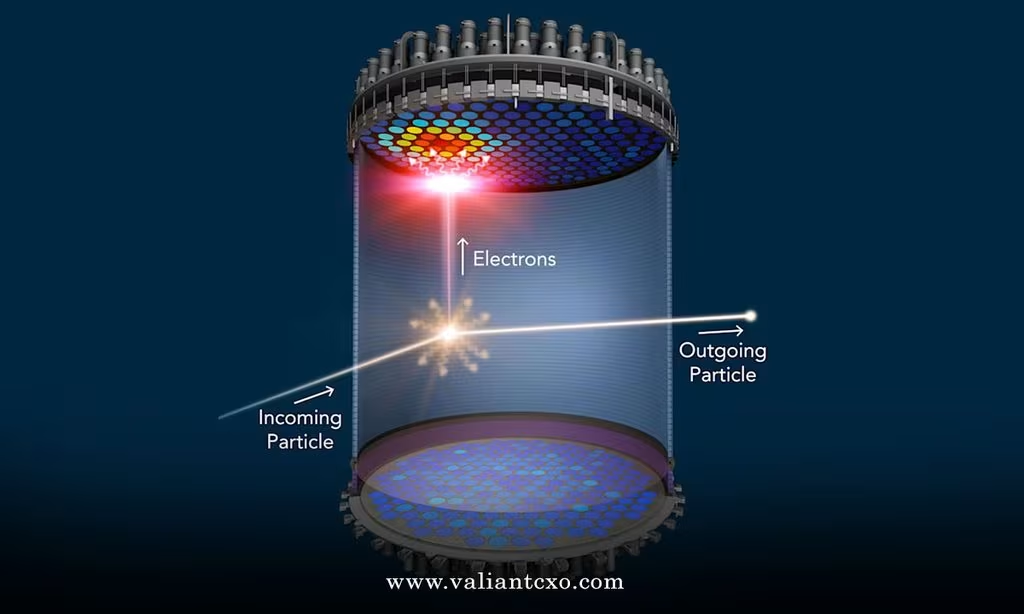
Picture a giant thermos of ultra-pure liquid xenon, seven active tonnes of it, ringed by photomultiplier tubes. A particle hits a xenon nucleus. The nucleus recoils. Two signals appear: a prompt scintillation flash (S1) and a delayed ionization signal that drifts upward in an electric field and produces a second flash (S2) in the gas phase. The ratio of those two lights, plus the reconstructed position and energy, tells the difference between nuclear recoils (the dark-matter signature) and electron recoils (most backgrounds).
LZ sits under 1,500 meters of rock. A water tank and liquid-scintillator outer detector veto neutrons and gammas that still sneak in. The collaboration salts the data with fake signals so analysts stay honest, then unsalts only after every cut is frozen. That discipline is why one leftover event carries weight.
Why this particular event stands out
Earlier LZ analyses focused on the classic low-energy WIMP window. This time the team opened the door higher—up to roughly 270 keV—to catch models where dark matter can dump more energy, including inelastic scattering or certain effective-field-theory operators. In that higher window the known backgrounds drop hard. After months of cross-checks, one candidate remained: 248 ± 23 (stat) ± 23 (sys) keV.
Rick Gaitskell, Brown physicist and LZ spokesperson, put it plainly: the event sits where dark matter is expected and backgrounds are lowest. They are not claiming detection. They are sharing the data so the rest of the field can poke holes in it.
Local significance reached 3.4σ in some models; after look-elsewhere corrections the global figure is 2.6σ—about a half-percent chance the background alone produced it. Five-sigma is the discovery threshold. This is still a long way short.
What the numbers mean for WIMP theory
If the event is real, the simplest spin-independent WIMP is in trouble. A heavy particle that interacts that way would have left a trail of lower-energy recoils. None appeared. That pushes theorists toward inelastic channels or momentum-dependent operators—ideas that have been on the shelf for years but rarely tested at this exposure and energy.
Mass scale sits above 200 GeV/c², possibly near a TeV. That range still overlaps with some supersymmetry and extra-dimension scenarios, but the interaction strength must be weaker than the classic weak scale in many places. Complementary searches at the LHC and indirect gamma-ray telescopes now have a concrete target.
| Aspect | Classic Low-Energy WIMP Search | Extended High-Energy Window (This Analysis) |
|---|---|---|
| Energy focus | ~1–50 keV nuclear recoils | Up to ~270 keV |
| Exposure used | Larger cumulative datasets in prior papers | 2.84 tonne-years (220 live days) |
| Background level | Higher, dominated by radon, solar neutrinos at lowest end | Very low in the high-energy pocket |
| Outcome | World-leading limits, no excess | One unexplained event at 2.6σ global |
| Implication if real | Standard SI WIMP parameters | Inelastic or non-standard operators preferred |
Step-by-step: how a beginner can follow the next chapter of the LUX-ZEPLIN (LZ) experiment possible first dark matter WIMP signal
- Bookmark the official LZ site and the arXiv preprint once it appears. Primary sources beat press releases every time.
- Watch the TeVPA talk slides or the upcoming Gaitskell colloquium recording. Hearing the experimentalists walk through the event selection removes most of the fog.
- Track the remaining live-time. LZ is still collecting; the next unblinding will either grow the significance or kill the candidate.
- Cross-check with XENON and future XLZD plans. Independent confirmation is the only path from hint to discovery.
- Read one solid review on inelastic dark matter so the theoretical language stops sounding like jargon.
- Ignore the “first detection” headlines. Treat every new claim as provisional until the collaboration itself upgrades the language.
Common mistakes people make when reading this result—and how to fix them
People treat 2.6σ as “almost five.” It is not. Fix: remember that look-elsewhere effects and systematic uncertainties still sit in the error budget.
Others assume the event energy proves a specific mass. The mass is a lower bound under particular model assumptions. Fix: read the paper’s model section before quoting a number.
Some claim the background is perfectly understood. The collaboration spent months hunting rare topologies precisely because they are not. Fix: wait for the full background appendix.
A few already write off the entire WIMP paradigm. Premature. Fix: note that only the simplest interaction is disfavored by this single event; the broader WIMP idea remains open.
What I would do if I were advising a new graduate student right now
Sit down with the event display and the background model side by side. Ask every “what if” question the collaboration already answered, then invent three more. Learn the salt-unblinding protocol cold. Then start working on the analysis tools that will handle the next 500 days of data. Hints this clean do not appear often. When they do, the people who understand the detector at the waveform level are the ones who move the needle.
The LUX-ZEPLIN (LZ) experiment possible first dark matter WIMP signal is still only a candidate. Yet the fact that a world-leading detector can isolate a single nuclear recoil this cleanly tells you the technology has arrived. Whether this particular flash survives the next dataset is the question that will dominate conversations through 2027 and beyond.
Key Takeaways
- One nuclear-recoil candidate at 248 keV survived every cut in 2.84 tonne-years of LZ data.
- Global significance is 2.6σ—intriguing, not discovery-level.
- The energy and lack of accompanying low-energy events favor non-standard WIMP interactions.
- LZ continues taking data toward its full 1,000-day exposure.
- Independent checks by other xenon experiments and theoretical work on inelastic models are now essential.
- The detector’s background rejection at high energy is the real technical achievement here.
- Press language will over-claim; stick to the collaboration’s own statements.
The next unblinding will decide whether this event was a statistical hiccup or the opening note of something larger. Until then, the smartest move is to keep reading the primary papers and let the data, not the headlines, set the temperature.
FAQs
Does the LUX-ZEPLIN (LZ) experiment possible first dark matter WIMP signal meet the discovery threshold?
No. 2.6σ falls well short of the 5σ standard used in particle physics. The collaboration is explicit on this point.
Why does the event energy matter for the LUX-ZEPLIN (LZ) experiment possible first dark matter WIMP signal?
At 248 keV the recoil sits far above the classic WIMP window. That forces any dark-matter interpretation into models that can produce higher-energy scatters without flooding the lower-energy band.
When will we know more about the LUX-ZEPLIN (LZ) experiment possible first dark matter WIMP signal?
LZ is still collecting data. The next major analysis with substantially more exposure is the natural checkpoint—likely within the next one to two years depending on livetime and analysis cycles.