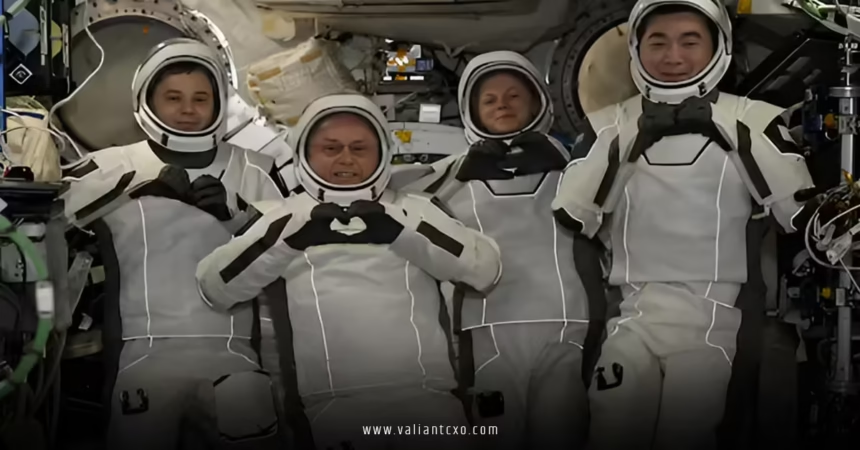
Imagine floating 250 miles above Earth, conducting groundbreaking research, when suddenly a serious—but stable—medical issue arises for one crew member. That’s exactly what happened aboard the International Space Station in early January 2026, leading NASA to make the tough call: bring the entire Crew-11 team home early. This event wasn’t a dramatic, sirens-blaring emergency de-orbit. Instead, it was a carefully planned, controlled return that highlighted NASA’s commitment to crew safety above all else. For the first time in the ISS’s 25-year history (and NASA’s 65 years of human spaceflight), a mission ended prematurely due to health concerns.
In this article, we’ll dive deep into the NASA Crew-11 medical evacuation International Space Station January 2026, exploring what led to it, how NASA handled it, the crew’s journey home, and why this matters for the future of space exploration.
What Was the NASA Crew-11 Mission?
Launched on August 1, 2025, from NASA’s Kennedy Space Center in Florida aboard a SpaceX Falcon 9 rocket, the Crew-11 mission was the 11th operational rotation under NASA’s Commercial Crew Program. The SpaceX Crew Dragon spacecraft, named Endeavour, carried four astronauts: NASA Commander Zena Cardman (on her first flight), Pilot Mike Fincke (a veteran with extensive space experience), JAXA astronaut Kimiya Yui, and Roscosmos cosmonaut Oleg Platonov.
The team docked with the ISS the next day and spent 167 days in orbit—traveling nearly 71 million miles and completing over 2,670 orbits. Their work included hundreds of hours of science experiments, technology demos, and station maintenance. They even celebrated the 25th anniversary of continuous human presence on the ISS in November 2025. Everything seemed on track for a February 2026 return, until…
The Trigger: A Serious Medical Concern Emerges
On January 7, 2026, NASA postponed a planned spacewalk (USA EVA-94) that would have prepared the station for new solar arrays. The reason? An undisclosed “medical situation” affecting one crew member. NASA kept details private out of respect for health privacy, but officials confirmed it was serious, stable, and not related to any operational injury.
The next day, January 8, NASA Administrator Jared Isaacman announced the decision to end the mission early. Why bring everyone back? Simple: The Crew Dragon was the only ride home for the crew. There’s no “ambulance” shuttle waiting in orbit—when one person needs ground-level medical care beyond what’s available on the ISS, the whole team returns.
This NASA Crew-11 medical evacuation International Space Station January 2026 wasn’t rushed. The astronaut’s condition allowed for a controlled timeline, giving the crew days to pack, train the remaining ISS residents (NASA’s Christopher Williams and two Russian cosmonauts), and prepare for undocking.

How NASA Handled the NASA Crew-11 Medical Evacuation International Space Station January 2026
NASA’s response showcased years of preparation. The ISS has first-aid kits, ultrasound machines, IVs, pharmaceuticals, and even dental tools—astronauts train extensively for emergencies. But the station lacks advanced diagnostic or surgical capabilities (no full operating room up there!). Computer models predict a medical evacuation might be needed every three years, yet this was the first for NASA.
Officials emphasized it was a “controlled medical evacuation,” not an urgent emergency. The crew undocked on January 14, 2026, at around 5:20 p.m. ET, after closing hatches and drifting away over Australia. The 10-hour-plus journey home involved a fiery re-entry at over 22 times the speed of sound, with g-forces up to 5G—tough after months in microgravity.
Early on January 15, 2026, the Dragon Endeavour parachuted into the Pacific Ocean off San Diego, California, at 3:41 a.m. ET. Recovery teams from SpaceX hoisted the capsule onto the ship, opened the hatch, and assisted the astronauts (who were helped onto gurneys as standard procedure due to readjustment to gravity). All four were taken to a local hospital for evaluation before heading to Houston.
This smooth execution proved NASA’s protocols work—even in rare scenarios.
The Crew’s Experience During the NASA Crew-11 Medical Evacuation International Space Station January 2026
Think about it: You’ve spent over five months adapting to weightlessness—your body fluids shift, muscles atrophy, bones weaken. Suddenly, you’re strapping in for a high-speed plunge back to Earth. The affected astronaut remained stable throughout, but the return was bittersweet. Crew members like Commander Cardman expressed relief at being home, while the team reflected on their achievements.
Veteran Mike Fincke, with over 549 career days in space, called it “NASA at its finest.” The group stayed together post-splashdown to protect privacy—no one wanted to single out the ill member.
Why This Medical Evacuation Matters for Future Missions
The NASA Crew-11 medical evacuation International Space Station January 2026 was a wake-up call. As we push toward Artemis Moon missions and Mars, health risks in deep space grow. Limited onboard medical resources mean ground return is often the only option for serious issues.
This event tested Commercial Crew reliability—SpaceX’s Dragon performed flawlessly. It also left the ISS temporarily with just three crew members, pausing spacewalks until Crew-12 arrives (potentially advanced from mid-February). Yet operations continued safely.
It reminds us: Space is unforgiving, but human ingenuity and safety-first thinking keep us exploring.
Conclusion
The NASA Crew-11 medical evacuation International Space Station January 2026 was a historic first—a testament to NASA’s prioritization of crew health. What started as a stable medical concern on January 7 led to a safe, controlled return on January 15, wrapping up 167 days of incredible work. The crew splashed down successfully, received care, and reminded everyone that even in orbit, safety comes first.
Events like this build resilience for future journeys to the Moon and beyond. They show we’re ready to handle the unexpected while keeping the dream of space exploration alive. What’s next? More missions, more discoveries—and hopefully, fewer surprises.
FAQs
What exactly happened during the NASA Crew-11 medical evacuation International Space Station January 2026?
One crew member developed a serious but stable medical condition in early January 2026, prompting NASA to end the mission early and return all four astronauts via SpaceX Crew Dragon for proper treatment on Earth.
Why did the entire Crew-11 have to return during the NASA Crew-11 medical evacuation International Space Station January 2026?
The Crew Dragon spacecraft is the only vehicle for crew transport to and from the ISS for this rotation. There’s no separate medical shuttle, so everyone returned together.
Was the NASA Crew-11 medical evacuation International Space Station January 2026 an emergency?
No—it was a controlled, planned return. The astronaut was stable, allowing time for preparation rather than an immediate de-orbit.
Who were the astronauts involved in the NASA Crew-11 medical evacuation International Space Station January 2026?
The crew included NASA’s Zena Cardman (commander) and Mike Fincke (pilot), JAXA’s Kimiya Yui, and Roscosmos’ Oleg Platonov. NASA has not identified the affected individual due to privacy.
How did the NASA Crew-11 medical evacuation International Space Station January 2026 affect ISS operations?
It temporarily reduced the crew to three, postponing spacewalks until the next rotation. However, core station functions continued normally.