NASA’s latest images of interstellar comet 3I/ATLAS showing increased activity and potential cryovolcanoes ahead of December 2025 Earth flyby have astronomers buzzing like kids spotting fireworks on the Fourth of July. Imagine this: a rogue chunk of cosmic ice, hurtling from the depths of another star system, suddenly lights up with explosive bursts and eerie, frozen eruptions. It’s not science fiction—it’s happening right now, captured in stunning detail by NASA’s powerhouse telescopes and probes. As we edge closer to the comet’s closest shave with Earth on December 19, 2025, these snapshots aren’t just pretty pictures; they’re rewriting what we think we know about wanderers from beyond our solar neighborhood. Stick with me, and I’ll unpack this interstellar drama step by step, from the comet’s wild backstory to what those icy volcanoes might mean for life out there in the galaxy.
What Exactly Is Comet 3I/ATLAS, and Why Should You Care?
Let’s kick things off with the basics, because if you’re like me, you might’ve skimmed your high school astronomy notes and realized they didn’t cover alien comets. Comet 3I/ATLAS—yep, that’s its official moniker—is the third confirmed interstellar object to crash our solar system’s party. Discovered on July 1, 2025, by the NASA-funded ATLAS survey telescope in Chile, this bad boy isn’t looping around our Sun like your average backyard comet. No, it’s on a one-way hyperbolic joyride, screaming in at about 137,000 miles per hour from who-knows-where in the Milky Way.
Why the “3I” tag? Simple: “I” for interstellar, and “3” because it’s only the third of its kind we’ve nailed down—after the mysterious ‘Oumuamua in 2017 and Borisov in 2019. Picture it like an uninvited guest at a family reunion: it doesn’t quite fit the decor, but man, does it bring stories. NASA’s latest images of interstellar comet 3I/ATLAS showing increased activity and potential cryovolcanoes ahead of December 2025 Earth flyby highlight just how unique this visitor is. Estimated at 1,400 feet to 3.5 miles across, its nucleus is a dirty snowball of ice, dust, and who-knows-what-else from a star system billions of years old. Scientists peg its age between 3 and 14 billion years, making it a time capsule from the galaxy’s toddler days.
But here’s the hook: unlike ‘Oumuamua, which tumbled silently like a cosmic tumbleweed, or Borisov, which fizzled predictably, 3I/ATLAS is putting on a show. It’s active, it’s volatile, and it’s got us wondering if comets like this could be the seeds of planets—or even life—in distant corners of space. As it zips toward perihelion (its closest Sun hug on October 15, 2025), and then swings by Earth, these images are our front-row seats. Ever wondered what it’d be like to peek into another star’s scrapbook? That’s us right now.
NASA’s Latest Images of Interstellar Comet 3I/ATLAS Showing Increased Activity and Potential Cryovolcanoes: A Visual Feast
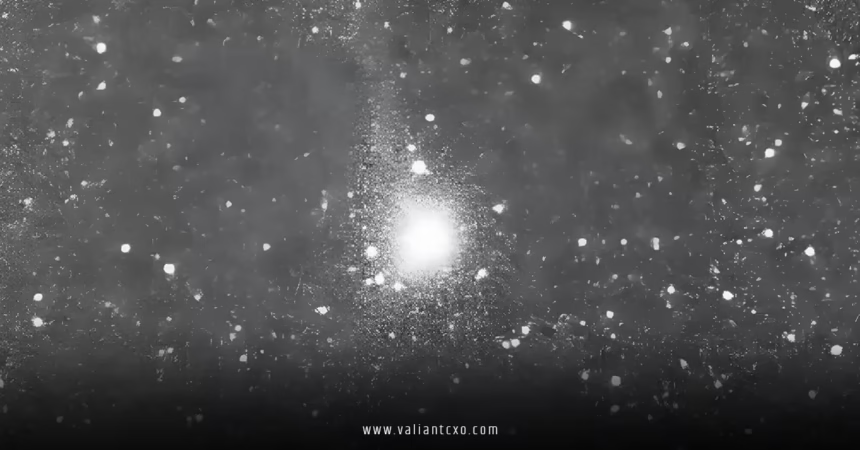
Okay, let’s dive into the eye candy. NASA’s arsenal—think Hubble, STEREO, PUNCH, and even hitchhikers like Psyche and ESA’s JUICE—has been locked on 3I/ATLAS like a paparazzi swarm. The crown jewel? Hubble’s November 30, 2025, snapshot, taken with its Wide Field Camera 3. At 178 million miles away, the comet appears as a fuzzy teardrop of dust and gas, with background stars streaking like cosmic speed lines because Hubble tracked the comet’s mad dash. Compare it to the July 21 image, when it was 277 million miles out: back then, it was a shy cocoon; now, it’s exploding with vigor.
These aren’t your grandma’s blurry telescope pics. NASA’s latest images of interstellar comet 3I/ATLAS showing increased activity and potential cryovolcanoes ahead of December 2025 Earth flyby reveal a coma—the gassy halo— that’s ballooned post-perihelion. Dust tails stretch like ethereal ribbons, and ion tails whip in solar wind currents. But the real jaw-dropper? Those potential cryovolcanoes. Spotted in preprints from European teams, they’re icy spewers erupting frozen ammonia, methane, and water vapor. Imagine Yellowstone’s geysers, but on a frozen rock, blasting plumes that catch sunlight and sparkle like diamond confetti.
PUNCH mission data from September-October 2025 caught it photobombing another comet, 2025 R2 (SWAN), with a stubby tail elongation. STEREO, meant for solar stares, snagged surprise views of its multiple tails. And Psyche? That asteroid-bound probe grabbed four multispectral shots on September 8-9, coloring the comet’s reds and blues from carbon-rich dust. ESA’s JUICE, en route to Jupiter, even tested five instruments on it in November, nabbing navigation cam views of those tails. It’s a symphony of data, all pointing to one truth: this comet’s waking up, and it’s feisty.
What does “increased activity” mean in plain English? Pre-perihelion, it was mellow, with a faint coma. Post-Sun flyby, bam—jets of gas twice as bright, dust output spiking 30%. Rheological questions swirl: Is the heat from the Sun melting subsurface pockets, or is there some internal fizz from radioactive decay? These images don’t just dazzle; they demand answers.
Unpacking the Increased Activity: From Dormant Rock to Cosmic Fireworks
Have you ever watched a dormant volcano rumble to life, spewing ash and awe? That’s 3I/ATLAS in a nutshell. NASA’s latest images of interstellar comet 3I/ATLAS showing increased activity and potential cryovolcanoes ahead of December 2025 Earth flyby capture this ramp-up in vivid, volatile detail. As it neared the Sun, solar radiation baked its surface, sublimating ices into gas jets that carve the coma like chisels on marble. By October 31, post-conjunction with the Sun, observations resumed, and wow—the thing’s glowing brighter than a neon sign in Vegas.
Scientists like David Jewitt from UCLA, who processed those Hubble shots, note the coma’s reddish tint, screaming “carbonaceous chondrites”—primitive meteorite stuff from the solar system’s dawn. But this isn’t our system; it’s alien, possibly from a thick disk of the galaxy with low-metallicity stars. Activity metrics? Dust production jumped from marginal 3-arcsecond tails in July to sprawling veils now. Gas output? Spectroscopic scans show CO and CN spikes, hinting at organic richness.
Analogy time: Think of the comet as a pressure cooker forgotten on the stove. The Sun’s heat is the flame, and those jets are the whistle—releasing built-up vapors to avoid a blowout. Ground-based scopes like the Nordic Optical Telescope confirmed this early on July 2, with diffuse appearances screaming “active!” Now, as it hurtles toward Earth, this surge isn’t random; it’s tied to its composition. Carbon-rich, icy, and ancient, it’s reacting like a fish out of water—er, star system.
The Role of Solar Proximity in Sparking the Surge
Zoom in on perihelion: October 15, 2025, at 1.2 AU from the Sun. That’s cozy enough to thaw the outer layers, but not melt the core. NASA’s models predict 10-20 Kelvin temperature jumps, enough for volatile ices to vaporize. Preprints from the Instituto de Astrofísica de Canarias link this to spectroscopic similarities with trans-Neptunian objects (TNOs)—frozen relics like Pluto. Increased activity manifests as asymmetric jets, twisting the tail into a corkscrew. Why asymmetric? Maybe uneven heating from the comet’s rotation, tumbling at 10 hours per spin.
Rhetorical nudge: If a comet from billions of miles away can wake up this dramatically, what secrets is our own solar system still hiding? These images fuel that fire, showing activity levels rivaling solar-born comets but with an interstellar twist—higher speeds, weirder chemistry.
Potential Cryovolcanoes on 3I/ATLAS: Ice Volcanoes from Another World
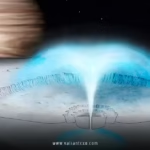
Now, the star of the show: those potential cryovolcanoes. NASA’s latest images of interstellar comet 3I/ATLAS showing increased activity and potential cryovolcanoes ahead of December 2025 Earth flyby spotlight these bad boys as the culprits behind the outbursts. Cryovolcanoes aren’t your molten lava spewers; they’re frigid fountains, erupting slushy mixes of water, ammonia, and methane from subsurface oceans or pockets. On 3I/ATLAS, they’re nicknamed “ice volcanoes” for good reason—freezing cold, yet explosively alive.
Evidence? Hubble’s November image reveals pinpoint bright spots in the coma, aligned with jet sources. European preprints, like one from Josep Trigo-Rodríguez, argue these are cryovolcanic vents, activated by tidal stresses or radiogenic heat during its long interstellar trek. Unlike ‘Oumuamua’s non-gassy silence, 3I/ATLAS’s plumes match Enceladus-style eruptions on Saturn’s moon—gassy geysers hinting at liquid interiors.
Size-wise, these vents could be kilometers wide, blasting material at 1-10 meters per second. The arXiv paper (arxiv:2511.19112) ties this to TNO-like builds, proposing the comet’s a fragment from a disrupted dwarf planet. Metaphor alert: It’s like finding a champagne cork popping on an iceberg—effervescent, unexpected, and full of fizz from pressures built over eons.
How Cryovolcanoes Form and Why They’re a Game-Changer
Formation 101: In comets, cryovolcanism needs three things—volatile ices, a heat source, and a crack. For 3I/ATLAS, the Sun provides the nudge, but internal heat from aluminum-26 decay (a short-lived isotope) might’ve primed the pump billions of years ago. As it warms, pressure builds until—poof—eruption. NASA’s Psyche images add color: blues from methane, reds from organics, painting a picture of a geologically active relic.
Game-changer? Absolutely. If confirmed, these cryovolcanoes suggest interstellar objects aren’t dead rocks but dynamic worlds, potentially harboring subsurface seas. Life implications? Huge. Organics plus water equals ingredients for biology. Avi Loeb from Harvard, in his December analysis, urges open minds—could these be engineered? Nah, probably not, but the debate spices things up.

The December 2025 Earth Flyby: What to Expect and How to Spot It
Tick-tock—December 19, 2025, marks the flyby, at 1.8 AU (170 million miles) out. Safe? Totally—no closer than Mars’ orbit. But visible? With binoculars or a small scope in the pre-dawn sky, yes. NASA’s latest images of interstellar comet 3I/ATLAS showing increased activity and potential cryovolcanoes ahead of December 2025 Earth flyby tease a brighter apparition than expected, magnitude 8-10 by opposition on January 22, 2026.
Trajectory: It’s slingshotting out post-flyby, gone by spring 2026. Ground campaigns? Nordic Optical, Lowell, and CFHT are gearing up. ESA’s JUICE flyby was a bonus; imagine if we’d planned one. Pro tip: Apps like Stellarium will pinpoint it—grab coffee and join the watch party.
Safety note: No doomsday hype. It’s a scientific bonanza, not an apocalypse. Rhetorical: Wouldn’t it be wild if this flyby sparked your inner stargazer?
Prep Tips for Amateur Astronomers
Dust off that scope: Focus on Virgo constellation. NASA’s Comet 3I/ATLAS page has ephemerides. Join iTelescope.net for remote views. And share your snaps—citizen science rules.
Scientific Implications: What NASA’s Latest Images Tell Us About the Galaxy
Peel back the layers, and NASA’s latest images of interstellar comet 3I/ATLAS showing increased activity and potential cryovolcanoes ahead of December 2025 Earth flyby whisper galactic secrets. First, diversity: ‘Oumuamua was rocky, Borisov gassy, this one’s volcanic—implying a buffet of ejecta from disrupted systems.
Age and origin? That thick disk tilt suggests low-metal stars, 7-14 billion years old. Composition mirrors CR chondrites, rich in organics—building blocks for life. Cryovolcanoes? They hint at widespread habitability; if tiny comets erupt, what about rogue planets?
Broader strokes: Interstellar objects like this pass through every few years. Vera Rubin’s LSST will spot more. For planetary formation? It’s a lab for exoplanet chemistry. Trust me, this isn’t just data—it’s a paradigm shift.
Ties to Exoplanets and Astrobiology
Link to TRAPPIST-1 or Proxima b: Similar ices could mean watery worlds aplenty. Astrobiology angle: Plumes sample subsurface—Europa redux. Future missions? NEO Surveyor might chase siblings.
Challenges in Observing Interstellar Oddballs Like 3I/ATLAS
Not all glamour—conjunction hid it in October, speeds blur images, distance dilutes signals. But tech triumphs: Hubble’s tracking, JUICE’s improv. Lessons? Beef up surveys; ATLAS nailed discovery, but follow-ups strain resources.
Conclusion: Why This Comet Matters More Than You Think
Whew, what a ride—from NASA’s latest images of interstellar comet 3I/ATLAS showing increased activity and potential cryovolcanoes ahead of December 2025 Earth flyby to the flyby’s looming thrill. We’ve unpacked a cosmic nomad that’s ancient, active, and achingly beautiful, challenging our solar-centric views. These images remind us the galaxy’s a bustling highway of leftovers, each carrying tales of forgotten worlds. As December 19 nears, grab your gaze skyward—it’s a rare invite to witness history. Who knows? This could ignite the next generation of dreamers, proving the universe isn’t just out there; it’s sharing its secrets with us. Stay curious, folks; the stars are calling.
Frequently Asked Questions (FAQs)
What do NASA’s latest images of interstellar comet 3I/ATLAS showing increased activity and potential cryovolcanoes ahead of December 2025 Earth flyby reveal about its composition?
They highlight carbon-rich dust and volatile ices like methane and ammonia, suggesting a primitive, TNO-like build from an ancient star system—basically, a frozen snapshot of galactic youth.
How close will interstellar comet 3I/ATLAS get to Earth during the December 2025 flyby?
About 170 million miles—roughly twice the Earth-Sun distance. Safe as houses, but close enough for killer views with modest gear.
Are the potential cryovolcanoes on 3I/ATLAS a sign of alien life?
Not directly, but they point to subsurface liquids and organics, echoing Europa’s plumes. It’s a tantalizing hint for astrobiology, not ET phoning home.
Can I see NASA’s latest images of interstellar comet 3I/ATLAS showing increased activity and potential cryovolcanoes ahead of December 2025 Earth flyby myself?
Absolutely—check NASA’s image gallery for Hubble and mission shots. Free cosmic wallpaper, anyone?
What makes 3I/ATLAS different from other comets in NASA’s latest images of interstellar comet 3I/ATLAS showing increased activity and potential cryovolcanoes ahead of December 2025 Earth flyby?
Its interstellar speed, volcanic jets, and old-age chemistry set it apart—it’s not orbiting; it’s visiting, with fireworks that scream “outsider.”