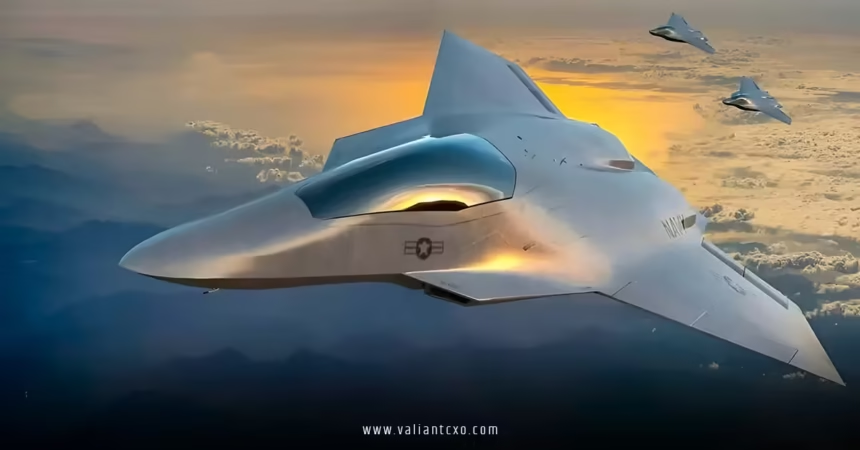
Next Generation Air Dominance Program stands as one of the most ambitious initiatives in modern aviation history. Picture this: a seamless network of cutting-edge aircraft, drones, and sensors working in perfect harmony to control the skies like never before. That’s the essence of the Next Generation Air Dominance Program, or NGAD, the U.S. Air Force’s bold vision for sixth-generation warfare. Launched to ensure America stays ahead in an era of rapidly advancing threats, this program isn’t just about building a new jet—it’s redefining air power entirely.
Understanding the Next Generation Air Dominance Program
At its heart, the Next Generation Air Dominance Program is a “family of systems” designed to replace the F-22 Raptor and maintain unchallenged air superiority. Why does this matter? In contested environments, like potential conflicts in the Indo-Pacific, current fighters struggle with range, survivability, and overwhelming enemy defenses. NGAD addresses that head-on.
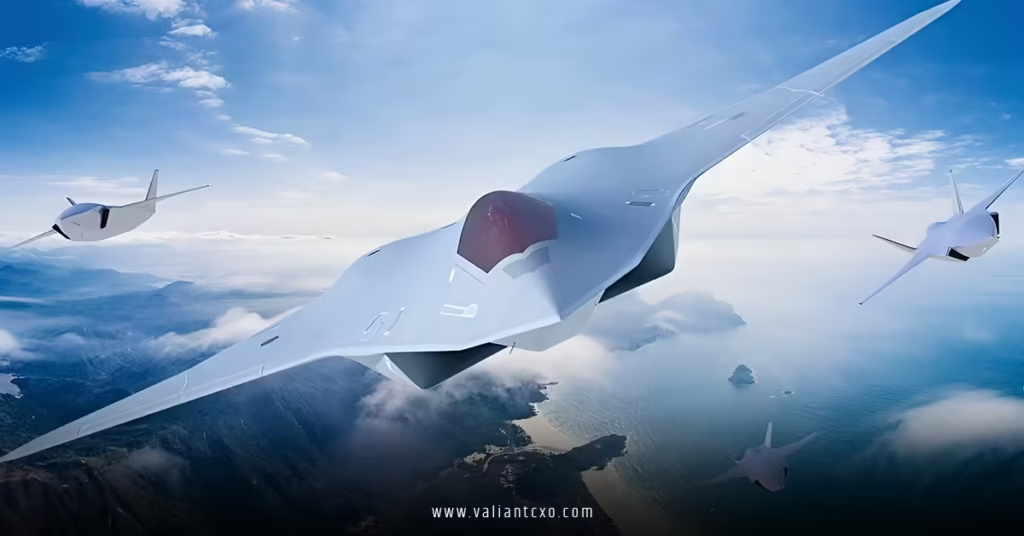
The centerpiece is a manned sixth-generation fighter, now known as the Boeing F-47, surrounded by unmanned Collaborative Combat Aircraft (CCAs), advanced engines, sensors, and networked technologies. Think of it as a quarterback leading a team of robotic wingmen—extending reach, multiplying firepower, and minimizing risks to pilots.
Origins of the Next Generation Air Dominance Program
The Next-eneration-Air-Dominance-Program traces back to 2014, when DARPA’s Air Dominance Initiative highlighted the need for systems capable of operating through 2035 and beyond. Early studies recognized that fifth-generation stealth alone wouldn’t suffice against peer adversaries advancing their own capabilities.
By the late 2010s, secret X-plane demonstrators began flying, logging hundreds of hours to mature technologies. These prototypes de-risked concepts like advanced stealth and propulsion, paving the way for full development.
Key Milestones in the Next Generation Air Dominance Program
The path hasn’t been straightforward. Costs soared, leading to a 2024 pause for reevaluation. But internal reviews reaffirmed its necessity, especially against evolving threats.
In March 2025, a major breakthrough: Boeing won the over $20 billion Engineering and Manufacturing Development contract for the manned platform, designated the F-47. This upset victory over Lockheed Martin revitalized the program.
As of early 2026, production is underway in St. Louis, with the first flight targeted for 2028 and initial service in the 2030s. Funding remains strong, with billions allocated in FY2026 budgets to accelerate progress.
The Boeing F-47: Core of the Next Generation Air Dominance Program
Curious about the star of the show? The Boeing F-47 embodies sixth-gen innovation. Details are classified, but expect a tailless design for extreme stealth, extended range for Pacific operations, and adaptive engines for efficiency or burst power.
It’s built for sustainability—higher availability and easier maintenance than predecessors. Paired with CCAs, the Boeing F-47 commands drone swarms for scouting, jamming, or striking, creating numerical superiority affordably.
Technologies Driving the Next Generation Air Dominance Program
What sets NGAD apart? It’s the integration.
- Advanced Stealth: Broadband low-observability to penetrate deep defenses.
- AI and Networking: Pilots process vast data quickly, staying ahead in decision cycles.
- Manned-Unmanned Teaming: The Boeing F-47 directs CCAs, turning one jet into a force multiplier.
- Next-Gen Propulsion: Variable-cycle engines from the NGAP program for supercruise and range.
Plans call for around 200 manned platforms and over 1,000 CCAs, balancing cost and capability.
Collaborative Combat Aircraft in the Next Generation Air Dominance Program
CCAs are game-changers. These affordable drones fly alongside the Boeing F-47, carrying weapons or sensors. They’re expendable yet smart, allowing bold tactics without endangering lives.
Challenges for the Next Generation Air Dominance Program
No program this complex is easy. Eye-watering costs—once projected at hundreds of millions per unit—sparked debates. Budget constraints forced tough choices, like prioritizing NGAD over other initiatives.
Geopolitical pressures demand speed: adversaries aren’t waiting. Yet, mature X-plane tech and Boeing’s investments keep momentum high.
Global Context: How the Next Generation Air Dominance Program Stacks Up
China’s emerging sixth-gen prototypes and Russia’s efforts underscore urgency. Allies pursue similar programs, like GCAP, but NGAD’s scale and integration aim to lead.
Domestically, Boeing’s win fosters competition, boosting innovation.
Future of the Next Generation Air Dominance Program
Looking ahead, NGAD will evolve with threats—modular designs enable upgrades. It secures U.S. dominance through the mid-century, potentially influencing exports or allied tech.
In conclusion, the Next-Generation-Air-Dominance-Program represents a paradigm shift, blending human ingenuity with autonomous systems for unparalleled control. From secretive beginnings to Boeing’s F-47 leading the charge, it’s a testament to forward-thinking defense. As production ramps and flights near, NGAD promises to keep American skies sovereign. What excites you most about this leap forward?
FAQs About the Next Generation Air Dominance Program
1. What is the main goal of the Next Generation Air Dominance Program?
The Next Generation Air Dominance Program aims to field a family of systems for air superiority, centered on the Boeing F-47 manned fighter and supported by drones.
2. How does the Boeing F-47 fit into the Next Generation Air Dominance Program?
The Boeing F-47 is the manned penetrating counter-air platform at the core of the Next Generation Air Dominance Program, commanding CCAs for enhanced lethality.
3. When will the Next Generation Air Dominance Program become operational?
The Next Generation Air Dominance Program targets initial capability in the 2030s, with the Boeing F-47’s first flight planned for 2028.
4. Why was there a pause in the Next Generation Air Dominance Program?
Cost concerns and reevaluations paused the Next Generation Air Dominance Program in 2024, but reviews confirmed its vital role, leading to Boeing’s 2025 contract.
5. How many aircraft are planned under the Next Generation Air Dominance Program?
The Next Generation Air Dominance Program envisions about 200 Boeing F-47 jets paired with over 1,000 Collaborative Combat Aircraft.